
WhatsApp Business API for Banking and NBFCs EMI Alerts, OTP and Loan Servicing India
Automate EMI payment reminders, loan disbursement alerts, account statements, OTP delivery, and fraud notifications through WhatsApp Business API integrated with your core banking system. Get Click Media integrates WhatsApp with core banking systems and NBFC loan management systems in India- improving on-time EMI payment rates by 28% and reducing collections team workload by 45%.
Official Meta BSP · CBS integration (Finacle, Temenos, FLEXCUBE) · RBI-aligned compliance · India-hosted data (AWS Mumbai)
28%
Improvement in on-time EMI payment rate
45%
Reduction in collections team workload
3.2x
Faster KYC completion via WhatsApp
99.1%
OTP delivery rate via WhatsApp API
Trusted by 10,000+ businesses across India




















WhatsApp Business API for banking and NBFCs enables automated EMI payment reminders, loan disbursement alerts, account statements, OTP delivery, and fraud notifications through WhatsApp. Get Click Media integrates WhatsApp with core banking systems and NBFC loan management systems in India- improving on-time EMI payment rates by 28% and reducing collections team workload by 45%.
Indian banks and NBFCs send millions of transactional messages daily- EMI reminders, payment confirmations, KYC alerts, and account updates. SMS achieves 30-35% open rates and has declining CTR. WhatsApp achieves 98% open rates and enables two-way interaction- a customer can confirm a payment, raise a dispute, or request a statement directly in the chat.
Why Banking and NBFC Businesses in India Need WhatsApp API
Indian banks and NBFCs face a critical challenge: the collections-to-EMI ratio is worsening as manual calling becomes less effective. Customers ignore unknown calls but respond to WhatsApp from a verified, named institution.
The verified Green Tick on WhatsApp creates trust that SMS sender IDs cannot match- critical for financial communication where fraud is a significant concern. With 28% improvement in on-time EMI payments and 45% reduction in collections team workload, WhatsApp is rapidly becoming the standard for banking communication in India.
Indian banks and NBFCs operate under one of the most compliance-heavy messaging environments of any industry- TRAI's DND (Do Not Disturb) regulations restrict promotional calls and SMS to registered numbers, RBI's fair-practices code requires clear, verifiable sender identity on any communication that touches a customer's account or repayment obligation, and every message has to be auditable for regulatory review. A collections call from an unlisted number gets ignored or blocked outright, and a promotional SMS to a DND-registered number is a compliance violation before it even reaches the customer. This leaves banks and NBFCs needing a channel that customers actually open, that carries verifiable sender identity, and that produces the audit trail a regulator can review- without falling foul of DND restrictions that apply to voice and SMS.
WhatsApp doesn't sit inside the DND framework the way promotional SMS and telemarketing calls do, and the Green Tick verified sender identity gives customers a reason to trust a message a masked SMS sender ID cannot provide. That shifts what the collections and customer service teams spend their day on: instead of dialling through a list of accounts approaching their EMI due date- a large share of which simply need a reminder, not a conversation- the team's outbound calling capacity is reserved for accounts that have already missed an automated WhatsApp reminder and moved into genuine pre-delinquency. Customer service follows the same pattern, fielding fewer routine statement and balance queries because customers can retrieve that information directly inside the WhatsApp thread.
The economics for a lender are straightforward: every percentage point improvement in on-time EMI collection reduces the volume of accounts that require manual collections effort, and manual collections- calls, field visits, legal notices- cost meaningfully more per account than an automated reminder sequence. KYC renewal follows the same logic on the acquisition side: a customer who abandons a renewal because the process required a branch visit or a slow document upload is either lost or requires a more expensive manual follow-up to recover, while an in-chat WhatsApp Flow captures the same documents in the channel the customer already has open.
💡 Key insight: SMS achieves 30-35% open rates with declining CTR. WhatsApp achieves 98% open rates and enables two-way interaction- a customer can confirm a payment, raise a dispute, or request a statement directly in the chat.
Getting a Banking & NBFC WhatsApp API Rollout Live
Banks and NBFCs typically move from kickoff to a fully compliant, automated customer communication flow within 4-6 weeks- CBS integration and compliance review are usually the longer poles, not the WhatsApp setup itself.
Meta Business Verification & Green Tick Application- Get Click Media handles Meta Business Solution Provider verification and Green Tick brand verification, critical for customer trust in financial communication, typically clearing within 3-5 business days.
Compliance & Security Review- Message templates, consent capture flows, and data-handling practices are reviewed against RBI's digital communication guidelines and DPDP 2023 requirements before any template is submitted for approval.
CBS & Collections System Connection- Your core banking system (Finacle, Temenos, Oracle FLEXCUBE, or custom CBS) is connected via API webhook or file-based trigger, alongside your fraud management and collections workflow systems.
Template Design & Audit Trail Configuration- EMI reminder, OTP, KYC, and fraud alert templates are built with masked account details and configured to log into the audit trail your compliance team needs for regulatory review, with a 2-year retention window.
Pilot, Compliance Sign-off, and Go-Live- A pilot runs on a subset of accounts with compliance sign-off at each stage, then the flow is switched on across the full customer base.
Complete WhatsApp API platform for banks and NBFCs
Manage all customer communication from a single dashboard- EMI reminders, loan disbursements, OTP delivery, KYC collection, account statements, and fraud alerts- with full integration to your core banking system.
- ✓Automated EMI reminder sequence with Pay Now button
- ✓Real-time fraud alerts with interactive buttons
- ✓KYC document collection via WhatsApp Flow
- ✓India-hosted data with full RBI compliance
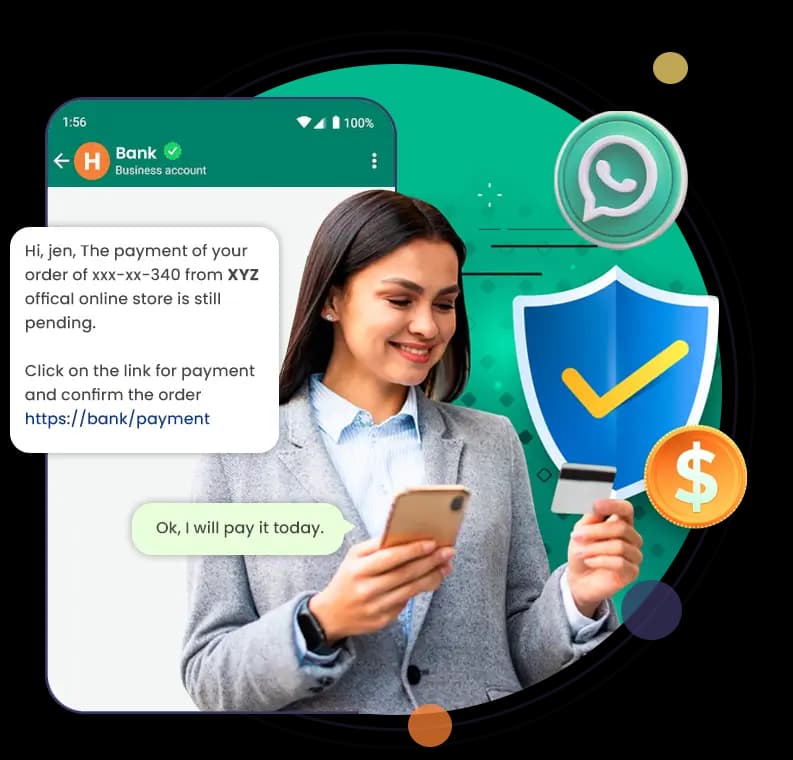
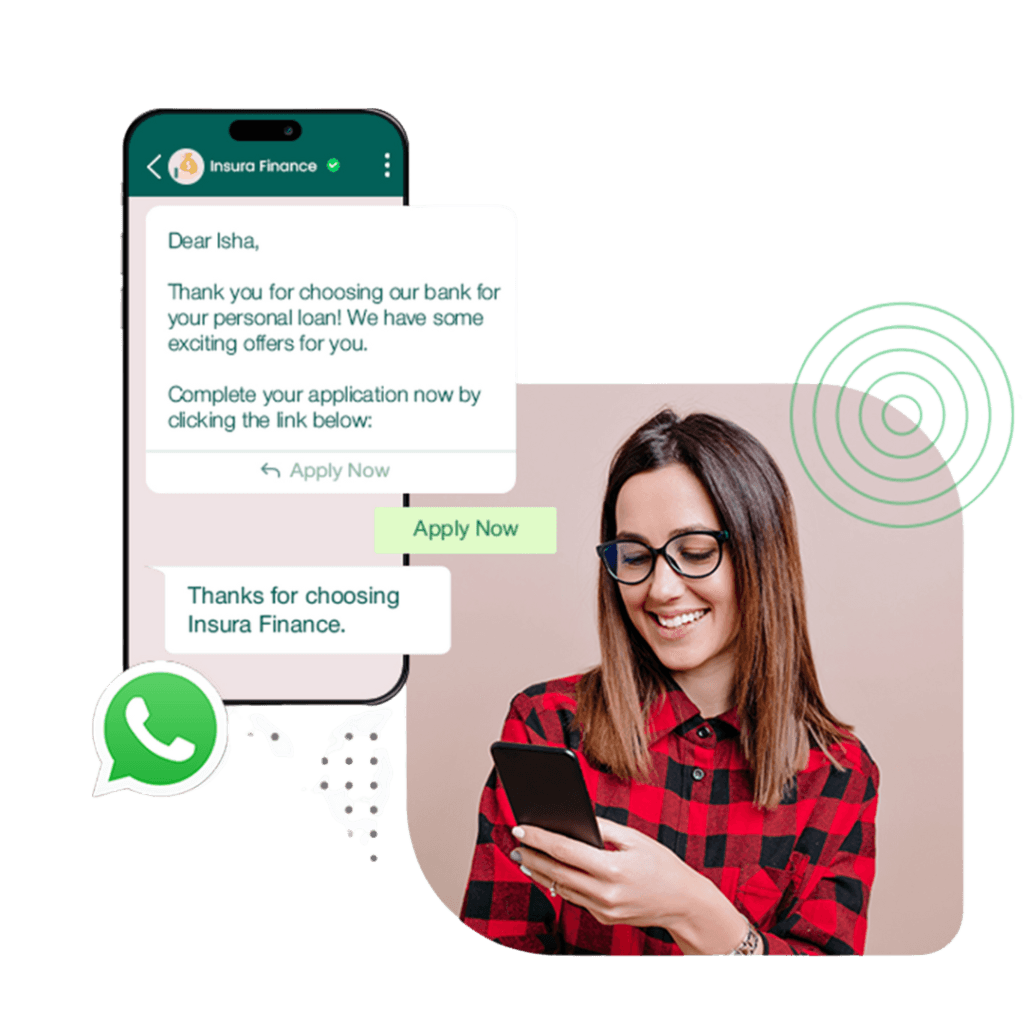
WhatsApp EMI reminders with one-tap payment
Interactive WhatsApp EMI reminders with Pay Now buttons linked directly to payment gateways. A 5-message sequence starting 7 days before due date catches at-risk customers before they become delinquent- reducing collections escalations by 45%.
- ✓98% open rate vs 35% for SMS reminders
- ✓Pay Now button links directly to payment gateway
- ✓5-message sequence with escalating urgency
- ✓Reduces collection calls and improves cash flow
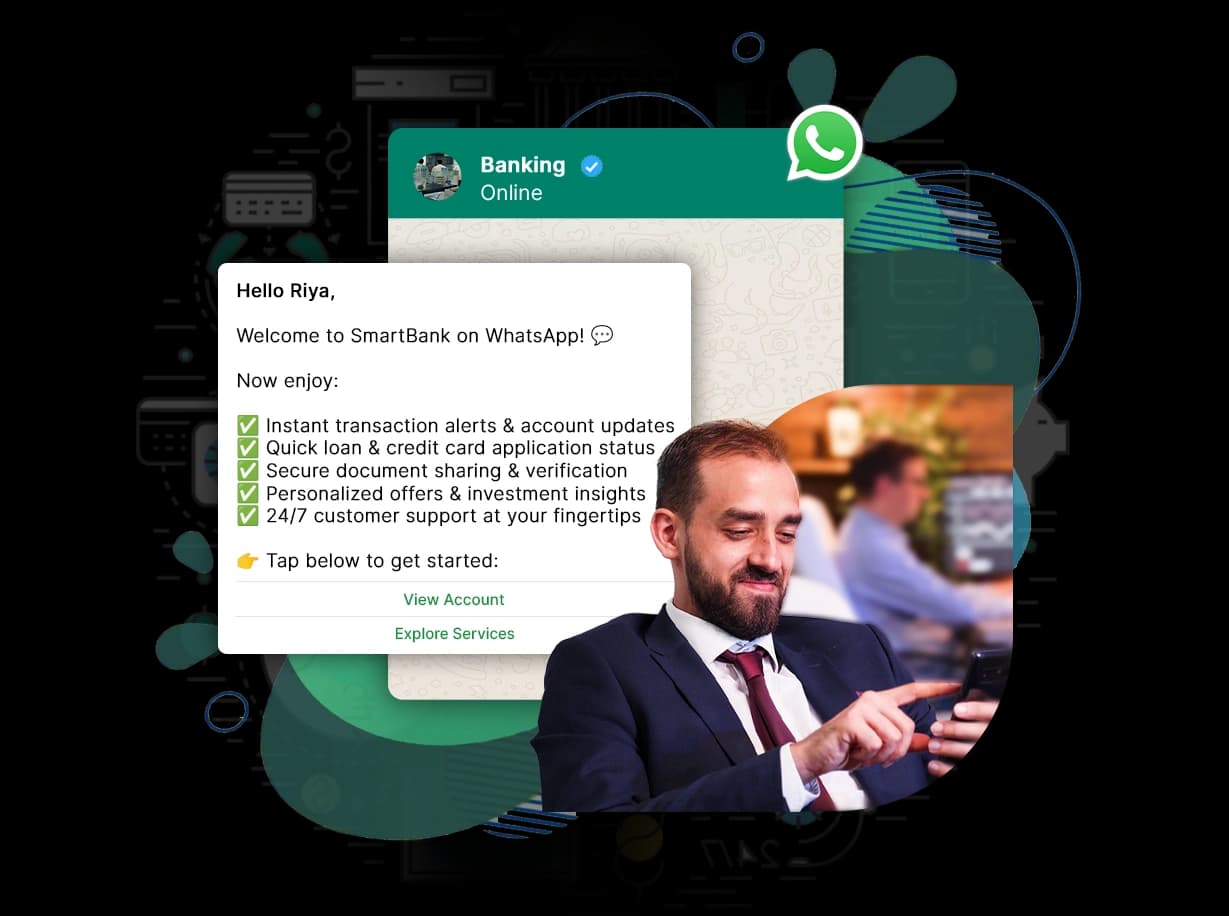
Connect WhatsApp with your core banking system
Get Click Media integrates with leading core banking systems- Finacle, Temenos, and Oracle FLEXCUBE- enabling real-time WhatsApp communication triggered by customer events like EMI due dates, loan disbursements, and KYC expiry. RBI-compliant with full audit trails and 2-year message retention.
- ✓Finacle
- ✓Temenos
- ✓Oracle FLEXCUBE
- ✓Custom CBS
- ✓API webhook
- ✓File-based trigger
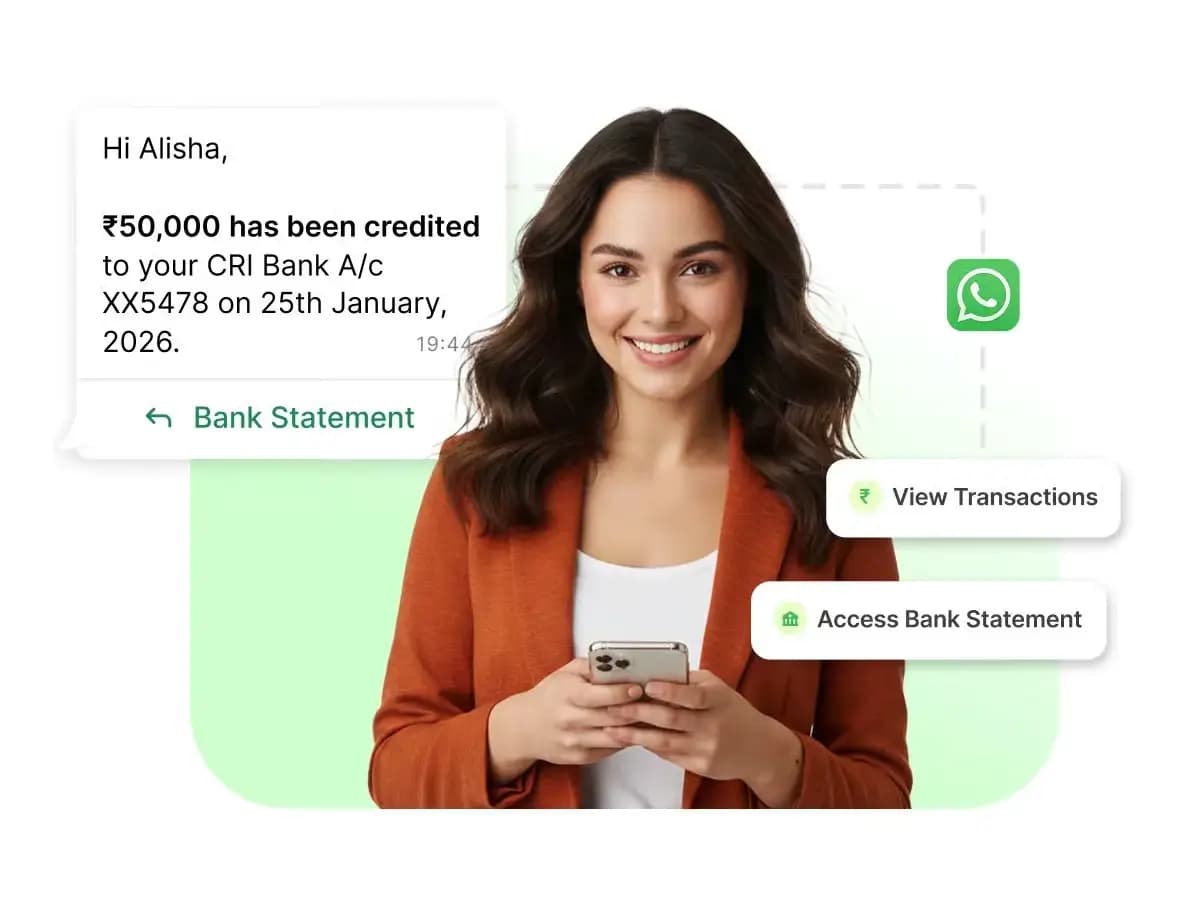
WhatsApp API Use Cases for Banking and NBFC- 6 Automations
Each of these runs as an automated flow triggered by a real event in your systems- not a one-off broadcast.
EMI Payment Reminder Sequence
Trigger: EMI due date- automated at Day -7, -3, 0, +1, +3. EMI amount, due date, account number (masked), and [Pay Now] button. Escalating urgency at each stage. Final notice before collections flag. Result: On-time payment +28%. Collections escalation -45%. Customer dispute calls -22%.
Loan Disbursement Notification
Trigger: Loan disbursed in CBS- amount credited to account. Loan disbursement confirmation with amount, loan account number, first EMI date, and repayment schedule PDF Result: Customer confusion calls -80%. Loan account activation rate +15%.
OTP Delivery- Authentication
Trigger: Customer initiates net banking login, NEFT, UPI, or card transaction requiring 2FA. Transaction OTP with amount, beneficiary (masked), and 5-minute expiry notice. Clear fraud warning. Result: OTP delivery rate 99.1% vs 97.2% SMS. Phishing susceptibility lower with verified WA sender.
Account Statement on Demand
Trigger: Customer messages STATEMENT or taps quick-reply button. Mini statement (last 5 transactions) inline + [Download Full Statement] PDF button + [Email Statement] option Result: Branch visit for statement -55%. Call centre statement queries -40%.
KYC Renewal Alert and Document Collection
Trigger: KYC expiry date approaching- 60 days, 30 days, 7 days. KYC renewal required notice with [Upload Documents] WhatsApp Flow button- captures Aadhaar, PAN, selfie in-chat Result: KYC renewal completion rate +3.2x. Branch visit for KYC -65%.
Fraud Alert and Account Security Notification
Trigger: Unusual transaction detected by fraud management system. Immediate alert: transaction attempt details. [This Was Me] / [Block Immediately] interactive buttons. 24/7 response. Result: Fraud transaction reversal speed 4x faster. Customer trust score +15 points.
Real results from Indian banking & nbfc providers
Figures drawn from Get Click Media's WhatsApp API deployments in this sector, comparing performance before and after automation.
| Metric | Before WhatsApp API | After WhatsApp API | Source |
|---|---|---|---|
| EMI on-time payment rate | 67% (SMS reminder baseline) | 86% (WhatsApp 5-message sequence) | GCM NBFC client data |
| Collections team call volume | 100% manual outreach | 45% reduction- WhatsApp handles pre-delinquency | GCM collections automation |
| KYC completion rate | 38% (email and SMS) | 72% (WhatsApp Flow document upload) | GCM bank client deployment |
| OTP delivery rate | 97.2% (SMS) | 99.1% (WhatsApp API) | GCM authentication platform data |
| Customer service call volume | Baseline | 28% reduction with WhatsApp self-service | GCM bank contact centre data |
EMI on-time payment rate
- Before WhatsApp API
- 67% (SMS reminder baseline)
- After WhatsApp API
- 86% (WhatsApp 5-message sequence)
- Source
- GCM NBFC client data
Collections team call volume
- Before WhatsApp API
- 100% manual outreach
- After WhatsApp API
- 45% reduction- WhatsApp handles pre-delinquency
- Source
- GCM collections automation
KYC completion rate
- Before WhatsApp API
- 38% (email and SMS)
- After WhatsApp API
- 72% (WhatsApp Flow document upload)
- Source
- GCM bank client deployment
OTP delivery rate
- Before WhatsApp API
- 97.2% (SMS)
- After WhatsApp API
- 99.1% (WhatsApp API)
- Source
- GCM authentication platform data
Customer service call volume
- Before WhatsApp API
- Baseline
- After WhatsApp API
- 28% reduction with WhatsApp self-service
- Source
- GCM bank contact centre data
Get Click Media's WhatsApp API Capabilities for Banking and NBFC
Everything below ships as part of your WhatsApp Business API setup- no separate contract or integration project required.
CBS integration
Finacle, Temenos, Oracle FLEXCUBE, and custom CBS via API webhook or file-based trigger
RBI compliance
Audit trail for all customer communications. Opt-in consent management. 2-year message retention for regulatory review.
India data residency
All customer financial data processed and stored on India-hosted infrastructure (AWS Mumbai)
Fraud alert integration
Fraud management system webhook- real-time WhatsApp alert within 10 seconds of flag
Collections workflow
Pre-delinquency WhatsApp sequence before traditional collections escalation
Verified Green Tick
GCM manages Green Tick application- critical for banking trust in India

One message could
change your business.
Big or small, we power communication for all- talk to us today.
WhatsApp API for Banking & NBFC

WhatsApp Business API is not explicitly regulated by RBI for banking communication- it falls under general digital communication guidelines. Banks and NBFCs use WhatsApp API for customer communication with appropriate safeguards: verified sender identity (Green Tick), explicit customer consent, India-hosted data, and complete audit trails. RBI's digital communication guidelines require authenticated sender identity and opt-out mechanisms- both of which WhatsApp API provides.
Yes- WhatsApp authentication-category templates are designed for OTP delivery. WhatsApp OTPs offer higher delivery rates (99.1% vs 97.2% for SMS) and stronger sender identity verification (Meta-verified business name + Green Tick) compared to SMS. Several Indian digital lenders and neo-banks use WhatsApp as their primary OTP channel. Get Click Media manages the authentication template setup and delivery infrastructure.
WhatsApp EMI reminders achieve 98% open rates compared to 35% for SMS, and include a Pay Now button that links directly to the payment gateway- reducing the steps from reminder to payment from 4+ (SMS > open > search payment app > pay) to 2 (open WhatsApp message > tap Pay Now > complete UPI payment). The 5-message reminder sequence starting 7 days before due date catches at-risk customers before they become delinquent.
WhatsApp messages are end-to-end encrypted in delivery. Get Click Media's infrastructure for banking clients includes: India-hosted data processing (AWS Mumbai), no storage of sensitive financial data in message logs, masked account numbers in templates, and DPDP 2023-compliant consent and data handling. We conduct security reviews for all banking integrations.
No. TRAI's DND framework governs promotional voice calls and SMS sent through telecom operator routes- WhatsApp Business API messages are delivered over Meta's platform and sit outside that specific regulatory regime, provided the customer has opted in and utility/transactional templates are used appropriately. This is one reason banks and NBFCs increasingly prefer WhatsApp for EMI and account communication- it reaches DND-registered customers that SMS and telemarketing calls legally cannot.
Most NBFCs are live within 4-6 weeks of kickoff, with banks sometimes taking longer depending on internal compliance review cycles. Green Tick verification typically clears in 3-5 business days and runs in parallel with CBS integration and the compliance/security review, which is usually the longer pole for regulated financial institutions.
Yes. Every message sent- EMI reminder, OTP, fraud alert, KYC notice- is logged with delivery and read status, and Get Click Media's banking infrastructure retains this communication history for 2 years to support regulatory review and internal audit requirements, consistent with the reporting expectations applied to other customer communication channels.
The 5-message reminder sequence escalates in urgency from Day -7 through the due date and a few days after, and an account that remains unresponsive through the full sequence is flagged for the collections team rather than continuing to receive automated messages indefinitely. This keeps early-stage reminders fully automated while ensuring genuinely at-risk accounts reach a human before they age further into delinquency.
Yes, though the two message categories are priced and templated differently under WhatsApp's conversation-based model- utility templates (EMI reminders, statements, fraud alerts) and marketing templates (new product offers, cross-sell campaigns) both run through the same verified Green Tick number, giving customers one consistent, trusted sender for every kind of communication from the institution.
Ready to transform banking communication with WhatsApp?
Get Click Media provides WhatsApp API for banking and NBFCs with CBS integration, RBI compliance, and India-hosted data infrastructure.