

WhatsApp Business API for Logistics Shipment Tracking, Delivery Alerts and Fleet India
WhatsApp Business API for logistics enables Indian courier companies, 3PL providers, and fleet operators to automate shipment tracking updates and delivery notifications. It also powers failed delivery recovery and customer delivery preference collection. Get Click Media integrates WhatsApp with TMS and WMS platforms, reducing failed delivery rates by 34% and customer support calls by 55%.
Official Meta BSP · TMS & WMS integration · Real-time tracking · India-based support
34%
Reduction in failed delivery attempts
55%
Fewer customer service calls on delivery status
2.1x
Faster delivery dispute resolution
92%
Customer satisfaction with WhatsApp updates
Trusted by 10,000+ businesses across India




















WhatsApp Business API for logistics enables Indian courier companies, 3PL providers, and fleet operators to automate shipment tracking updates and delivery notifications. It also powers failed delivery recovery and customer delivery preference collection. Get Click Media integrates WhatsApp with TMS and WMS platforms, reducing failed delivery rates by 34% and customer support calls by 55%.
India processes over 25 million daily shipments through e-commerce, B2B logistics, and direct courier services. Failed deliveries cost the industry ₹45 per failed attempt in re-delivery and reverse logistics costs. WhatsApp delivery management includes real-time updates, customer confirmation before delivery, and instant rescheduling. It is the most effective tool Indian logistics companies have to reduce failed deliveries.
Why Logistics Businesses in India Need WhatsApp API
Indian customers track their shipments 3-5 times per day via IVR or website. Each call or visit represents a cost to the logistics provider and frustration for the customer.
WhatsApp proactive updates eliminate this behaviour. Customers receive updates before they need to search for them, and can reschedule delivery with a single button tap. With 34% reduction in failed deliveries and 55% fewer customer support calls, WhatsApp is rapidly becoming the standard for logistics communication in India.
The underlying problem is structural- last-mile delivery in India runs on a narrow, mostly unpredictable delivery window, and the customer has no reliable way to know when that window will actually happen. A shipment "out for delivery" could arrive in the next hour or the next six, so a customer who has to be physically present- a working professional, someone caring for a child or an elderly parent- ends up calling the support line simply to manage their own day around an unknown arrival time. Multiply that by tens of thousands of shipments a day and the support-call volume isn't a training problem, it's the predictable consequence of leaving the customer with no information to act on.
Automating delivery communication doesn't remove the delivery agent or the support team from the process- it changes what they spend their time doing. Instead of the agent making a call that frequently goes unanswered, or support fielding "where is my order" queries that have a factual answer already sitting in the TMS, both roles shift toward the shipments that actually need a human decision- a failed delivery that needs rescheduling input, a delayed shipment that needs proactive outreach, or a dispute that needs someone to look at the evidence. The system handles the routine status broadcast; people handle the exceptions.
The economics are set by how thin the margin is on a single shipment in Indian logistics- a failed delivery attempt doesn't just cost the ₹45 in re-delivery expense cited above, it also consumes a delivery agent's time slot that could have gone to a successful drop elsewhere on the route. Because failed-delivery cost compounds through reverse logistics, re-attempt scheduling, and agent route inefficiency, even a modest reduction in first-attempt failure rate- the kind a pre-delivery confirmation message reliably produces- changes the unit economics of the delivery network more than most cost-cutting measures aimed directly at per-shipment handling cost.
💡 Key insight: Failed deliveries cost the industry ₹45 per failed attempt in re-delivery and reverse logistics costs. WhatsApp delivery management includes real-time updates, customer confirmation before delivery, and instant rescheduling. It is the most effective tool to reduce failed deliveries.
Getting a Logistics WhatsApp API Rollout Live
Most courier companies, 3PLs, and fleet operators go from kickoff to a fully automated delivery-communication flow within two to three weeks- TMS/WMS integration is usually the longer pole, not the WhatsApp setup itself.
Meta Business Verification & Number Onboarding- Get Click Media handles Meta Business Solution Provider verification for your operations number, so pickup, dispatch, and delivery messages carry a verified business identity from the first shipment.
TMS & WMS Connection- FarEye, Locus, Shiprocket, or your custom TMS/WMS is connected via REST API webhook, so every milestone event- pickup, in-transit, out for delivery, delivered, or failed- fires the corresponding WhatsApp message automatically.
Delivery Sequence & Template Configuration- Pickup confirmation, out-for-delivery, pre-delivery confirmation, failed-delivery recovery, and POD templates are drafted and submitted for Meta approval, matched to your actual delivery attempt and reschedule workflow.
B2B Contact & Reverse Pickup Setup- Designated WhatsApp numbers for enterprise account managers or warehouse teams are configured for B2B shipment updates, alongside the reverse pickup and returns coordination flow.
Pilot, Ops Team Training, and Go-Live- A pilot runs across a subset of routes or hubs while operations and support staff are shown the CRM-side view of delivery-message activity, then the flow is switched on network-wide.
Complete WhatsApp API platform for logistics operators
Manage all shipment communication from a single dashboard: pickup confirmation, out-for-delivery alerts, failed delivery recovery, proof of delivery, and B2B shipment updates. It comes with full integration to your TMS and WMS systems.
- ✓Automated pickup and dispatch notifications
- ✓Out-for-delivery alerts with confirmation buttons
- ✓Failed delivery recovery with instant rescheduling
- ✓Proof of delivery with photo and timestamp
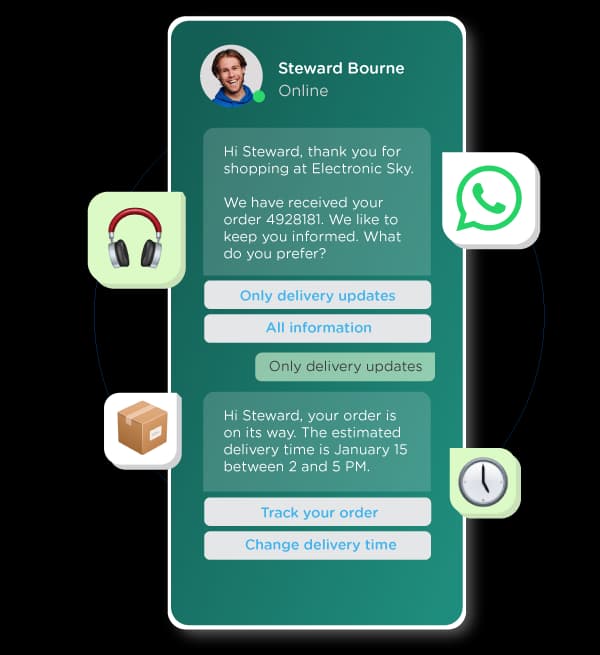
WhatsApp delivery alerts with one-tap rescheduling
Automated out-for-delivery alerts with confirm, reschedule, and delivery instruction buttons. Customers can choose a time that works for them. This reduces failed first-attempt deliveries by 28-34% compared to no pre-notification.
- ✓Out-for-delivery alert with agent name and contact
- ✓Confirm delivery timing button
- ✓Reschedule delivery with preferred time selection
- ✓Delivery instructions for agent (gate code, floor)
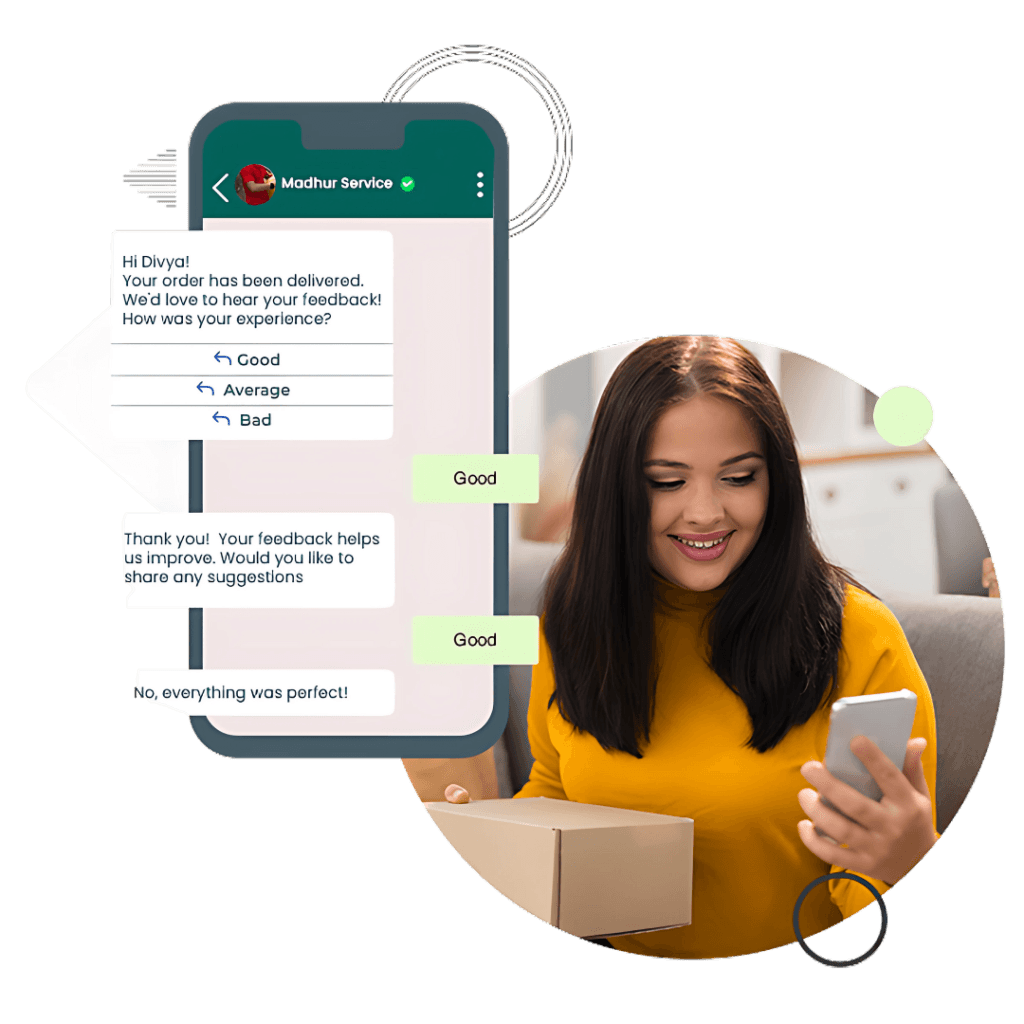
Connect WhatsApp with your TMS and WMS systems
Get Click Media integrates with leading logistics platforms, including FarEye, Locus, Shiprocket, and custom TMS systems. This enables automated WhatsApp communication at every shipment milestone from pickup to final delivery. Setup takes 3-5 days after WhatsApp API onboarding is complete.
- ✓FarEye
- ✓Locus
- ✓Shiprocket
- ✓Custom TMS
- ✓WMS integration
- ✓REST API webhooks
WhatsApp API Use Cases for Logistics- 6 Automations
Each of these runs as an automated flow triggered by a real event in your systems- not a one-off broadcast.
Shipment Pickup and Dispatch Notification
Trigger: Pickup completed and shipment scanned at origin hub. Pickup confirmed. AWB number. Estimated delivery date. Track shipment button. Customer support WhatsApp number. Result: Inbound tracking queries -40%. Customer confidence from first touchpoint.
Out for Delivery Alert and Pre-Delivery Confirmation
Trigger: Shipment loaded on delivery vehicle- out for delivery scan. Your order is out for delivery today. Delivery agent name and contact. [Confirm delivery timing] or [Reschedule delivery] or [Delivery instructions] buttons. Result: Failed delivery -34%. Delivery success rate first attempt +28%.
Failed Delivery Recovery
Trigger: Delivery attempt failed- reason code from delivery system. We missed you. Your delivery is rescheduled. Tap to choose: [Tomorrow morning] [Tomorrow afternoon] [Day after] [Delivery instructions for agent] Result: Recovery rate for failed deliveries +45%. Re-delivery cost -₹32 per shipment.
Delivery Confirmation and Proof of Delivery
Trigger: Delivery completed- final scan. Your order has been delivered. Delivered to: [Name]. Time: [Timestamp]. Photo of delivery (if configured). Rate delivery [1-5 stars]. Result: Delivery dispute rate -60%. CSAT survey response rate 4x vs IVR.
B2B Shipment Status for Enterprise Clients
Trigger: Status change events from TMS- multiple milestones. Shipment milestone update with AWB, origin, destination, current status, ETA, and exception alerts for delays Result: Enterprise client satisfaction +35%. Account renewal rate +22%.
Reverse Pickup and Return Coordination
Trigger: Return pickup request created in OMS or returns portal. Return pickup scheduled. Date, time window, agent contact. Packaging instructions. Refund timeline confirmation. Result: Return pickup success rate first attempt +40%. Returns customer satisfaction +28 points.
Real results from Indian logistics providers
Figures drawn from Get Click Media's WhatsApp API deployments in this sector, comparing performance before and after automation.
| Metric | Before WhatsApp API | After WhatsApp API | Source |
|---|---|---|---|
| Failed delivery rate | 18-22% (industry average India) | 10-14% with WhatsApp pre-delivery confirmation | GCM logistics client data |
| Customer service calls per 1,000 shipments | 180 calls | 82 calls (55% reduction) | GCM 3PL client post-deployment |
| Delivery dispute resolution time | 4-5 days average | 1.9 days with WhatsApp POD | GCM courier client |
| CSAT survey response rate | 8% (IVR) | 34% (WhatsApp) | GCM logistics client |
| B2B client escalations | Baseline | 28% reduction with proactive WhatsApp updates | GCM enterprise logistics client |
Failed delivery rate
- Before WhatsApp API
- 18-22% (industry average India)
- After WhatsApp API
- 10-14% with WhatsApp pre-delivery confirmation
- Source
- GCM logistics client data
Customer service calls per 1,000 shipments
- Before WhatsApp API
- 180 calls
- After WhatsApp API
- 82 calls (55% reduction)
- Source
- GCM 3PL client post-deployment
Delivery dispute resolution time
- Before WhatsApp API
- 4-5 days average
- After WhatsApp API
- 1.9 days with WhatsApp POD
- Source
- GCM courier client
CSAT survey response rate
- Before WhatsApp API
- 8% (IVR)
- After WhatsApp API
- 34% (WhatsApp)
- Source
- GCM logistics client
B2B client escalations
- Before WhatsApp API
- Baseline
- After WhatsApp API
- 28% reduction with proactive WhatsApp updates
- Source
- GCM enterprise logistics client
Get Click Media's WhatsApp API Capabilities for Logistics
Everything below ships as part of your WhatsApp Business API setup- no separate contract or integration project required.
TMS integration
FarEye, Locus, custom TMS- event webhook triggers at every milestone
WMS integration
Warehouse management system- pickup confirmation, dispatch triggers
Delivery preference collection
WhatsApp Flow for delivery time preference, OTP delivery, safe drop instructions
Fleet tracking
Real-time delivery agent location sharing via WhatsApp link
Customer support chatbot
Tracking query chatbot + agent handoff for exceptions and disputes
POD automation
Delivery confirmation message with photo proof and digital signature capture

One message could
change your business.
Big or small, we power communication for all- talk to us today.
WhatsApp API for Logistics

WhatsApp sends a pre-delivery confirmation when the shipment is out for delivery. It lets customers confirm they will be available, reschedule to a preferred time, or provide specific delivery instructions such as a gate code, floor number, or neighbour delivery. This proactive communication reduces failed first-attempt deliveries by 28-34% compared to no pre-notification. The rescheduling button within the WhatsApp message makes it frictionless for customers to choose a time they can receive.
Yes. Get Click Media integrates with FarEye, Locus, Ezyslips, Shiprocket, and custom TMS platforms via REST API webhooks. Each milestone event in the TMS (pickup, in-transit, out for delivery, delivered, or failed) triggers an appropriate WhatsApp message to the consignee automatically.
WhatsApp Proof of Delivery (POD) is a delivery confirmation message with photo evidence and timestamp, sent immediately on delivery. It reduces dispute rates by 60%. When a dispute does arise, the WhatsApp delivery confirmation record with photo provides unambiguous evidence of delivery completion. This reduces resolution time from 4-5 days to under 2 days.
Yes. For B2B enterprise clients, GCM configures WhatsApp updates for their designated contacts. Every shipment milestone, exception alert, and ETA update is sent automatically to the appropriate account manager or warehouse team WhatsApp number. B2B clients consistently rate WhatsApp shipment communication higher than portal-based tracking.
Yes. The pre-delivery confirmation message can include the COD amount due, giving the customer a chance to arrange exact change or flag that they'd prefer to switch to prepaid before the agent arrives- reducing the on-doorstep payment disputes and refusals that are a common cause of failed COD deliveries in India.
Where the fleet-tracking integration is enabled, the out-for-delivery message can include a live location link so the customer can see the agent's approximate position and estimated arrival, rather than only a broad time-window estimate. This is configured per client based on what your fleet management system exposes.
No- shipments belonging to the same order are grouped under a single consignment reference wherever your TMS supports it, so the customer receives one consolidated update rather than a separate WhatsApp message for every carton in a multi-box order. This is configured during TMS integration based on how your system structures multi-piece shipments.
Yes, for 3PLs and couriers handling international shipments- customs-hold, clearance, and duty-payment-required events from your TMS can trigger the same milestone-alert pattern used for domestic delivery, so the consignee knows when action is needed on their end rather than only finding out when the shipment doesn't arrive on schedule.
Yes. The delivery-preference WhatsApp Flow can capture standing instructions- gate code, security desk drop-off, floor and flat number, or a preferred neighbour contact- once, and this is reused for future deliveries to the same address rather than being requested again on every out-for-delivery message.
Related WhatsApp Business API resources
Ready to transform logistics communication with WhatsApp?
Get Click Media provides WhatsApp API for logistics with TMS and WMS integration, automated delivery alerts, and proof of delivery automation.