
In this article
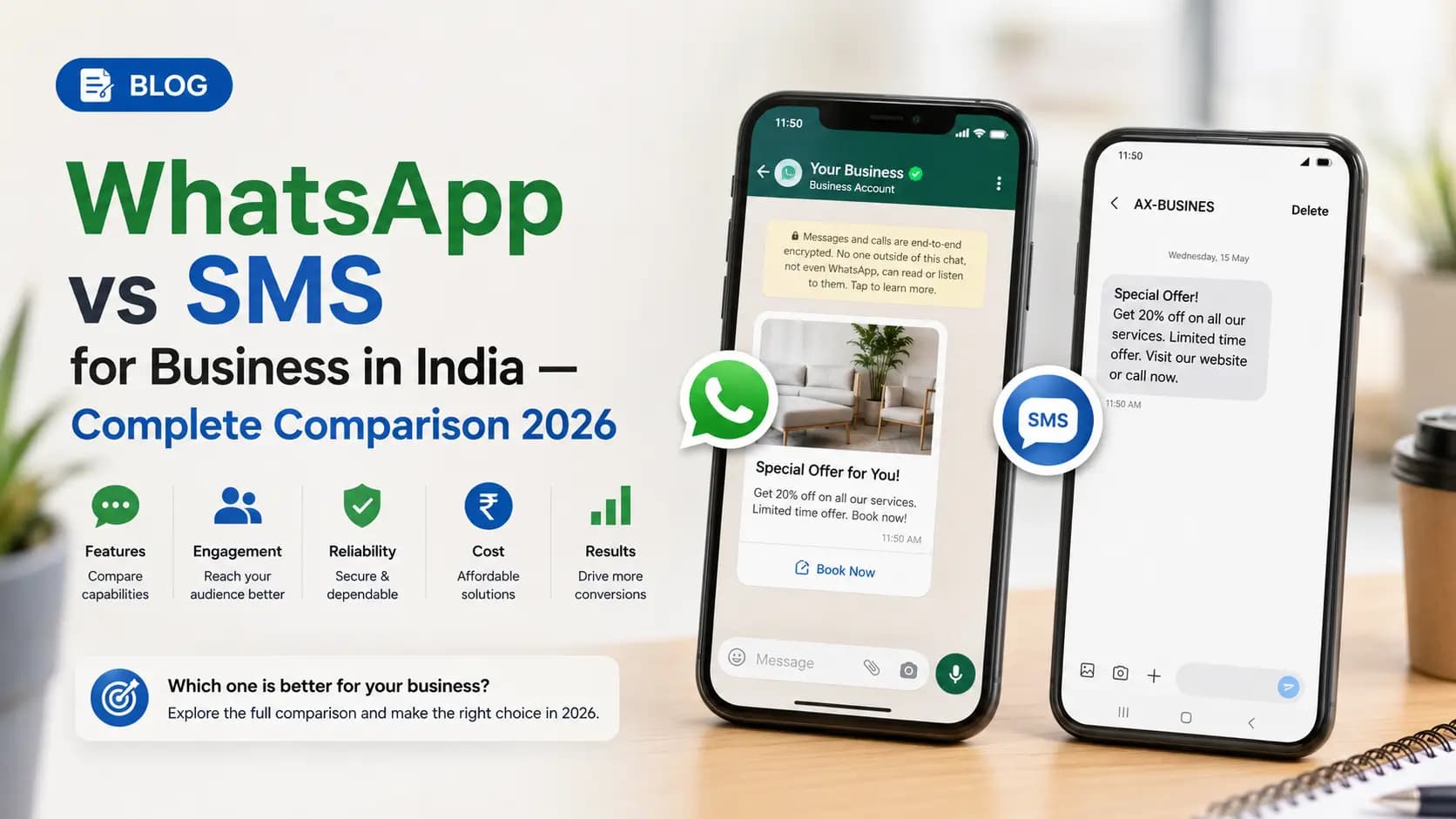
Explore the key concepts, practical considerations, and frequently asked questions related to whatsapp vs sms for business in india- complete comparison 2026.
Key takeaways
- In a worked 1,00,000-recipient campaign, WhatsApp generated ₹19.41L in revenue at 22.8x ROAS versus SMS's ₹21,000-24,000 at 2.6-3.0x.
- SMS remains the only channel reaching feature phones and the roughly 600 million Indian mobile users without an active WhatsApp account.
- WhatsApp needs no DLT registration since Meta's own template approval replaces the TRAI DLT process required for every commercial SMS.
WhatsApp Business API and Bulk SMS are both widely used business messaging channels in India, but they serve different purposes. WhatsApp achieves 98% open rates and 20-28% CTR with rich media and verified sender identity- but requires internet connectivity and customer opt-in. Bulk SMS reaches all 1.1 billion Indian mobile numbers without internet, but open rates average 30-35% and CTR is under 2%. Get Click Media offers both WhatsApp Business API and bulk SMS service from a single platform in India.
Indian businesses have been using SMS for customer communication for over two decades. WhatsApp has been available as a business channel for the last five years. Today, many businesses run both- but do not always know when to use which.
This page gives you a definitive, data-driven comparison of WhatsApp API and Bulk SMS for Indian businesses- covering open rates, costs, compliance, reach, and the specific use cases where each channel outperforms the other. The goal is to help you allocate your messaging budget intelligently, not to declare one channel the winner.
Quick answer: WhatsApp wins for engaged customers with opt-in, rich content, and conversion-driven campaigns. SMS wins for universal reach, guaranteed delivery without internet, OTP fallback, and compliance-heavy regulated industries. Most mature Indian businesses use both- they complement each other perfectly.
Get WhatsApp Business API- 98% open rate · Rich media · Chatbot Get Bulk SMS Service- 1.1B reach · DLT registered · OTP
WhatsApp vs SMS- 22-Point Comparison
| Dimension | WhatsApp Business API | Bulk SMS |
|---|---|---|
| India reach | ~500 million WhatsApp users | 1.1 billion+ all Indian mobile numbers |
| Internet required | Yes- WiFi or data | No- works on any mobile network |
| Works on feature phones | No | Yes |
| App installation | WhatsApp must be installed | No app needed |
| Average open rate India | 98% | 30–35% |
| Average CTR India | 20–28% | 1.5–2% |
| Rich media support | Images, video, PDF, carousels, buttons | Text only (160 chars per SMS) |
| Verified sender identity | Green Tick- Meta verified | Sender ID (6-char alphanumeric) |
| Two-way conversation | Yes- native conversation thread | No- reply triggers new SMS |
| Chatbot support | Full AI and rule-based chatbot | No native chatbot |
| Character limit | No limit (multiple message types) | 160 chars per SMS (concatenated for longer) |
| Marketing cost India | ₹0.79–0.91 per conversation | ₹0.08–0.14 per message |
| Utility/transactional cost | ₹0.14–0.17 per conversation | ₹0.12–0.18 per message |
| Free monthly quota | 1,000 service conversations | None |
| DND restrictions | None- not under TRAI DND | Yes- promotional SMS cannot reach DND numbers |
| DLT registration required | No | Yes- mandatory for commercial SMS in India |
| Opt-in for marketing | Yes- explicit WhatsApp opt-in | No- but DND filtering applies |
| OTP delivery | Yes- authentication category | Yes- widely used, universal reach |
| Delivery without internet | No | Yes- SMS works offline |
| Click tracking | Yes- read + click + conversion tracking | Link shortener required for basic click tracking |
| CRM integration | Deep- full API and pre-built connectors | Webhook-based |
| Analytics | Full funnel- delivery, read, click, conversion | Basic- delivery report only |
The Real ROI Comparison- 1 Lakh Message Campaign India
Numbers speak louder than features. Here is a worked example for a D2C brand sending a flash sale campaign to 1,00,000 customers:
| Metric | WhatsApp API | Bulk SMS |
|---|---|---|
| Recipients | 1,00,000 | 1,00,000 (minus DND- actual ~65,000) |
| Send cost | ₹85,000 (₹0.85/conv) | ₹8,000 (₹0.12/msg) |
| Average open rate | 98% | 30–35% |
| Messages opened | 98,000 | 19,500–22,750 (DND adjusted) |
| Average CTR | 22% | 1.8% |
| Total clicks | 21,560 | 351–410 |
| Conversion rate (click to purchase) | 6% | 4% |
| Total orders generated | 1,294 | 14–16 |
| Average order value | ₹1,500 | ₹1,500 |
| Total revenue generated | ₹19,41,000 | ₹21,000–24,000 |
| Cost per order | ₹65.7 | ₹500–571 |
| Revenue per ₹1 spent on messaging | ₹22.84 | ₹2.63–3.00 |
| ROAS | 22.8x | 2.6–3.0x |
What this shows: WhatsApp costs ₹77,000 more to send than SMS for this campaign- but generates ₹19,17,000 more in revenue. Cost per order is ₹65.7 vs ₹535 for SMS. ROAS is 22.8x vs 2.8x. For any e-commerce campaign with an opted-in customer base, WhatsApp API delivers dramatically superior ROI despite the higher per-conversation cost.
Where SMS Beats WhatsApp- 5 Scenarios
WhatsApp is not always the better channel. Here are the 5 scenarios where SMS outperforms WhatsApp for Indian businesses:
1. Reaching customers without WhatsApp
India has 1.1 billion mobile subscribers but only ~500 million active WhatsApp users. The remaining 600 million- concentrated in rural areas, older demographics, and feature phone users- are not reachable via WhatsApp. For FMCG brands, rural banking, agricultural services, and government communication, SMS is the only viable channel. WhatsApp cannot reach these segments at all.
2. Guaranteed delivery without internet
SMS delivers even when the recipient has no internet connectivity- essential for rural areas with patchy data coverage, for customers roaming internationally, or for critical alerts (fraud detection, emergency notifications) where internet availability cannot be guaranteed. WhatsApp messages queue and deliver when internet is restored- too slow for time-critical communication.
3. DND compliance for promotional messaging
Bulk promotional SMS to non-DND numbers is a legal, compliant, and widely accepted channel in India. Every Indian mobile subscriber has a number registered in TRAI's system- and businesses can legally SMS the non-DND subset without prior opt-in for promotional messages (subject to DLT registration and content approval). WhatsApp marketing requires explicit opt-in, which limits campaign addressable audience to your existing opted-in base.
4. OTP delivery fallback
WhatsApp OTP works well for opted-in users with internet access. But for authentication flows where 100% delivery is non-negotiable- banking OTP, payment verification, government services- SMS is the universal fallback that guarantees delivery to any mobile number on any network in any location. Best practice: attempt WhatsApp OTP first (lower cost, higher trust), fall back to SMS if undelivered within 30 seconds.
5. Cost efficiency for high-volume transactional notifications
For pure notification-only messages where no response or engagement is needed- shipping updates to rural areas, balance alerts, recharge confirmations- SMS at ₹0.12-0.18 per message is 20-40% cheaper than equivalent WhatsApp utility conversations. If the customer does not need to interact and just needs the information, SMS may be the more economical choice for very high volume sends.
Where WhatsApp Beats SMS- 5 Scenarios
And here are the 5 scenarios where WhatsApp clearly outperforms SMS:
1. Marketing campaigns to opted-in customers
For customers who have opted in, WhatsApp marketing campaigns consistently outperform SMS by 10x to 15x on conversion- driven by 98% vs 35% open rate, rich product carousels vs text-only, and single-tap buttons vs URL links. For any e-commerce, D2C, or retail business with an opted-in customer base, WhatsApp is the primary campaign channel.
2. Customer service and support
WhatsApp enables true two-way customer service with conversation threads, chatbot automation, and agent handoff- none of which are possible in SMS. A customer replying to an SMS gets a new disconnected thread. A customer replying on WhatsApp continues the same conversation, with the agent seeing full history. Support satisfaction scores are consistently higher on WhatsApp than SMS-based support.
3. High-consideration purchase journeys
Real estate enquiry, loan application, insurance purchase, premium electronics- these are decisions that require back-and-forth conversation, document exchange, and trust-building. WhatsApp handles the entire journey in one thread: initial enquiry, qualification questions, PDF brochure sent, payment link, and follow-up. SMS can only deliver a text and a link- the customer must then leave SMS entirely to complete the journey.
4. Post-purchase relationship management
Order tracking, review collection, replenishment reminders, loyalty programme updates- all require either rich media or two-way conversation that SMS cannot support. A WhatsApp order tracking message with a live tracking button, a review request with 1-5 star chips, and a replenishment reminder with a one-tap reorder link are all dramatically more effective than equivalent SMS links.
5. AI-powered conversations
WhatsApp + AI chatbot enables personalised, contextual conversations at scale- the chatbot remembers the customer's last order, their preferences, and their previous support queries. This is impossible in SMS. As Indian businesses increasingly invest in AI-powered customer communication, WhatsApp is the primary channel- SMS is a notification medium, not a conversation one.
WhatsApp vs SMS- Use Case Recommendation Matrix
| Use case | Best channel | Why |
|---|---|---|
| Flash sale campaign- opted-in customers | 10x higher CTR, rich carousels, one-tap purchase | |
| Flash sale campaign- full database | SMS first, WA for opted-in | SMS reaches DND + non-WA users; WA converts better |
| OTP delivery- primary | WhatsApp (opted-in) + SMS fallback | WA: lower cost, higher trust. SMS: universal fallback |
| Order confirmation | Rich order card, tracking button, two-way for queries | |
| Shipment tracking | Live tracking button, delivery rescheduling in-chat | |
| EMI payment reminder | Both | WA for engaged customers; SMS for broader reach |
| Customer support queries | Two-way conversation, chatbot, agent handoff- SMS cannot | |
| Rural customer communication | SMS | Internet penetration lower in rural India |
| Feature phone users | SMS | WhatsApp not available on feature phones |
| Lead qualification | Chatbot qualification flow impossible in SMS | |
| New user onboarding | Rich welcome sequence, interactive flows, chatbot | |
| Regulatory compliance alerts (SEBI, IRDAI) | SMS or both | Regulatory bodies may mandate SMS delivery for compliance |
| Appointment reminder | Reschedule button, confirmation in-chat, map link | |
| Win-back campaign (lapsed customers) | Personalised carousel, 10% offer, conversational re-engagement |
TRAI DLT Compliance- SMS vs WhatsApp
Indian SMS compliance is governed by TRAI's Telecom Commercial Communications Customer Preference Regulations (TCCCPR). WhatsApp is not subject to these regulations. Understanding this difference is critical for Indian marketing teams:
| Compliance requirement | Bulk SMS | WhatsApp Business API |
|---|---|---|
| TRAI DLT registration | Mandatory- entity registration on DLT portal (Vi, Airtel, Jio, BSNL) | Not required |
| Sender ID registration | Mandatory- 6-character alphabetic header | Not required |
| Template registration | Mandatory- all templates approved on DLT | Meta approval required (not TRAI) |
| DND scrubbing | Mandatory before promotional sends | Not applicable- WhatsApp not under DND rules |
| Commercial message time restrictions | Promotional SMS: 9 AM to 9 PM only | No time restrictions |
| Transactional SMS | Permitted 24x7 with proper categorisation | No restrictions |
| DPDP Act 2023 | Applies- consent and data handling | Applies- opt-in consent required for marketing |
| Consent for promotional messages | Implicit (non-DND = legal to send) | Explicit opt-in mandatory before marketing sends |
GCM compliance note: Get Click Media manages DLT registration, Sender ID approval, and template submission for SMS clients. For WhatsApp clients, GCM manages Meta template approval and opt-in flow design. Both channels are handled end-to-end- your team does not need to navigate regulatory portals directly.
The Recommended Strategy- Use Both Intelligently
The most effective Indian messaging strategy in 2026 combines WhatsApp and SMS based on customer segment, use case, and delivery priority:
| Layer | Channel | Who | Message type |
|---|---|---|---|
| Primary- high engagement | WhatsApp API | All opted-in customers | Rich campaigns, service, chatbot, conversational |
| Secondary- universal reach | Bulk SMS | Customers without WA opt-in + rural + feature phone | Notifications, OTP fallback, compliance alerts |
| Fallback- guaranteed delivery | SMS OTP fallback | Any customer where WA delivery fails in 30 sec | OTP, critical alerts, payment confirmations |
| Broadest reach campaigns | SMS first | Non-opted-in, new customer list, full database | Awareness, broad promotional, regulatory |
GCM unified platform: Get Click Media offers WhatsApp Business API and bulk SMS service on the same platform- one dashboard, one API endpoint, one analytics view, one account manager. Configure intelligent channel routing: attempt WhatsApp for opted-in customers, automatically fall back to SMS when WhatsApp delivery fails or the customer is not reachable. Most enterprise clients set this up as a waterfall: WA first, SMS fallback, voice last.
Frequently Asked Questions- WhatsApp vs SMS India
Is WhatsApp better than SMS for business in India? For opted-in customers with smartphones and internet access, WhatsApp consistently outperforms SMS- 98% vs 35% open rate, 20-28% vs 1.5-2% CTR, and 10x to 15x higher conversion for marketing campaigns. However, SMS is better for universal reach (1.1B mobile numbers vs 500M WhatsApp users), offline delivery, OTP fallback, and reaching rural and feature phone users. Most mature Indian businesses use both channels together.
Is WhatsApp cheaper than SMS in India? Per-message, SMS is cheaper: ₹0.08-0.18 per SMS vs ₹0.14-0.91 per WhatsApp conversation. However, WhatsApp's dramatically higher conversion rates make the cost per order or cost per lead from WhatsApp campaigns 80-90% lower than equivalent SMS campaigns in most e-commerce scenarios. The right comparison is not per-message cost- it is cost per conversion.
Can I send WhatsApp messages to DND-registered numbers in India? Yes. WhatsApp Business API is not subject to TRAI's DND regulations. Customers on the DND registry can receive WhatsApp messages from your business- as long as they have given explicit opt-in consent. This is a significant advantage over promotional SMS, which legally cannot reach DND-registered numbers.
Do I need DLT registration for WhatsApp Business API? No. DLT registration is a TRAI requirement for commercial SMS- it does not apply to WhatsApp. WhatsApp Business API requires Meta's own template approval process, separate from TRAI's DLT system. If you run both SMS and WhatsApp, you need DLT registration for SMS but not for WhatsApp.
What is the character limit for WhatsApp messages vs SMS? SMS is limited to 160 characters per message (concatenated messages can be longer but are charged per SMS unit). WhatsApp has no meaningful character limit- a single text message can contain up to 65,536 characters, and WhatsApp supports rich message types (images, videos, PDFs, carousels, buttons) that are impossible in text-only SMS.
Which channel has better delivery rates- WhatsApp or SMS? For customers reachable on both channels, WhatsApp and SMS have comparable delivery rates when internet is available. SMS has an advantage for customers without internet, in areas with poor data connectivity, and for feature phone users. For OTP and critical alerts, SMS is used as a universal fallback precisely because it delivers even when WhatsApp cannot.
Can I use WhatsApp API and Bulk SMS from the same platform? Yes- with Get Click Media. Our platform supports both WhatsApp Business API and Bulk SMS with a unified dashboard, single API integration point, shared contact lists, and combined analytics- with intelligent waterfall routing so you can attempt WhatsApp first and fall back to SMS automatically when delivery fails.
What is the difference between WhatsApp marketing and SMS marketing in India? WhatsApp marketing uses Meta-approved templates sent via WhatsApp Business API to opted-in customers- with rich media, 98% open rates, and 20-28% CTR. SMS marketing uses TRAI-registered templates sent via A2P SMS to non-DND numbers- text only, 30-35% open rate, 1.5-2% CTR. WhatsApp requires explicit opt-in; promotional SMS can reach non-DND numbers without prior consent. Both channels have their place in a mature Indian digital marketing stack.
Get Started
Whether your priority is rich, conversational engagement with opted-in customers or guaranteed universal reach across every Indian mobile number, Get Click Media can set you up on the right channel- or both. Explore WhatsApp API pricing in India, our broader WhatsApp marketing services, and how WhatsApp stacks up against RCS messaging as a third channel option, or dive into our bulk SMS service in India for the full universal-reach picture.
Get WhatsApp Business API- 98% open rate · Rich media · Chatbot Get Bulk SMS Service- 1.1B reach · DLT registered · OTP
Article topics
Frequently Asked Questions
Is WhatsApp better than SMS for business in India?
For opted-in customers with smartphones and internet access, WhatsApp consistently outperforms SMS- 98% vs 35% open rate, 20-28% vs 1.5-2% CTR, and 10x to 15x higher conversion for marketing campaigns. However, SMS is better for universal reach (1.1B mobile numbers vs 500M WhatsApp users), offline delivery, OTP fallback, and reaching rural and feature phone users. Most mature Indian businesses use both channels together.
Is WhatsApp cheaper than SMS in India?
Per-message, SMS is cheaper: ₹0.08-0.18 per SMS vs ₹0.14-0.91 per WhatsApp conversation. However, WhatsApp's dramatically higher conversion rates make the cost per order or cost per lead from WhatsApp campaigns 80-90% lower than equivalent SMS campaigns in most e-commerce scenarios. The right comparison is not per-message cost- it is cost per conversion.
Can I send WhatsApp messages to DND-registered numbers in India?
Yes. WhatsApp Business API is not subject to TRAI's DND (Do Not Disturb) regulations. Customers on the DND registry can receive WhatsApp messages from your business- as long as they have given explicit opt-in consent to receive WhatsApp communications. This is a significant advantage over promotional SMS, which legally cannot reach DND-registered numbers.
Do I need DLT registration for WhatsApp Business API?
No. DLT registration is a TRAI requirement for commercial SMS- it does not apply to WhatsApp. WhatsApp Business API requires Meta's own template approval process, which is separate from TRAI's DLT system. If you run both SMS and WhatsApp, you need DLT registration for your SMS campaigns but not for your WhatsApp communications.
What is the character limit for WhatsApp messages vs SMS?
SMS is limited to 160 characters per message (concatenated messages can be longer but are charged per SMS unit). WhatsApp has no meaningful character limit- a single WhatsApp text message can contain up to 65,536 characters. More importantly, WhatsApp supports rich message types (images, videos, PDFs, carousels, buttons) that are impossible in SMS, which is text-only.
Which channel has better delivery rates- WhatsApp or SMS?
For customers reachable on both channels, WhatsApp and SMS have comparable delivery rates when internet is available. SMS has an advantage for customers without internet, in areas with poor data connectivity, and for feature phone users. For OTP and critical alerts, SMS is used as a universal fallback precisely because it delivers even when WhatsApp cannot.
Can I use WhatsApp API and Bulk SMS from the same platform?
Yes- with Get Click Media. Our platform supports both WhatsApp Business API and Bulk SMS with a unified dashboard, single API integration point, shared contact lists, and combined analytics. This eliminates the need to manage two separate vendor relationships and enables intelligent waterfall routing- attempt WhatsApp first for opted-in customers, fall back to SMS automatically when WhatsApp delivery fails.
What is the difference between WhatsApp marketing and SMS marketing in India?
WhatsApp marketing uses Meta-approved message templates sent via WhatsApp Business API to opted-in customers- with rich media, 98% open rates, and 20-28% CTR. SMS marketing uses TRAI-registered templates sent via A2P SMS to non-DND numbers- text only, 30-35% open rate, 1.5-2% CTR. WhatsApp requires explicit opt-in; promotional SMS can reach non-DND numbers without prior consent. Both channels have their place in a mature Indian digital marketing stack.
About the author
Get Click Media creates practical resources for businesses using messaging, automation, analytics, and digital communication to improve customer engagement. This article was published on .