
In this article
Explore the key concepts, practical considerations, and frequently asked questions related to whatsapp vs email marketing in india- which drives more revenue in 2026?.
Key takeaways
- WhatsApp hits 98% open rates and 20-28% CTR in India versus email's 20-25% open rate and 3-5% CTR for equivalent campaigns.
- A 50,000-recipient campaign nets 27x-35x ROAS on WhatsApp versus 8x-15x on email, despite WhatsApp costing far more per send.
- WhatsApp wins 7 of 8 customer-journey funnel stages; email still leads for B2B correspondence and detailed transactional records.
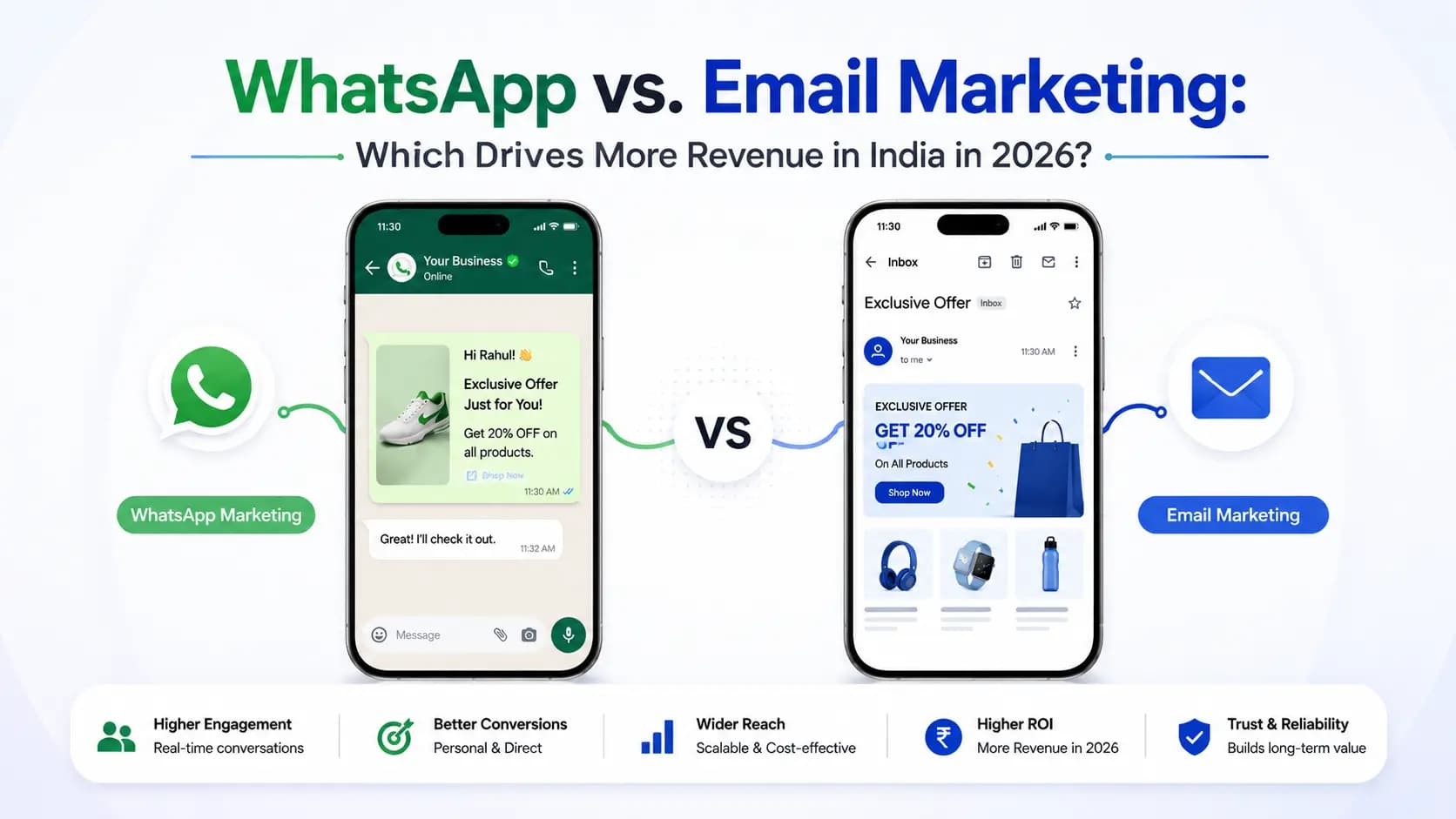
WhatsApp Business API achieves 98% open rates and 20-28% CTR in India, compared to email's 20-25% open rate and 3-5% CTR. WhatsApp generates 5x to 10x higher click-through rates than email for equivalent campaigns. However, email supports longer content, lower cost per send, and is essential for B2B communication and detailed transactional records. Most high-performing Indian marketing stacks use both- WhatsApp for high-engagement campaigns and conversational follow-up, email for detailed content, nurture sequences, and B2B communication.
Email vs WhatsApp is not a binary choice for Indian businesses- it is a channel allocation decision. The question is not which one to use, but which one to use for which purpose at which stage of the customer journey.
The short answer: WhatsApp outperforms email on almost every engagement metric for B2C communication in India- open rates, CTR, conversion, and response speed. Email outperforms WhatsApp on content depth, B2B communication, automation complexity, and cost per send at very high volume.
This page gives you the data, the use case breakdown, and the recommended strategy- so you can allocate your marketing investment across both channels intelligently.
Note: Email isn't a Get Click Media product- we're a WhatsApp Business API provider. This comparison is here to help you allocate budget correctly, not to sell you an email platform. Most businesses need both channels; we're simply making the case for where WhatsApp should sit in that mix.
Get WhatsApp Business API- 98% open rate · Conversational · Chatbot WhatsApp + Email Together- Unified strategy · Max reach · Best ROI · Talk to GCM Team
WhatsApp vs Email- 20-Point Comparison
| Dimension | WhatsApp Business API | Email Marketing |
|---|---|---|
| Average open rate India | 98% | 20–25% |
| Average CTR India | 20–28% | 3–5% |
| Average conversion rate | 5–10% (campaign to purchase) | 1–3% (email to purchase) |
| Time to read (avg) | Immediate- 90% read within 3 min | 4–24 hours- checked 2-3x per day |
| Spam filtering | No spam folder- direct inbox delivery | 20–25% land in spam or promotions tab |
| Rich media | Images, video, carousels, buttons | HTML email- images often blocked by default |
| Two-way conversation | Yes- native conversation thread | No- reply starts new thread, often ignored |
| Chatbot support | Full AI and rule-based chatbot | No native chatbot (external integration needed) |
| Content length | Short- suited for concise messages | Long-form- newsletters, detailed content, reports |
| Cost per send India | ₹0.79–0.91 per marketing conversation | ₹0.05–0.30 per email (depending on platform) |
| Cost at 10L recipients | ₹8-9L (WA marketing conversations) | ₹5,000–30,000 (email platform fee) |
| Opt-in requirement | Yes- explicit WhatsApp opt-in required | Yes- CAN-SPAM + DPDP opt-in required |
| Opt-in ease | Lower- many customers reluctant to opt in | Higher- email addresses widely shared |
| Addressable audience India | ~500 million WhatsApp users | ~300 million internet users with email |
| B2B acceptance | Moderate- growing in India | High- email is primary B2B channel globally |
| Automation depth | Trigger-based workflows, chatbot, Flows | Advanced multi-step drip sequences, A/B, segmentation |
| Personalisation | CRM-data-driven variable personalisation | Deep- behavioural, predictive, dynamic content |
| Archival and records | Conversation history in WhatsApp thread | Full email thread- easily archived and searched |
| Delivery guarantee | Requires internet + WhatsApp installed | Requires valid email + not caught by spam |
| Brand trust signal | Verified Green Tick + familiar WA interface | Domain reputation- varies by sender quality |
The Real Numbers- India Campaign Performance 2026
Here is how a 50,000-recipient promotional campaign performs on each channel for a mid-size D2C brand:
| Metric | WhatsApp API | Email Marketing |
|---|---|---|
| Send cost | ₹42,500 (₹0.85/conv) | ₹2,500 (₹0.05/email) |
| Delivered | 50,000 | 42,000 (84%- 16% spam/bounce) |
| Opened | 49,000 (98%) | 9,240–10,500 (22–25%) |
| Clicked | 10,780–13,720 (22–28%) | 277–525 (3–5%) |
| Conversion rate (click to purchase) | 6% | 4% |
| Orders generated | 647–823 | 11–21 |
| Average order value | ₹1,800 | ₹1,800 |
| Revenue generated | ₹11.6L–14.8L | ₹19,800–37,800 |
| Cost per order | ₹51.6–65.7 | ₹119–227 |
| Revenue per ₹1 spent | ₹27.3–34.8 | ₹7.9–15.1 |
| ROAS | 27x–35x | 8x–15x |
WhatsApp vs email cost perspective: WhatsApp costs ₹40,000 more to send this campaign. But it generates ₹11.2L–14.4L more revenue. For any Indian D2C or e-commerce brand with an opted-in WhatsApp base, the ROI case for WhatsApp over email for promotional campaigns is unambiguous. Email still has a strong role- but for driving immediate purchase in India, WhatsApp wins.
WhatsApp vs Email- Where Each Channel Wins
Where WhatsApp clearly outperforms email
- Flash sales and time-sensitive offers- 98% open rate means your urgency message actually lands. Email flash sale campaigns in India suffer from 20-25% open rates and long open latency (average 4 hours).
- Abandoned cart recovery- WhatsApp recovery rates of 18-26% vs email's 4-6%. The product image, name, and one-tap Buy Now button in WhatsApp eliminates friction that kills email cart recovery.
- Customer support and service- two-way WhatsApp conversation with chatbot and agent handoff is vastly superior to email support, which customers in India increasingly dislike for reactive communication.
- Post-purchase engagement- order tracking, review requests, replenishment reminders all perform 5x-8x better via WhatsApp than email in India due to higher open rates and mobile-native experience.
- Lead qualification- WhatsApp chatbot can qualify leads conversationally in real time. Email nurture sequences take days to gather the same information.
- Payment reminders- WhatsApp payment reminders with Pay Now buttons have 28% higher on-time payment rates than email reminders with links.
Where email clearly outperforms WhatsApp
- B2B communication- email is the primary professional communication channel for Indian B2B buyers. Proposals, contracts, invoices, and formal business correspondence belong in email, not WhatsApp.
- Long-form content- newsletters, detailed product guides, case studies, industry reports- email supports the length and formatting required. WhatsApp is not suited for long-form content.
- Cost at very high volume- for organisations sending 10 million+ monthly messages where engagement is secondary to reach (government comms, utility bills), email's ₹0.05 per send vs WhatsApp's ₹0.85 per conversation makes a significant cost difference.
- New customer nurture sequences- long 30-90 day email drip sequences with complex branching logic, A/B testing across 10+ variants, and behavioural triggers are better served by mature email marketing platforms than WhatsApp automation.
- Detailed transactional records- email provides a searchable, archivable record of all communications that both parties retain permanently. For legal and compliance purposes, email is more defensible.
- International customers- for Indian businesses with a global customer base, email has more universal adoption than WhatsApp, which has variable penetration outside Asia and Latin America.
WhatsApp vs Email Across the Customer Journey Funnel
| Funnel stage | WhatsApp role | Email role | Winner |
|---|---|---|---|
| Awareness | Click-to-WhatsApp ads bring new leads into WA conversation | Newsletter introduces brand to subscribed audience | |
| Consideration | Chatbot qualifies, sends product carousels, answers questions | Long-form comparison guides, case studies, product deep-dives | |
| Intent | Product recommendation + price drop alert + limited time offer | Abandoned cart email, browse abandonment sequence | |
| Purchase | One-tap buy button, payment link, instant checkout | Order confirmation email (archival + detailed receipt) | Both |
| Onboarding | Welcome sequence, quick-start in chat, chatbot FAQs | Detailed onboarding guide, video tutorials, help articles | |
| Retention | Replenishment reminder, loyalty points, exclusive offers | Monthly newsletter, product update digest, re-engagement drip | |
| Advocacy | Review request, referral programme invite, NPS survey | Referral programme email, testimonial request, affiliate programme | |
| B2B sales | Initial warm lead follow-up, quick updates | Proposal, contract, detailed pitch deck, meeting follow-up |
Funnel insight: WhatsApp wins 7 of 8 funnel stages for B2C Indian businesses- email wins for B2B sales correspondence and detailed transactional records. For most Indian D2C and e-commerce brands, WhatsApp should be the primary engagement channel and email the secondary one for record-keeping and long-form content.
The Recommended Multi-Channel Strategy- India 2026
The most effective Indian marketing stacks in 2026 use WhatsApp and email together- not as alternatives but as complementary layers with defined roles:
| Marketing moment | Primary channel | Secondary channel | Why |
|---|---|---|---|
| Flash sale launch | Email (same day, later send) | WA: immediate high-CTR. Email: catches non-WA audience | |
| Abandoned cart- first 2 hours | - | WA cart recovery 18-26% vs email 4-6% | |
| Abandoned cart- 24+ hours | WhatsApp + Email | - | Both channels- maximise recovery |
| New subscriber welcome | WA: instant warm welcome. Email: detailed onboarding | ||
| Monthly newsletter | WhatsApp teaser | Email: content depth. WA: drive opens for key articles | |
| Customer support | Email (escalation/ticket confirmation) | WA: real-time. Email: formal escalation trail | |
| B2B proposal or pitch | WhatsApp (gentle follow-up) | Email: professional format. WA: follow-up nudge | |
| Post-purchase review | Email (3-day backup) | WA: 5x higher review submission rate | |
| Win-back campaign | Email (for those without WA opt-in) | WA: personalised, interactive. Email: broader reach | |
| Loyalty programme | Email (monthly summary) | WA: real-time points updates. Email: programme overview |
How Get Click Media fits in: We don't run your email platform- but we make sure the WhatsApp side of this strategy is airtight: Meta template approval, opt-in flow design, chatbot automation, and CRM-linked personalisation, all through the same WhatsApp marketing services that power the campaigns in the table above.
Frequently Asked Questions- WhatsApp vs Email Marketing India
Is WhatsApp marketing better than email marketing in India? For B2C promotional campaigns and customer engagement, WhatsApp consistently outperforms email in India- 98% vs 20-25% open rate, 20-28% vs 3-5% CTR, and 5x-10x higher campaign ROI. However, email is better for B2B communication, long-form content, complex nurture sequences, and detailed transactional records. The optimal strategy uses both channels together, with WhatsApp as the primary engagement channel and email as the long-form and B2B channel.
Why is WhatsApp open rate so much higher than email in India? WhatsApp messages deliver directly to the personal conversation inbox where Indian users are already highly active- the average Indian checks WhatsApp 25+ times per day. Emails land in Gmail or Outlook, often in the Promotions tab, competing with hundreds of other marketing emails. WhatsApp has no spam filter to bypass- the notification is identical to a message from a friend. These structural differences make WhatsApp open rates approximately 4x to 5x higher than email in the Indian market.
Is WhatsApp marketing more expensive than email marketing? Per send, WhatsApp is more expensive: ₹0.79-0.91 per marketing conversation vs ₹0.05-0.30 per email. However, the relevant comparison is cost per conversion, not cost per send. WhatsApp campaigns in India typically achieve 10x to 15x higher conversion rates than equivalent email campaigns- making the cost per order from WhatsApp 60-80% lower than from email despite the higher per-message cost.
Should Indian businesses replace email with WhatsApp? No. Email and WhatsApp serve different purposes and should coexist. Replacing email with WhatsApp loses long-form content capability, B2B professional communication, detailed transactional records, and the lower cost for very-high-volume sends. The recommended approach makes WhatsApp the primary engagement channel for B2C customers while keeping email for long-form content, B2B communication, and audiences without WhatsApp opt-in.
How does spam filtering affect WhatsApp vs email deliverability? WhatsApp messages do not go through a spam filter- they deliver directly to the conversation inbox if the customer has opted in. Email deliverability is significantly more complex: approximately 20-25% of marketing emails in India land in the Promotions tab or spam folder, and inbox placement varies based on sender reputation, domain authentication, and content quality. WhatsApp has effectively 100% inbox delivery for opted-in contacts who have not blocked the sender.
Can I run the same campaign on both WhatsApp and email? Yes- and this is recommended for maximum reach. Create the campaign in both formats: WhatsApp (concise, visual, with action buttons) and email (fuller narrative, more detail, archivable). Send WhatsApp to opted-in customers first- it has higher urgency and engagement- and email to your broader list simultaneously or shortly after, catching customers who have not opted into WhatsApp. Combined reach significantly exceeds either channel alone.
Which channel is better for B2B marketing in India? Email remains the primary B2B communication channel in India- business proposals, RFP responses, contracts, invoices, and formal business correspondence are expected in email. However, WhatsApp is increasingly used for warm lead follow-up and quick updates in Indian B2B sales- a WhatsApp message to a business prospect after an initial email exchange is common practice in Indian sales teams. The recommended B2B approach: email for formal communication, WhatsApp for relationship follow-up and quick responses.
How do WhatsApp and email comply with India's DPDP Act 2023? Both channels require explicit consent under India's Digital Personal Data Protection Act 2023. For WhatsApp, customers must have given explicit opt-in to receive communications from your business. For email, customers must have opted in to your mailing list. Both require an opt-out mechanism (unsubscribe for email, STOP for WhatsApp) and retention of consent records. Get Click Media manages WhatsApp opt-in flows and consent documentation; your email marketing platform manages email consent.
Get Started
If WhatsApp isn't yet part of your marketing mix, it's the highest-leverage channel you can add in 2026- see WhatsApp API pricing in India and our full WhatsApp marketing services. For the complete channel picture, compare WhatsApp against SMS and RCS as well- most Indian businesses end up running a coordinated mix of all four.
Get WhatsApp Business API- 98% open rate · Conversational · Chatbot WhatsApp + Email Together- Unified strategy · Max reach · Best ROI · Talk to GCM Team
Article topics
Frequently Asked Questions
Is WhatsApp marketing better than email marketing in India?
For B2C promotional campaigns and customer engagement, WhatsApp consistently outperforms email in India- 98% vs 20-25% open rate, 20-28% vs 3-5% CTR, and 5x-10x higher campaign ROI. However, email is better for B2B communication, long-form content, complex nurture sequences, and detailed transactional records. The optimal strategy uses both channels together, with WhatsApp as the primary engagement channel and email as the long-form and B2B channel.
Why is WhatsApp open rate so much higher than email in India?
WhatsApp messages deliver directly to the personal conversation inbox where Indian users are already highly active- the average Indian checks WhatsApp 25+ times per day. Emails land in Gmail or Outlook, often in the Promotions tab, competing with hundreds of other marketing emails. WhatsApp has no spam filter to bypass. These structural differences make WhatsApp open rates approximately 4x to 5x higher than email in the Indian market.
Is WhatsApp marketing more expensive than email marketing?
Per send, WhatsApp is more expensive: ₹0.79-0.91 per marketing conversation vs ₹0.05-0.30 per email. However, the relevant comparison is cost per conversion, not cost per send. WhatsApp campaigns in India typically achieve 10x to 15x higher conversion rates than equivalent email campaigns, making the cost per order from WhatsApp 60-80% lower than from email despite the higher per-message cost.
Should Indian businesses replace email with WhatsApp?
No. Email and WhatsApp serve different purposes and should coexist. Replacing email with WhatsApp loses long-form content capability, B2B professional communication, detailed transactional records, and the lower cost for very-high-volume sends. The recommended approach makes WhatsApp the primary engagement channel for B2C customers while keeping email for long-form content, B2B communication, and audiences without WhatsApp opt-in.
How does spam filtering affect WhatsApp vs email deliverability?
WhatsApp messages do not go through a spam filter- they deliver directly to the conversation inbox if the customer has opted in. Email deliverability is more complex: approximately 20-25% of marketing emails in India land in the Promotions tab or spam folder, and inbox placement varies based on sender reputation, domain authentication, and content quality. WhatsApp has effectively 100% inbox delivery for opted-in contacts who have not blocked the sender.
Can I run the same campaign on both WhatsApp and email?
Yes- and this is recommended for maximum reach. Create the campaign in both formats: WhatsApp (concise, visual, with action buttons) and email (fuller narrative, more detail, archivable). Send WhatsApp to opted-in customers first for higher urgency and engagement, and email to your broader list simultaneously or shortly after to catch customers who have not opted into WhatsApp. Combined reach significantly exceeds either channel alone.
Which channel is better for B2B marketing in India?
Email remains the primary B2B communication channel in India- business proposals, RFP responses, contracts, invoices, and formal business correspondence are expected in email. However, WhatsApp is increasingly used for warm lead follow-up and quick updates in Indian B2B sales. The recommended approach: email for formal communication, WhatsApp for relationship follow-up and quick responses.
How do WhatsApp and email comply with India's DPDP Act 2023?
Both channels require explicit consent under India's Digital Personal Data Protection Act 2023. For WhatsApp, customers must have given explicit opt-in to receive communications from your business. For email, customers must have opted in to your mailing list. Both require an opt-out mechanism (unsubscribe for email, STOP for WhatsApp) and retention of consent records. Get Click Media manages WhatsApp opt-in flows and consent documentation; your email marketing platform manages email consent.
About the author
Get Click Media creates practical resources for businesses using messaging, automation, analytics, and digital communication to improve customer engagement. This article was published on .