

In this article
Explore the key concepts, practical considerations, and frequently asked questions related to rcs vs sms: key differences every indian business must know (2026).
Key takeaways
- RCS is not subject to TRAI's DND rules or the 9 AM-9 PM sending window that restrict promotional SMS in India.
- SMS still reaches 1.1 billion+ mobile connections including 2G feature phones, versus RCS's 350-450 million devices limited to Android and iOS 18+.
- The article's decision framework favours RCS for visual, high-CTA campaigns and keeps SMS for OTPs and rural or low-connectivity audiences.
If you are running bulk SMS campaigns in India today and wondering whether RCS is worth the switch, you are asking exactly the right question.
The honest answer is not a simple yes or no- it depends on what you are trying to achieve, who you are trying to reach, and what kind of experience you want to deliver to your customers.
This guide breaks down every meaningful difference between RCS and SMS for Indian businesses- from the obvious (rich media vs plain text) to the less obvious (DND regulations, pricing models, and device reach). By the end, you will have a clear framework for deciding when to use RCS, when to use SMS, and when the smart move is to use both.
Quick answer: RCS is better than SMS for rich, visual, interactive campaigns. SMS is better for guaranteed universal reach, OTPs on all devices, and audiences with limited internet connectivity. Most Indian businesses will benefit from running both channels together.
RCS vs SMS at a Glance
| Feature | RCS | Bulk SMS |
|---|---|---|
| Message format | Rich cards, carousels, images, buttons | Plain text only |
| Character limit | No limit | 160 chars (or 153 for multipart) |
| Verified sender | Yes- brand name, logo, checkmark | No- 6-char alphanumeric header only |
| Interactive buttons | Yes- URL, call, map, quick reply | No |
| Read receipts | Yes | No |
| Device reach | Android (Google Messages) + iOS 18+ | All mobile phones (any network) |
| Works on 2G / no data | No- needs internet | Yes |
| DND compliance (India) | None required | TRAI DLT + DND rules apply |
| Fallback on fail | Auto-falls to SMS | N/A |
| Avg open rate | 70–80% | 95%+ |
| Avg click-through rate | 15–35% | 1–5% |
| Setup | Google brand verification (5–7 days) | TRAI DLT registration |
| Best for | Rich campaigns, high engagement | OTPs, alerts, universal reach |
What Is RCS Messaging?
RCS- Rich Communication Services- is the next-generation successor to SMS. It delivers an interactive, branded experience inside the customer's native messaging app, without requiring any app download.
An RCS message can contain a high-resolution product image, your company logo and verified name, a short description, and a 'Shop Now' button- all in a single message. The customer sees it and acts on it without ever leaving their messaging app.
In India, RCS is available on Jio, Airtel, and Vi networks for Android devices with Google Messages, and for iPhones running iOS 18 and above.
The Get Click Media RCS messaging service handles brand verification, carrier connectivity, real-time capability detection, and intelligent SMS fallback- so your team can focus on campaign creative and strategy.
What Is Bulk SMS?
Bulk SMS is the sending of large volumes of text messages from a business to its customers through an SMS gateway. It has been the backbone of business communication in India since the early 2000s and remains one of the most reliable ways to reach any mobile phone in the country.
SMS works on every mobile phone- smartphones and feature phones alike- on every network, including 2G. It does not require an internet connection. It is immediate, near-universal, and deeply familiar to every Indian consumer.
In India, all commercial SMS is regulated by TRAI under the DLT (Distributed Ledger Technology) framework. Businesses must register their entity, Sender ID, and message templates on the DLT platform before sending commercial SMS. For a complete walkthrough, see our DLT Registration Guide.
8 Key Differences Between RCS and SMS for Indian Businesses
1. Rich Media vs Plain Text
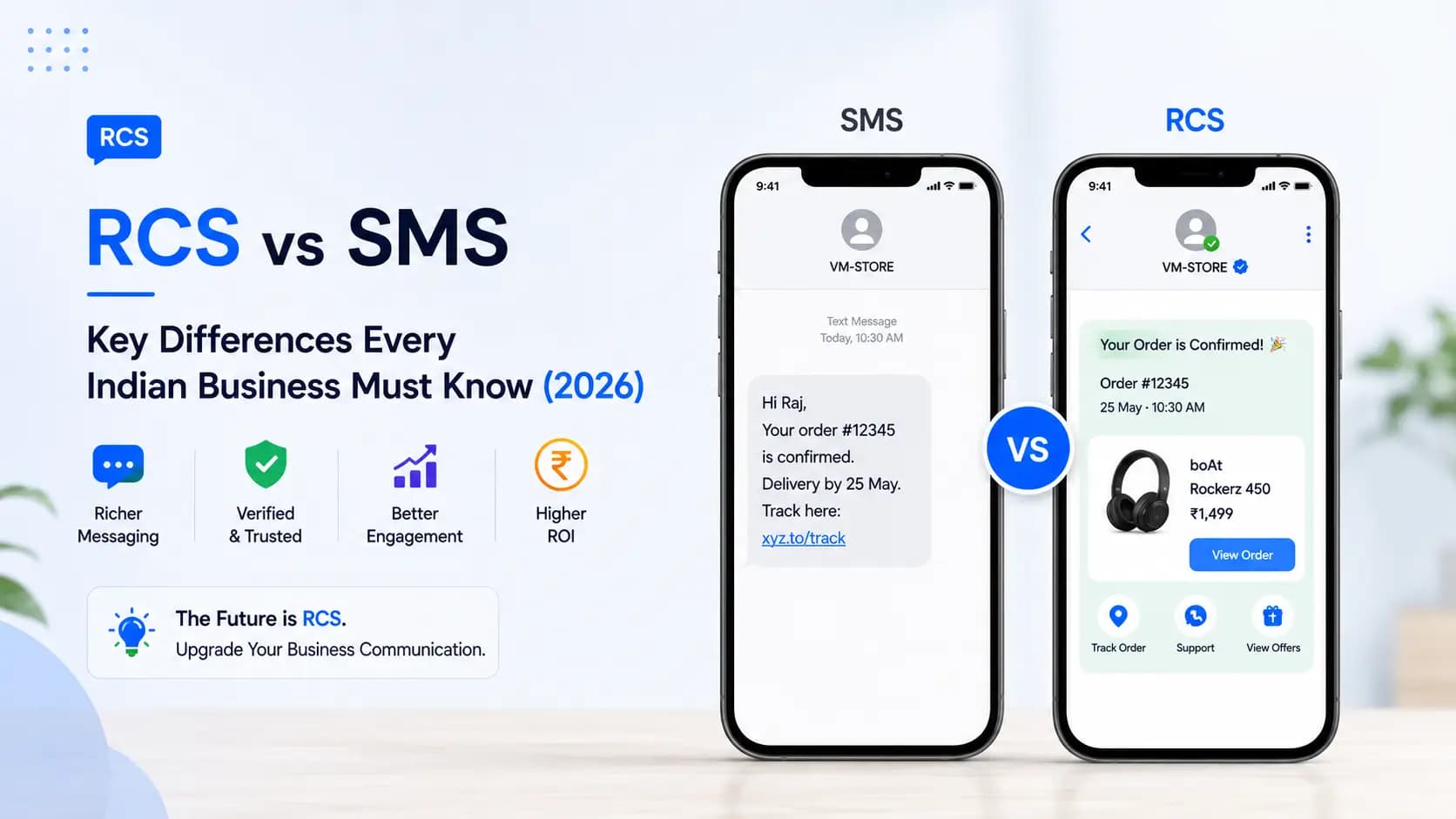
RCS supports high-resolution images, GIFs, video thumbnails, audio files, and document attachments- all delivered natively inside the message. A product launch campaign can show the product image, its price, and a 'Buy Now' button in a single message.
SMS is plain text only. No images, no formatting, no visual elements of any kind. Every message is rendered in the same font, the same size, the same colour as every other message. The only way to add visual context is to include a URL to an external page- which adds friction and reduces trust.
For industries where visuals drive conversion- retail, e-commerce, travel, real estate- this difference alone often makes the case for RCS.
2. Verified Sender Identity vs Anonymous Header
Every RCS message is sent with your brand's verified name, logo, and a verification badge- similar to the blue checkmark on social media. Google verifies the sender's identity before authorising RCS business messaging. Customers can trust that the message is genuinely from your brand.
SMS shows only a 6-character alphanumeric Sender ID- for example, 'GETCLK' or 'AMAZON'. There is no verification. Anyone can register a Sender ID that resembles a legitimate brand. This is why SMS phishing is rampant in India- the channel has no built-in identity trust mechanism. RCS removes this problem entirely with Google's verified sender process.
3. Interactive Buttons vs Text Links
RCS messages can include up to three interactive action buttons- Open URL, Call Now, View Location, and Quick Reply. The customer does not need to copy-paste a link or remember a number. The call-to-action is embedded directly in the message and works with a single tap.
SMS can only include text. Any call-to-action requires a URL link or phone number that the customer must manually open or dial. Shortened URLs (like bit.ly) are common in SMS but reduce trust- customers have become rightfully suspicious of short links in text messages, and for good reason.
4. No Character Limit vs 160-Character Constraint
RCS has no practical character limit for message text. You can write a full, descriptive message with context, offer details, and terms- without counting characters. Rich cards carry a headline, a subtitle, and body text across separate fields, each with its own display treatment.
A single SMS is limited to 160 characters (GSM 7-bit encoding) or 153 characters per part if the message is multipart. Longer messages are split into multiple parts and charged accordingly. Marketers routinely compromise on clarity and context to fit within this constraint- often cutting the information that would have driven the click.
5. Read Receipts and Interaction Tracking vs Delivery-Only Reporting
RCS provides business-level delivery and read receipts- you know when the message was delivered to the device, when the customer opened it, and what button they tapped. This data is actionable: retarget non-openers, send follow-ups based on specific button interactions, and optimise send times by actual read patterns.
SMS provides delivery reports- you know whether the message reached the carrier or the device. But you do not know if the customer actually read it or what they did next. There is no read receipt, no click tracking within the message itself, and no interaction data. Campaign optimisation based on SMS data alone is largely guesswork.
6. DND and Regulatory Rules in India
This is one of the most commercially significant differences between RCS and SMS for Indian businesses.
RCS Business Messaging in India is not currently classified as commercial SMS under TRAI's Telecom Commercial Communications Customer Preference Regulations. This means RCS messages are not subject to DND restrictions or the 9 AM – 9 PM sending window that applies to promotional SMS. You can send RCS messages at any time to any RCS-capable customer who has not explicitly opted out.
Under TRAI regulations, promotional SMS in India can only be sent between 9 AM and 9 PM, and only to customers who are not on the DND registry. Transactional SMS (OTPs, alerts) is exempt from DND, but all commercial SMS requires DLT registration. The DND constraint alone significantly reduces the addressable audience for many promotional SMS campaigns.
7. Pricing Model Comparison
RCS is typically priced on a per-message basis for A2P (application-to-person) single messages, or on a per-session basis for conversational flows. Per-message RCS pricing in India is broadly comparable to SMS pricing at moderate volumes- but the dramatically higher engagement rates mean a significantly lower cost per conversion. See our RCS pricing guide for a detailed breakdown.
Bulk SMS in India is priced on a per-message basis, typically ranging from ₹0.08 to ₹0.18 per SMS depending on volume, route, and provider. The raw cost per message can be slightly lower than RCS, but the lower click-through rates mean a higher cost per conversion for marketing campaigns.
8. Device and Network Reach
RCS reaches Android devices with Google Messages on Jio, Airtel, and Vi networks, plus iPhones on iOS 18 and above. Estimated reach: 350–450 million devices in India- roughly 45–55% of smartphone users. Does not work on 2G or 3G without data. Does not work on feature phones.
SMS reaches every mobile phone in India on every network- Jio, Airtel, Vi, BSNL, and all MVNOs. This includes 2G feature phones and the most basic handsets. Estimated reach: 1.1+ billion mobile connections. For pan-India campaigns including rural and low-connectivity audiences, SMS is unmatched in reach.
When to Use RCS vs SMS: A Practical Decision Guide
The choice between RCS and SMS is not about one replacing the other- it is about choosing the right tool for the specific job.
Use RCS when:
- You are running a promotional campaign with a visual offer- product images, sale banners, app promotions
- Your message has a clear call-to-action- a button that drives a specific conversion (buy, book, pay, download)
- Your audience is predominantly urban, smartphone-heavy, and on Jio or Airtel
- You want verified sender identity to build trust- particularly important for banking, insurance, and fintech
- You want to measure campaign engagement with read receipts and click tracking
- You are running a conversational campaign- booking confirmations, support flows, feedback collection
- You want to send carousels- multiple products, multiple options, or sequential story-style messaging
Use SMS when:
- You are sending OTPs- guaranteed delivery on all devices and networks is non-negotiable
- Your audience includes rural customers, feature phone users, or anyone with low-end devices
- You need to reach BSNL subscribers or users in low-data-coverage areas
- You are sending urgent alerts where simplicity and speed matter more than richness
- You need to reach DND-exempt numbers for transactional communication (account alerts, bank transactions)
- Your audience is on iOS 17 or below
Use both RCS + SMS together when:
- You want maximum campaign reach- RCS for smartphones, SMS fallback for everyone else
- You are running a national campaign targeting diverse geographies and demographics
- You want to deliver the best experience possible to each customer based on their device capability
- You are running a funnel- RCS for awareness and engagement, SMS for transactional follow-ups
Platform note: Get Click Media's platform supports both RCS and SMS from a single dashboard. You define one campaign- the platform automatically routes RCS to capable devices and SMS to everyone else. No manual segmentation required.
RCS vs SMS: What the Performance Data Shows
Businesses that have run parallel RCS and SMS campaigns- sending the same offer to comparable audience segments- consistently report significantly higher engagement from RCS.
| Metric | RCS | Bulk SMS |
|---|---|---|
| Average open rate | 70–80% | 95%+ |
| Average click-through rate | 15–35% | 1–5% |
| Average conversion rate (e-commerce) | 8–12% | 1–3% |
| Cost per click (relative) | Lower | Higher |
| Cost per conversion (relative) | Lower | Higher |
| Customer trust score | Higher | Lower |
A note on open rates: SMS shows a deceptively high open rate (95%+) because customers often open SMS messages out of habit- even spam. The 70–80% RCS open rate is more meaningful because it represents genuine attention to a message the customer recognises as coming from a verified sender.
The CTR gap is where the business case for RCS becomes undeniable. A 15–35% CTR versus 1–5% CTR means that for every 1,000 messages sent, an RCS campaign generates 150–350 clicks versus 10–50 from SMS. If the message content and offer are equivalent, the RCS campaign is delivering 3× to 7× more conversions from the same audience size.
How RCS and SMS Differ from WhatsApp Business API
RCS and SMS are sometimes compared directly with WhatsApp Business API- and the three channels are genuinely distinct in how they work and who they are best for.
WhatsApp is strongest for two-way conversational support and customer service flows. It requires the customer to have WhatsApp installed and to have opted in to receive messages from your business- which is a significant barrier for broad outbound campaigns.
RCS reaches customers through their native messaging app with no separate app install and no explicit opt-in required beyond standard telecom consent. For outbound promotional campaigns at scale, RCS has a structural reach advantage over WhatsApp in India. For deep two-way conversational support, WhatsApp has the richer toolset.
SMS remains the universal baseline- the channel that works for every customer on every device in every location.
The optimal strategy for most Indian businesses is to run all three channels from a unified platform, using each where it excels.
Can You Run RCS and SMS Together?
Yes- and the most sophisticated Indian businesses already do. Running both channels from a unified platform gives you the best of both worlds: the rich experience of RCS for capable devices, and the universal reach of SMS as a fallback.
Here is how it works on the Get Click Media platform:
- You upload your contact list- no pre-segmentation needed
- You build your RCS campaign- rich card, carousel, or message with buttons
- You define the SMS fallback version- shorter, plain text, with a URL
- You launch the campaign
- Our platform checks RCS capability for each number in real time and routes accordingly
- Your dashboard shows the RCS delivery count and the SMS fallback count separately
This approach ensures your entire audience receives your message, while the RCS-capable segment- typically 45–80% of urban audiences- receives the richer, more effective version.
For transactional flows (OTPs, payment alerts, order confirmations), the same logic applies: attempt RCS first, fall back to SMS automatically. The customer always gets the message. The business always gets the delivery data.
To run RCS and SMS campaigns from a single platform, request a demo from Get Click Media.
Get Click Media is one of India's leading RCS messaging service providers, with direct carrier integrations with Jio, Airtel, and Vi. Our unified platform handles RCS and bulk SMS from a single dashboard- with real-time capability detection, intelligent fallback, brand verification, and campaign analytics built in.
Article topics
Frequently Asked Questions
Is RCS better than SMS for Indian businesses?
RCS is better than SMS for rich, visual, interactive campaigns where click-through rate and conversion matter. SMS is better for guaranteed universal reach, OTPs on all devices, and audiences with limited internet connectivity. Most Indian businesses benefit most from running both channels together- RCS as the primary experience for capable devices, SMS as the fallback for everyone else.
Does RCS replace SMS completely?
No. RCS does not replace SMS- it complements it. SMS remains essential for use cases that require guaranteed delivery on all devices, including OTPs, emergency alerts, and communication to audiences with feature phones or 2G-only connectivity. RCS is best understood as an upgrade layer for the portion of your audience whose devices and networks support it.
Is RCS more expensive than SMS in India?
RCS and SMS are broadly comparable in per-message pricing at moderate volumes in India. However, because RCS campaigns generate significantly higher click-through rates and conversion rates, the cost per conversion from RCS is typically lower than from an equivalent SMS campaign. Businesses find that RCS delivers better ROI even if the per-message cost is similar or slightly higher.
Do I still need TRAI DLT registration if I am using RCS?
RCS Business Messaging is not currently classified under TRAI's commercial SMS regulations, so TRAI DLT registration is not required for RCS messages. However, you do need to complete Google's RCS brand verification process before sending. Get Click Media handles this verification as part of your onboarding. If you are also sending SMS campaigns, DLT registration remains mandatory for those.
Can I send RCS to customers on the DND registry?
RCS Business Messaging is not subject to the TRAI DND rules that restrict promotional SMS. This means you can send RCS messages at any time, including outside the 9 AM–9 PM window, and to customers on the DND registry- as long as they have not explicitly opted out of your communications. This is a significant regulatory advantage of RCS over promotional SMS in India.
What happens if a customer's phone does not support RCS?
Get Click Media's platform automatically detects whether each recipient's device can receive RCS before sending. If a device does not support RCS, the platform sends an SMS fallback version of your message automatically. You define both versions in a single campaign setup- no manual segmentation required.
How long does it take to start sending RCS messages in India?
The main step required before sending RCS is Google brand verification. This is a one-time process that typically takes 5 to 7 business days. Get Click Media handles the entire verification on your behalf as part of onboarding. Once verified, you can launch your first RCS campaign within the same business day.
About the author
Get Click Media creates practical resources for businesses using messaging, automation, analytics, and digital communication to improve customer engagement. This article was published on .