

In this article
Explore the key concepts, practical considerations, and frequently asked questions related to rcs vs whatsapp business api: which should you choose in 2026?.
Key takeaways
- RCS needs no app install or WhatsApp-specific opt-in, while reaching a customer on WhatsApp requires the app plus explicit marketing consent.
- RCS auto-falls back to SMS when delivery fails, but WhatsApp has no fallback mechanism- an undelivered WhatsApp message simply never arrives.
- RCS A2P messages run ₹0.10-0.25 each versus WhatsApp's ₹0.40-0.80 per 24-hour conversation session, though WhatsApp wins for high-volume two-way chat.
Two of the most powerful business messaging channels available in India today- RCS and WhatsApp Business API- are often discussed as rivals. But that framing misses the point.
RCS and WhatsApp are built on different technical foundations, serve different communication needs, reach different audience segments, and operate under different compliance frameworks. Choosing between them is not a matter of one being better- it is a matter of understanding which channel is better suited to each specific use case, and then deciding whether to use one, the other, or both together.
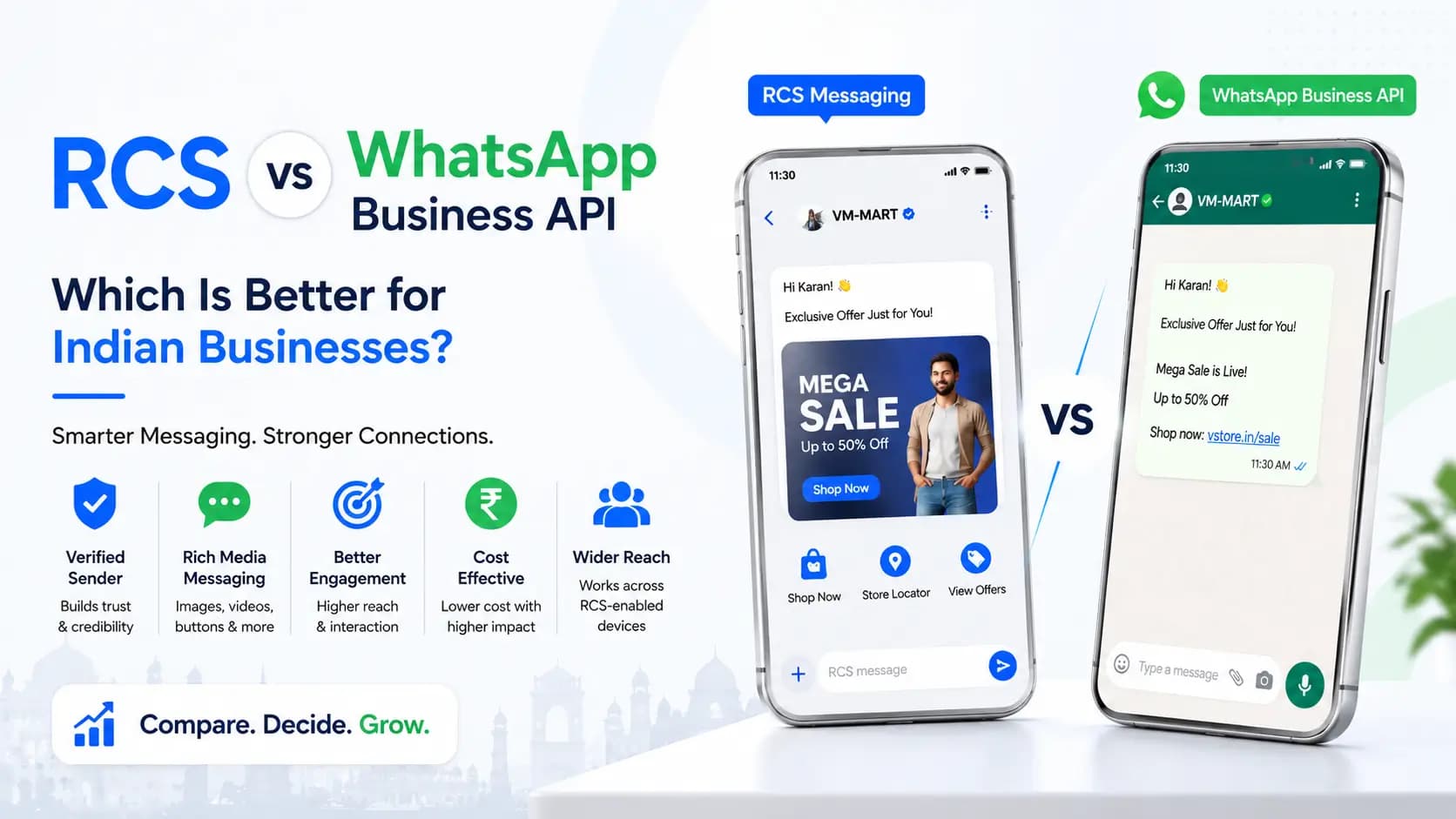
This guide gives you a complete, honest comparison of RCS and WhatsApp Business API for Indian businesses in 2026- across reach, cost, features, compliance, performance data, and use-case fit. By the end, you will have a clear framework for making the right channel decision for your campaigns. This page focuses on helping you decide which channel fits your business right now- for a full feature-by-feature comparison table, see the pillar page RCS vs WhatsApp Business API. See also: WhatsApp vs RCS, a companion comparison that leads with WhatsApp's side of the story.
Quick answer: Choose RCS if you need to reach a broad audience without an existing opt-in list- new customer acquisition, broad campaigns, or Android users who haven't installed WhatsApp. Choose WhatsApp Business API if your priority is two-way conversations, customer support, or deepening engagement with an already-opted-in base. Most established Indian businesses end up running both: RCS for outbound reach, WhatsApp for conversation- from a single platform like Get Click Media's.
RCS vs WhatsApp at a Glance
| Dimension | RCS | WhatsApp Business API |
|---|---|---|
| Full form / type | Rich Communication Services- carrier-based | Meta-owned OTT messaging app |
| App required | No- uses default messaging app | Yes- WhatsApp must be installed |
| India device reach | 350–450M Android + iOS 18+ users | ~500M active WhatsApp users |
| Opt-in requirement | Standard marketing consent | Explicit WhatsApp opt-in required |
| Verified sender | Yes- Google-verified brand + logo | Yes- Meta-verified green tick |
| Rich media | Images, carousels, buttons, video thumbnails | Images, carousels, buttons, documents |
| Two-way messaging | Yes- chatbot or agent reply supported | Yes- core WhatsApp strength |
| Read receipts | Yes | Yes |
| Works without internet | No- needs data; SMS fallback available | No- needs internet; no fallback |
| DND rules India | Not regulated as commercial SMS | Not regulated as commercial SMS |
| Per-message cost | ₹0.10–0.25 per A2P message | ₹0.40–0.80 per 24-hr conversation |
| Template approval | Google review (1–3 days) | Meta review (1–3 days) |
| Fallback on fail | Auto SMS fallback | No fallback- message not delivered |
| Best for | Outbound campaigns, broad reach | Conversations, support, community |
Understanding RCS and WhatsApp: Two Different Architectures
What is RCS?
RCS (Rich Communication Services) is a carrier-level messaging protocol- it runs on the same network infrastructure as SMS, upgraded to support rich content. Messages are delivered through the telecom operator's RCS gateway (Jio, Airtel, Vi) into the recipient's default messaging app- Google Messages on Android, or the native Messages app on iOS 18+. No separate app is required.
From the business side, RCS is accessed through an RCS Business Messaging (RBM) platform like Get Click Media, with Google verifying brand identity before messages can be sent.
What is WhatsApp Business API?
WhatsApp Business API is Meta's enterprise messaging product, built on top of the WhatsApp consumer app. Unlike the free WhatsApp Business App (designed for small businesses managing conversations manually), the API is for large-scale automated messaging- campaigns, OTPs, booking confirmations, chatbots- integrated with CRM and marketing systems.
To receive WhatsApp Business messages, the customer must have WhatsApp installed. To send marketing messages, the business must have an explicit opt-in from the customer for WhatsApp communication specifically. Businesses access the API through a Meta-authorised Business Solution Provider (BSP)- Get Click Media is an official Meta BSP in India.
Key structural difference: RCS is carrier-based- it works like a next-generation SMS. WhatsApp is app-based- it works like a branded chat experience. This one difference drives most of the other distinctions between the two channels.
RCS vs WhatsApp: 8 Head-to-Head Rounds
Round 1: Audience Reach in India
| RCS | WhatsApp Business API | |
|---|---|---|
| Reach | Reaches all Android devices with Google Messages + iOS 18+ iPhones. Estimated 350–450M users. Does not require any app or sign-up. | Reaches ~500M active WhatsApp users in India. Marketing messages require explicit WhatsApp opt-in- your reachable opted-in list may be far smaller. |
Verdict: Depends on your opt-in database. Raw reach is comparable. WhatsApp's 500M user base is larger on paper, but RCS reaches anyone on a capable device without an opt-in database. For businesses with large opt-in WhatsApp lists, WhatsApp wins on reach. For businesses without an established WhatsApp list, RCS wins.
Round 2: App Installation Requirement- RCS wins
RCS has no app requirement. It works in the default messaging app on Android and iOS 18+. Zero friction for the customer- they just receive the message.
WhatsApp must be installed and active on the customer's phone. In India, approximately 80% of smartphone users have WhatsApp, but the remaining 20%- largely older demographics, rural users, and budget device users- cannot be reached.
Verdict: RCS wins on accessibility. It eliminates the app-install barrier entirely. For campaigns targeting the broadest possible audience, RCS is structurally advantaged.
Round 3: Opt-In Requirements- RCS wins
RCS requires standard marketing consent- the same consent you already collect for SMS or email. No WhatsApp-specific opt-in needed.
WhatsApp requires explicit WhatsApp opt-in for marketing messages. Customers must agree to receive messages specifically on WhatsApp. Sending without opt-in risks account suspension by Meta.
Verdict: RCS wins for businesses that do not yet have a large WhatsApp opt-in database. If you already have a strong WhatsApp opt-in list, this distinction matters less.
Round 4: Rich Media and Message Formats- Tie
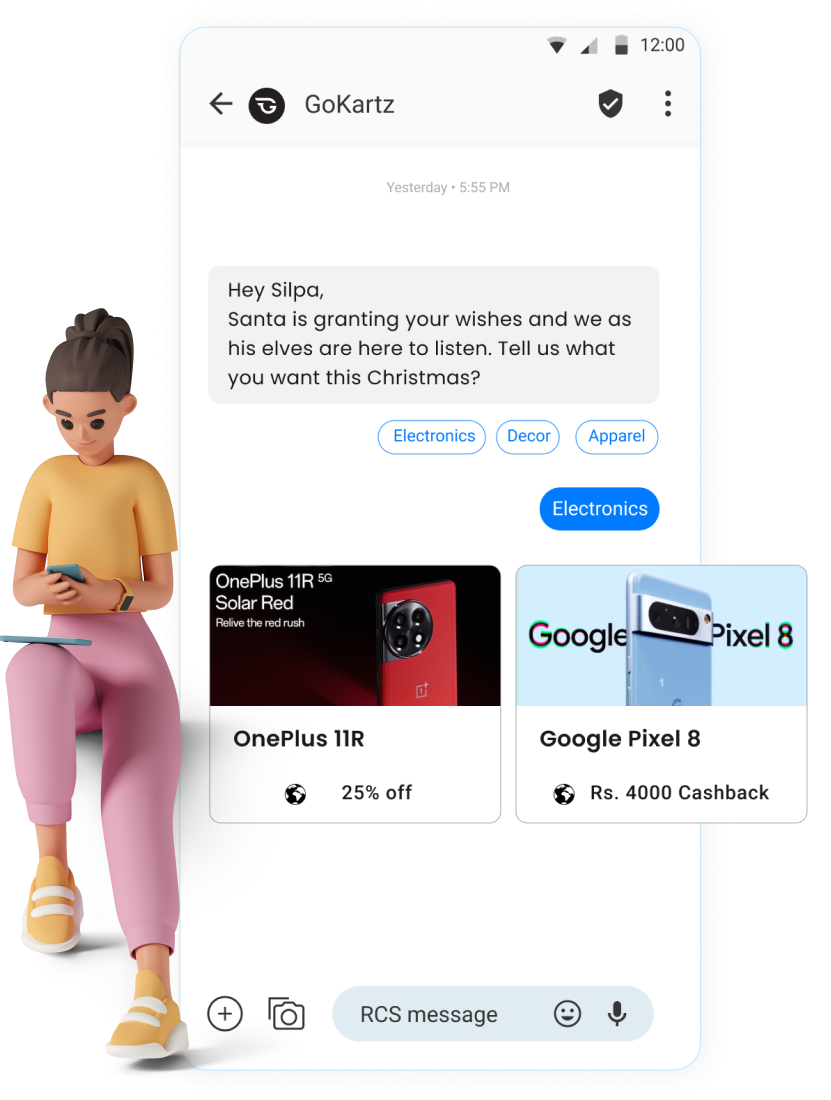
Both channels support the full range of rich content that modern campaigns require. RCS offers rich cards, carousels (up to 10 cards), images, GIF, video thumbnails, audio, documents, location sharing, and action buttons (URL, call, map, quick reply) with up to 3 buttons per message.
WhatsApp supports images, carousels, video, audio, documents, location sharing, quick-reply buttons, call-to-action buttons, product catalogues, and payment buttons (India). WhatsApp has a slight edge in payment integration via WhatsApp Pay- relevant for e-commerce and fintech in India.
Verdict: Effectively a tie for most use cases. WhatsApp's payment button integration is a meaningful edge for transaction-driven flows.
Round 5: Two-Way Conversation Capability- WhatsApp wins
RCS supports two-way messaging- customers can reply via quick-reply buttons or free text, and chatbot flows work. However, RCS is primarily architected for outbound campaigns, and its two-way tooling is less mature than WhatsApp's.
WhatsApp was built as a conversation platform. Two-way messaging is its core strength. The WhatsApp Business API has a mature ecosystem of chatbot builders, live agent tools, CRM integrations, and conversation management platforms.
Verdict: WhatsApp wins decisively for conversational use cases. If your primary need is two-way customer conversations, live chat, or complex chatbot flows, WhatsApp's tooling is significantly more mature.
Round 6: Pricing- RCS wins for outbound
RCS A2P messages cost ₹0.10–0.25 per message. No per-conversation session fee for single outbound messages. Cost scales linearly with message volume.
WhatsApp Business API charges ₹0.40–0.80 per 24-hour conversation session for business-initiated messages. More cost-effective for high-volume two-way conversations, but more expensive for single outbound notifications. See our RCS messaging cost guide for a full ROI breakdown.
Verdict: RCS wins for outbound notification and campaign use cases. WhatsApp can be more cost-effective for high-volume conversational flows where multiple message exchanges are covered by a single session fee.
Round 7: Delivery Reliability and Fallback- RCS wins
RCS auto-detects capability. It falls back to SMS automatically for non-capable devices. Guaranteed delivery via SMS regardless of RCS support- total reach is effectively 100% of mobile users.
WhatsApp has no fallback mechanism. If WhatsApp is not installed, or if the customer is offline, the message is not delivered. Businesses must separately trigger an SMS if WhatsApp delivery fails.
Verdict: RCS wins decisively on delivery reliability. The automatic SMS fallback means your message always reaches the customer. WhatsApp's lack of fallback is a genuine risk for time-sensitive communications.
Round 8: Brand Verification and Trust- Tie
Every RCS message shows your Google-verified brand name, logo, and a verification indicator. Google's verification process is rigorous- which builds trust in the verified sender signal.
WhatsApp's Meta-verified green tick on your WhatsApp Business profile is widely recognised in India- many consumers associate it with a legitimate, trusted brand.
Verdict: Tie. Both channels offer strong, recognisable brand verification. WhatsApp's green tick has higher consumer brand recognition in India currently, but RCS's Google verification is equally authoritative.
RCS vs WhatsApp: Which Channel for Each Use Case?
Use this table as a quick reference when deciding which channel to use for a specific business communication need:
| Use case | Best channel | Why |
|---|---|---|
| Flash sale campaign (broad reach) | RCS | No opt-in barrier; reaches all capable devices; carousel format ideal |
| OTP / authentication | SMS | SMS fallback ensures 100% delivery on all devices and networks |
| Order confirmation & tracking | RCS | Rich card with map button; verified sender builds trust; auto-fallback |
| Customer support / live chat | WhatsApp's two-way tooling is more mature; customers expect chat on WA | |
| Abandoned cart recovery | RCS | Product image carousel with Buy Now button; no app install needed |
| Appointment reminder with reschedule | Both | RCS for initial reminder + button; WA for conversational reschedule |
| Payment reminder (bank/fintech) | RCS | Verified sender critical; Pay Now button; no DND restriction |
| Post-purchase review request | Higher trust for personal-feel messages; quick-reply star rating | |
| Product launch to new audience | RCS | Reaches audience without existing opt-in; rich visual card |
| Loyalty programme updates | Existing customers, relationship-depth comms; community feel | |
| Lead qualification chatbot | Mature chatbot ecosystem; customers comfortable chatting on WA | |
| Festive campaign to mass audience | RCS | Carousel format; no opt-in friction; broad reach on Jio/Airtel |
| Insurance renewal reminder | RCS | Policy card with premium details + Renew Now CTA; verified sender |
RCS vs WhatsApp by Industry: What Works Best in India
Banking and Financial Services
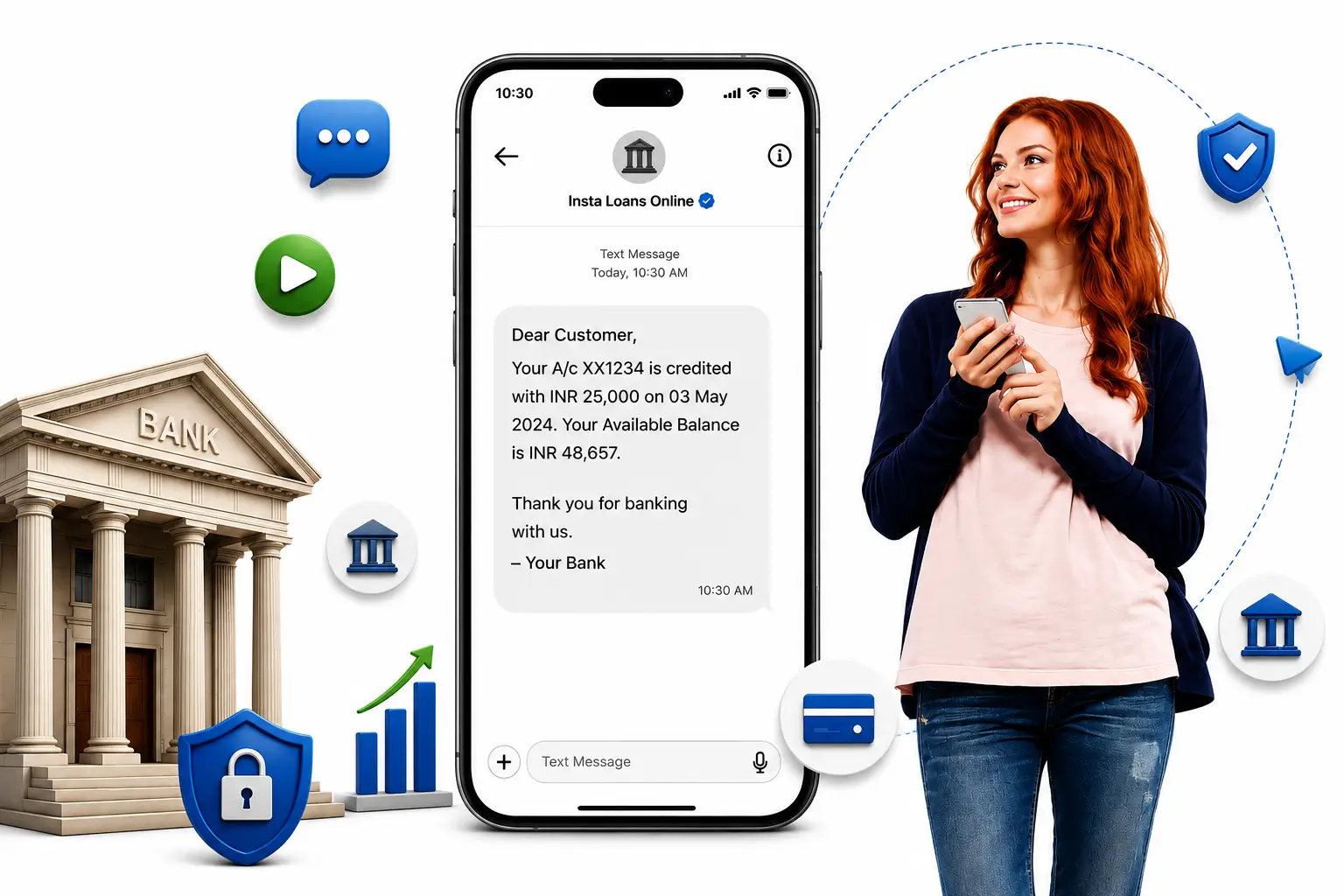
RCS is the stronger channel for outbound banking communications- credit card offers, loan pre-approvals, payment reminders, and account alerts. The verified sender identity is critical in banking, where customers are acutely aware of SMS phishing. RCS's non-DND status is also valuable for payment reminders that need to reach customers at any time.
WhatsApp is better for banking customer support- balance enquiries, dispute resolution, account queries- where a two-way conversational interface is more appropriate than a rich card. Several Indian banks run both: RCS for outbound campaigns, WhatsApp for support.
E-Commerce and Retail
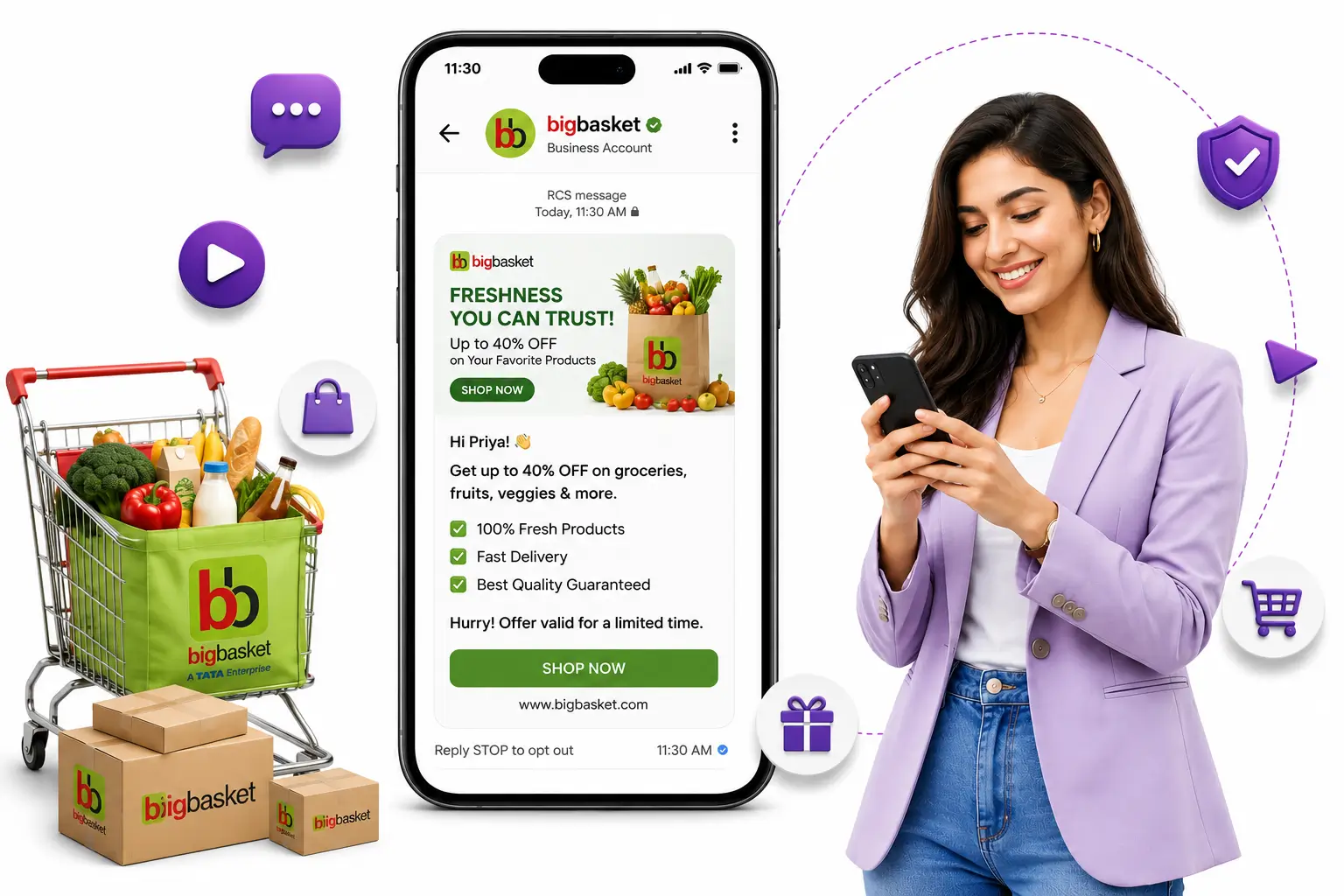
E-commerce is RCS's strongest use case. Flash sale carousels, abandoned cart messages with product images, and delivery tracking updates with map buttons are all better suited to RCS than WhatsApp- primarily because RCS reaches customers without requiring a WhatsApp opt-in, which is a significant barrier for new customers.
WhatsApp is better for post-purchase relationship management- order feedback, loyalty programme communication, and customer support- where the conversational intimacy of WhatsApp is an asset.
Education and Edtech
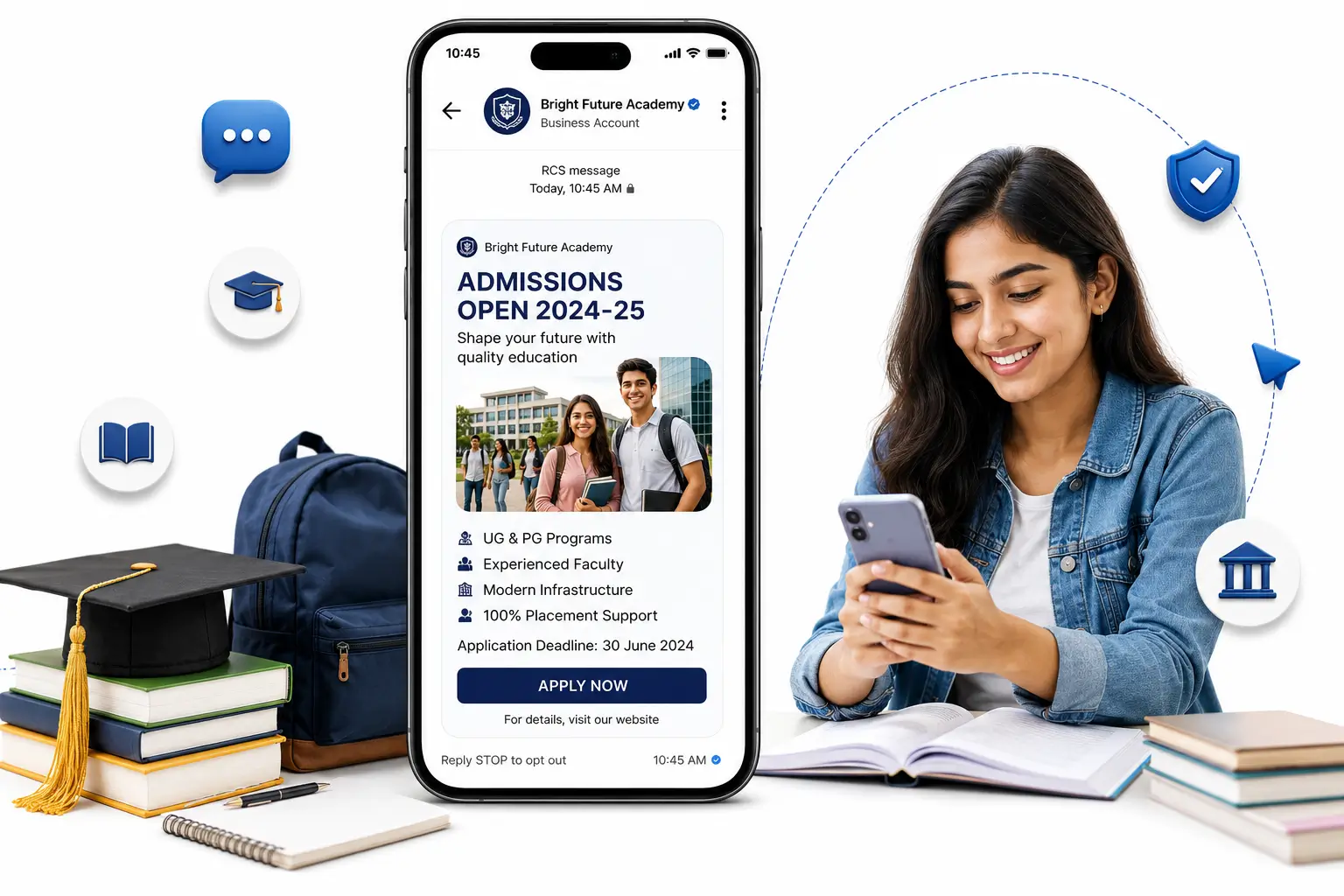
Edtech platforms in India often have strong WhatsApp opt-in lists built through their app onboarding flows. For these platforms, WhatsApp is the primary engagement channel- course updates, class reminders, and mentor communications all work well on WhatsApp.
RCS is better for top-of-funnel edtech communication- reaching prospective students who have not yet opted into the platform's WhatsApp channel. Admission enquiry follow-ups and course recommendation carousels targeting a broad audience are natural RCS use cases.
Healthcare
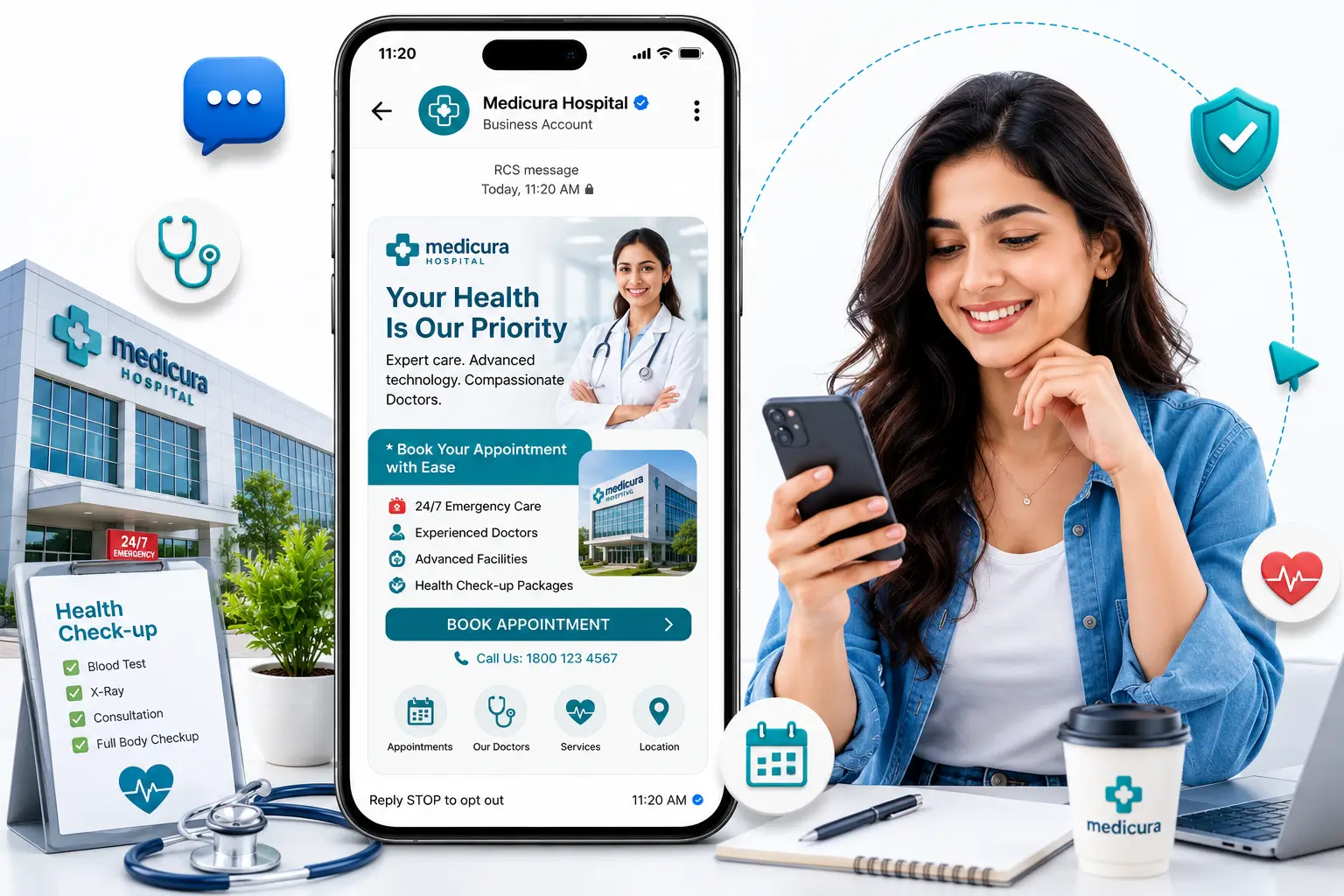
Healthcare communication in India has a sensitivity dimension- patients often prefer WhatsApp for anything that feels personal (lab results, prescription follow-ups, doctor communications) because the app-based interface feels more private.
RCS is better for healthcare mass communication- appointment reminders, health tip campaigns, vaccination drives, and insurance renewals- where a verified, professional sender identity and a structured action button (Confirm Appointment) are more important than conversational intimacy.
Real Estate
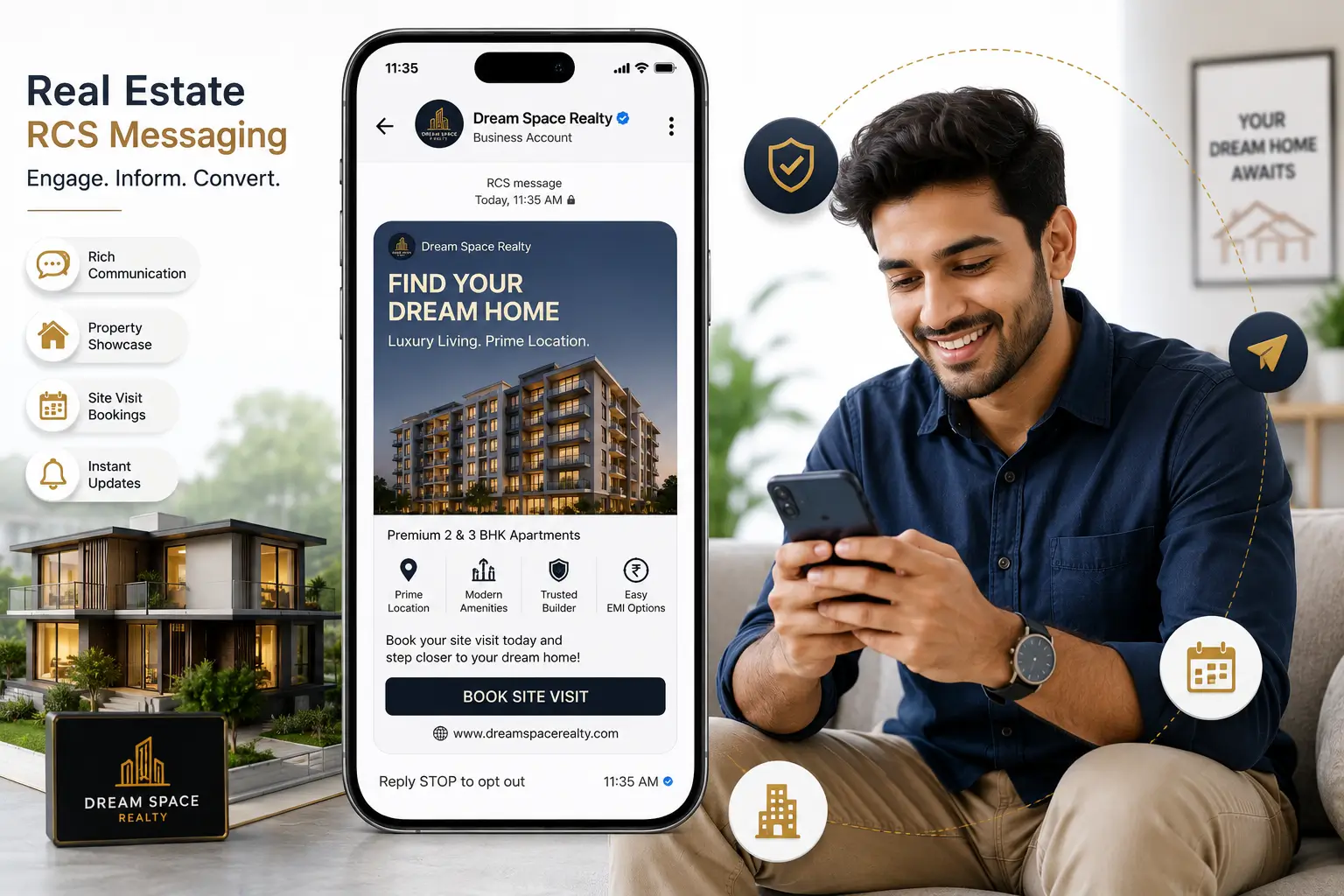
Real estate works well with RCS for property launch campaigns- rich cards with property images, location maps, and 'Book Site Visit' buttons reaching a broad audience. For follow-up conversations after a site visit enquiry, WhatsApp is typically more effective- buyers expect a personal back-and-forth, not a broadcast message.
The Optimal Strategy: Running RCS and WhatsApp Together
The businesses getting the best results from messaging in India are not choosing between RCS and WhatsApp- they are running both from a unified platform, using each channel for the jobs it does best.
A typical omnichannel messaging flow for an Indian e-commerce business looks like this:
| Stage | Channel | Message type | Why this channel |
|---|---|---|---|
| 1. New customer acquisition | RCS | Flash sale carousel with Buy Now button | No opt-in needed; reaches all Android users; rich visual drives impulse purchase |
| 2. Order confirmation | RCS | Rich card with order summary + track button | Verified sender builds trust; map link for delivery address; auto-SMS fallback |
| 3. Delivery update | RCS | Status update with live map | Real-time tracking button; works even if customer has no WhatsApp |
| 4. Post-delivery | Review request + loyalty points update | Conversational; personal feel; customer already engaged via app | |
| 5. Support query | Live chat / chatbot | WhatsApp's two-way tooling handles queries naturally | |
| 6. Re-engagement | RCS | Personalised offer carousel | Reaches even lapsed customers who may have muted WhatsApp |
This omnichannel approach maximises both reach and depth. RCS handles the broad, visual, outbound moments. WhatsApp handles the intimate, conversational, relationship-depth moments. The customer gets the right experience on the right channel at the right time.
Get Click Media supports both RCS and WhatsApp Business API from a single platform- one dashboard, one API, one analytics view. You can manage both channels without duplicating your tech stack, your team's workflow, or your contact lists.
Platform note: Get Click Media is both a Google-authorised RCS provider and an official Meta Business Solution Provider for WhatsApp Business API. To set up your omnichannel messaging stack, request a demo.
Compliance: RCS vs WhatsApp Business API in India
Both RCS and WhatsApp Business API operate outside TRAI's DLT framework that governs commercial SMS in India. Neither requires DLT entity registration, Sender ID registration, or template pre-approval with TRAI. However, both have their own compliance requirements:
RCS compliance requirements
- Google brand verification- one-time process before sending is permitted
- Message template review- templates submitted for Google review; approval typically 1–3 business days
- Marketing consent- standard opt-in consent required (same as email marketing)
- Opt-out handling- customers must be able to opt out; opt-outs must be honoured
- No DND restriction- RCS is not classified as commercial SMS under TRAI regulations
- No sending hour restriction- unlike promotional SMS (9 AM–9 PM only), RCS has no time restriction
WhatsApp Business API compliance requirements
- Meta Business Verification- your business must be verified with Meta
- WhatsApp Business Account (WABA) approval- your account must be approved by Meta
- Message template approval- all outbound templates must be approved by Meta before use
- Explicit WhatsApp opt-in- customers must specifically consent to receive messages on WhatsApp
- Opt-out handling- violations risk account suspension
- Quality rating monitoring- Meta tracks customer complaint rates; poor quality ratings can restrict sending
Key compliance difference: WhatsApp requires explicit WhatsApp-specific opt-in. RCS requires standard marketing consent. For businesses building a new messaging audience, RCS's lighter opt-in requirement is a meaningful advantage.
To understand more about RCS coverage in India and which networks your audience is on, see our dedicated network guide. For a full breakdown of RCS vs SMS, see our dedicated comparison. And for pricing details, see the RCS messaging cost India guide.
Article topics
Frequently Asked Questions
Is RCS better than WhatsApp for Indian businesses?
Neither is universally better- they serve different purposes. RCS is better for broad outbound campaigns to mass audiences, especially where no WhatsApp opt-in exists. WhatsApp is better for two-way conversations, customer support, and relationship-depth communication. Most Indian businesses benefit from using both channels together, with RCS for outbound campaigns and WhatsApp for conversations.
Can I reach WhatsApp users with RCS?
RCS and WhatsApp are separate channels. Sending an RCS message does not reach the customer via WhatsApp- it is delivered to their native messaging app (Google Messages on Android, or Messages on iOS 18+). However, most Indian smartphone users have both WhatsApp and a capable RCS messaging app, so you can reach the same person on either channel depending on your use case.
Is RCS cheaper than WhatsApp Business API?
For outbound single notifications, yes- RCS A2P messages typically cost ₹0.10–0.25 per message, compared to ₹0.40–0.80 per 24-hour WhatsApp conversation session. For high-volume two-way conversations where multiple messages are exchanged in one session, WhatsApp can be more cost-effective. The right comparison depends on your use case.
Do customers need WhatsApp for RCS?
No. RCS does not require WhatsApp or any other app. It is delivered to the default messaging app on the customer's device- Google Messages on Android, or the native Messages app on iOS 18+. This is one of RCS's key advantages over WhatsApp for businesses trying to reach customers who may not have WhatsApp or who are not on your WhatsApp opt-in list.
What happens if I send an RCS message and the customer does not have RCS?
Get Click Media's platform automatically detects whether each recipient can receive RCS. If not- because their device, operating system, or network does not support RCS- the platform sends an SMS fallback version of your message automatically. Your message always gets through. WhatsApp has no equivalent fallback mechanism.
Can I use both RCS and WhatsApp at the same time?
Yes. Running both channels from a single platform is the approach used by India's most sophisticated business messaging operations. Get Click Media supports both RCS and WhatsApp Business API from a single dashboard. You can manage both channels, both contact lists, both campaign analytics, and both template libraries in one place- without duplicating your infrastructure.
Is WhatsApp more trusted than RCS in India?
WhatsApp has higher consumer brand recognition in India currently- the green tick is widely understood as a trust signal. However, RCS's Google-verified sender identity is equally rigorous in terms of actual verification. As RCS adoption grows in India, consumer familiarity with the verified RCS sender indicator will increase. For now, WhatsApp has a brand trust advantage with consumers, while RCS has a reach and compliance advantage.
Do I need separate teams to manage RCS and WhatsApp?
Not if you use a unified platform. Get Click Media's platform manages both RCS and WhatsApp from a single dashboard- the same team can run campaigns, manage templates, view analytics, and handle opt-outs for both channels in one interface. The campaigns, content formats, and analytics are different, but the operational overhead is not duplicated.
How do I decide between RCS and WhatsApp if I can only launch one channel first in 2026?
Start with whichever channel matches your biggest immediate gap. If you already have a large opted-in WhatsApp list and your priority is deeper conversational engagement or support, launch WhatsApp first. If you need to reach a broad audience that has not opted into WhatsApp- new customer acquisition, re-engaging lapsed contacts, or reaching Android users outside your existing list- launch RCS first. Most Get Click Media clients who start with one channel add the second within 3 to 6 months once the first is generating results.
About the author
Get Click Media creates practical resources for businesses using messaging, automation, analytics, and digital communication to improve customer engagement. This article was published on and was last reviewed on .