

In this article
Explore the key concepts, practical considerations, and frequently asked questions related to how indian banks are using rcs for fraud alerts and emi reminders.
Key takeaways
- A typical RCS fraud alert shows the transaction amount, merchant, and time with two buttons- confirm it was genuine or dispute it- resolved in one tap.
- An EMI reminder's Pay Now button links directly into a payment flow, removing the extra taps and redirects that cause missed or delayed payments.
- There is no regulatory mandate pushing banks toward RCS; adoption is driven purely by verified branding, richer formatting, and one-tap fraud confirmation.
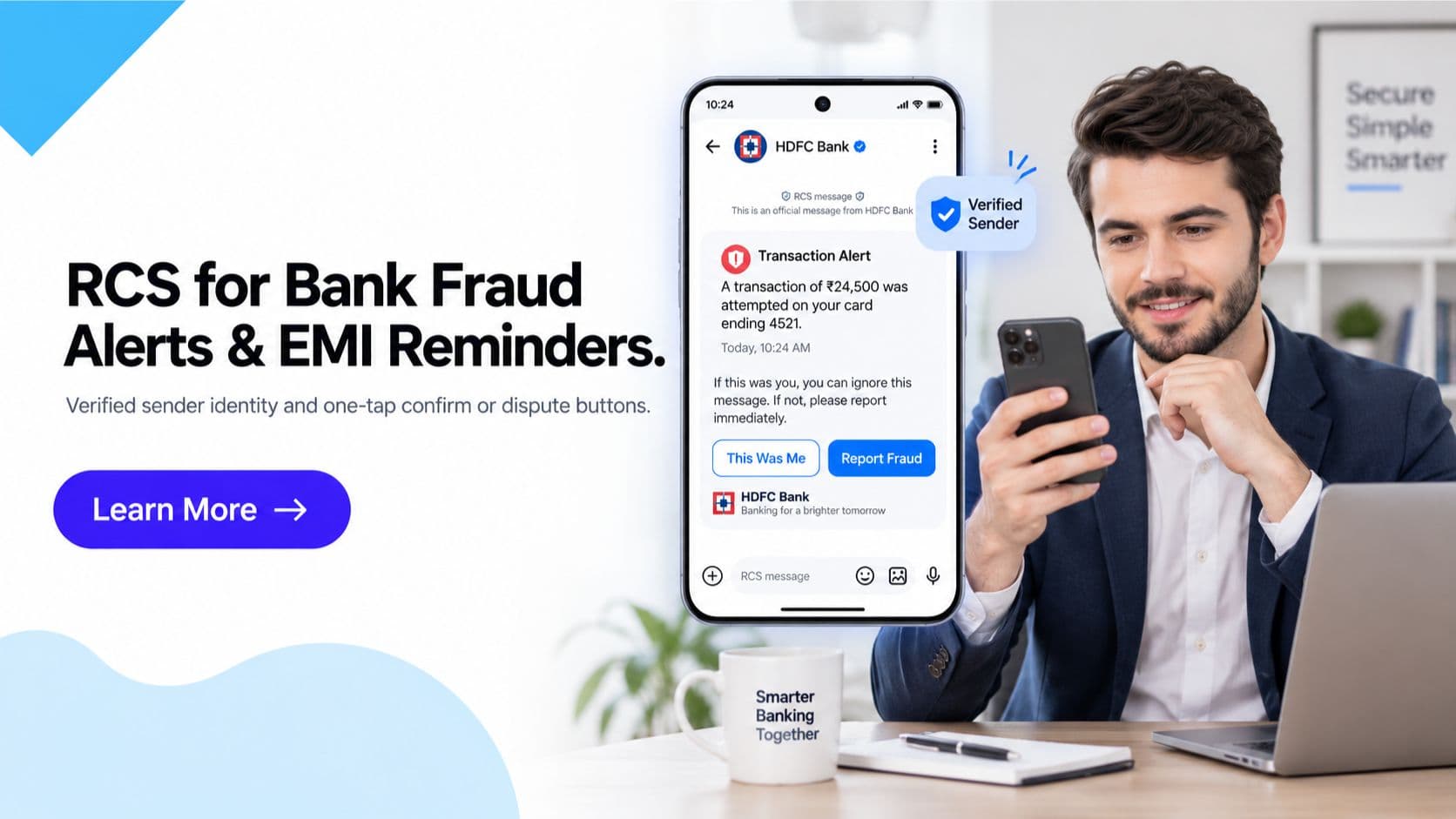
A growing number of Indian banks and NBFCs are moving fraud alerts and EMI reminders onto RCS, and the reason is consistent across institutions: a Google-verified sender identity is harder to phish than an anonymous SMS sender ID, and rich formatting turns a bare text notification into a message with clear, tappable actions- "This wasn't me," "Confirm it was me," "Pay Now"- instead of a string of text the customer has to interpret and act on manually.
This is a real, increasingly common pattern across Indian BFSI messaging, not a hypothetical. It builds on the campaign patterns covered in our RCS campaign examples guide, which already highlights verified payment reminders and one-tap fraud confirmation as two of the strongest-performing RCS use cases. This guide looks specifically at how banks and NBFCs structure these two flows and why verified branding carries extra weight in financial services.
Note on specifics: This guide describes a common pattern used across the Indian banking and NBFC sector generally. It does not name or describe the practices of any specific bank, and it does not cite a specific fraud-reduction percentage or adoption statistic- those numbers vary by institution and are not something we fabricate here.
Why Banks and NBFCs Are Adopting RCS
Three factors specifically make RCS a good fit for fraud alerts and EMI reminders in banking:
- Google-verified sender identity reduces impersonation risk. Plain SMS sender IDs are a short alphanumeric string with no verification tied to them, and fraudulent lookalike sender IDs are a well-known problem in India- a message that looks like it's from a bank often isn't. RCS displays a Google-verified brand name and logo before the customer even opens the message, which raises the bar for anyone trying to impersonate the bank.
- Rich formatting turns alerts into clear actions. A fraud alert sent as plain SMS text forces the customer to read, interpret, and then separately decide what to do- call a number, reply with a code, or ignore it. An RCS rich card can present the same information with explicit "This wasn't me" and "Confirm it was me" buttons, converting a judgment call into a one-tap decision.
- EMI reminders benefit from a direct Pay Now flow. Rather than routing a customer through a text link that opens a browser and requires further navigation, a "Pay Now" button on an RCS card can link straight into a payment flow, cutting steps out of the process at exactly the moment friction is most likely to cause a missed or delayed payment.
Fraud Alert Use Case Walkthrough
A typical RCS fraud alert flow follows a consistent sequence:
- Transaction detected. The bank's fraud detection system flags a transaction as unusual, based on its existing risk rules.
- RCS alert sent with transaction details and two action buttons. The customer receives a verified RCS message showing the transaction amount, merchant, and time, with two clear buttons- one confirming the transaction was genuine, one disputing it.
- Customer taps to confirm or dispute. Instead of calling a helpline or replying to an SMS with a specific keyword, the customer resolves the alert with a single tap.
- Response routes to the appropriate next step. A confirmation closes the alert. A dispute routes into the bank's fraud handling process- for example, triggering a card freeze or connecting the customer to a fraud specialist- the same downstream process the bank already runs, just reached faster and with less friction than a phone call.
The core benefit here isn't a new fraud process- it's a faster, clearer entry point into the fraud response the bank already has, at the exact moment a customer's decision matters most.
EMI Reminder Use Case Walkthrough
The EMI reminder flow follows a similarly direct structure:
- Due date approaching. The lender's system identifies an upcoming EMI due date for a loan or credit account.
- RCS reminder sent with amount, due date, and a Pay Now button. The customer receives a verified card showing exactly what's due and when, with a button that opens directly into a payment flow.
- Optional automatic follow-up if unpaid after the due date. Some lenders configure a second RCS message- often with a slightly different tone or an added note about any applicable late fee- if the EMI remains unpaid past the due date, without requiring manual follow-up from a collections team for routine cases.
Removing the extra steps between "reminder received" and "payment made" is the whole point- every additional tap or redirect between the two is a point where a customer might get distracted and forget to complete the payment.
Why Verified Branding Matters More in BFSI
Verified sender identity is valuable across every industry that uses RCS, but it carries more practical weight in banking and financial services specifically, for one straightforward reason: the downside of a successful impersonation is categorically worse. A fraudulent message impersonating a retail brand might lead to an unwanted click; a fraudulent message impersonating a bank can lead directly to a customer handing over credentials or authorising a payment to a scammer.
Because financial fraud and impersonation sit at the top of the trust-risk hierarchy for BFSI customers, a Google-verified sender badge does more real work in this sector than it does for a lower-stakes promotional message elsewhere. It's a big part of why fraud alerts and payment-related notifications are consistently among the strongest RCS use cases in Indian banking, alongside the verified payment reminder and fraud-confirmation patterns already covered in our RCS campaign examples guide.
To see how RCS fits into a bank's broader messaging strategy, see our dedicated pages on RCS for banking and RCS payment reminders. For the technical building blocks behind these flows- rich cards, action buttons, and verified sender setup- see the RCS Business Messaging features guide.
Considering RCS for your bank or NBFC's fraud alerts and EMI reminders? Request a free RCS demo from Get Click Media →
Frequently Asked Questions
Why are Indian banks using RCS for fraud alerts? RCS gives banks a Google-verified sender identity- a confirmed brand name and logo displayed before the customer even opens the message- which is much harder for a fraudster to imitate than a generic SMS sender ID. Fraud alerts also benefit from RCS's rich formatting, since a suspicious-transaction message can include clear action buttons like "This wasn't me" or "Confirm it was me" instead of asking the customer to call a number or reply with a code.
How does an RCS fraud alert work in practice? A typical flow starts when a bank's fraud detection system flags a transaction. An RCS alert is sent with the transaction details- amount, merchant, time- along with two action buttons, one to confirm the transaction was genuine and one to dispute it. The customer taps the relevant button, and that response routes automatically to the appropriate next step, such as closing the alert or escalating to the bank's fraud team.
How does an RCS EMI reminder work? As an EMI due date approaches, the bank or NBFC sends an RCS reminder showing the amount due and the due date, along with a "Pay Now" button that links directly into a payment flow, rather than a text link the customer has to tap and then navigate through separately. Some lenders configure an optional automatic follow-up message if the EMI remains unpaid after the due date.
Is RCS better than SMS for banking notifications? RCS has structural advantages for banking notifications specifically- a verified sender badge, richer formatting, and tappable action buttons instead of bare text. SMS remains valuable as a universal fallback, since it reaches devices and networks where RCS isn't supported. Most banks and NBFCs use RCS as the primary channel for these notifications with automatic SMS fallback, rather than replacing SMS outright.
Why does verified sender identity matter more for banks than other industries? Financial fraud and sender impersonation are a bigger trust risk category in banking than in most other industries- a fraudulent message impersonating a bank can lead directly to a customer losing money, not just clicking an unwanted ad. Because of that heightened stakes, a Google-verified sender badge carries more practical weight in BFSI communication than it does for, say, a retail promotional message.
Do RCS fraud alerts replace a bank's fraud call centre? No. RCS fraud alerts are a faster first layer for routine confirm-or-dispute decisions, not a replacement for a bank's broader fraud response infrastructure. A dispute tapped on an RCS alert still routes into the bank's existing fraud handling process- the RCS message simply gives the customer a faster, clearer way to flag the issue than a phone call or a plain SMS with a callback number.
What happens if a bank customer's device doesn't support RCS? The message automatically falls back to SMS for devices or networks that don't support RCS, so fraud alerts and EMI reminders still reach the customer either way. The rich formatting and action buttons are specific to RCS, so the SMS fallback version is typically a concise text message with the key details and a link or callback number for the same action.
Are Indian banks required to use RCS for these notifications? No, there is no regulatory requirement to use RCS specifically. Adoption is being driven by the practical benefits- verified branding, richer formatting, and one-tap actions- rather than by any mandate. RCS operates outside the SMS-specific DLT/DND framework, but banks still need to meet their usual compliance and customer-consent obligations regardless of channel.
Article topics
Frequently Asked Questions
Why are Indian banks using RCS for fraud alerts?
RCS gives banks a Google-verified sender identity- a confirmed brand name and logo displayed before the customer even opens the message- which is much harder for a fraudster to imitate than a generic SMS sender ID. Fraud alerts also benefit from RCS's rich formatting, since a suspicious-transaction message can include clear action buttons like 'This wasn't me' or 'Confirm it was me' instead of asking the customer to call a number or reply with a code.
How does an RCS fraud alert work in practice?
A typical flow starts when a bank's fraud detection system flags a transaction. An RCS alert is sent with the transaction details- amount, merchant, time- along with two action buttons, one to confirm the transaction was genuine and one to dispute it. The customer taps the relevant button, and that response routes automatically to the appropriate next step, such as closing the alert or escalating to the bank's fraud team.
How does an RCS EMI reminder work?
As an EMI due date approaches, the bank or NBFC sends an RCS reminder showing the amount due and the due date, along with a 'Pay Now' button that links directly into a payment flow, rather than a text link the customer has to tap and then navigate through separately. Some lenders configure an optional automatic follow-up message if the EMI remains unpaid after the due date.
Is RCS better than SMS for banking notifications?
RCS has structural advantages for banking notifications specifically- a verified sender badge, richer formatting, and tappable action buttons instead of bare text. SMS remains valuable as a universal fallback, since it reaches devices and networks where RCS isn't supported. Most banks and NBFCs use RCS as the primary channel for these notifications with automatic SMS fallback, rather than replacing SMS outright.
Why does verified sender identity matter more for banks than other industries?
Financial fraud and sender impersonation are a bigger trust risk category in banking than in most other industries- a fraudulent message impersonating a bank can lead directly to a customer losing money, not just clicking an unwanted ad. Because of that heightened stakes, a Google-verified sender badge carries more practical weight in BFSI communication than it does for, say, a retail promotional message.
Do RCS fraud alerts replace a bank's fraud call centre?
No. RCS fraud alerts are a faster first layer for routine confirm-or-dispute decisions, not a replacement for a bank's broader fraud response infrastructure. A dispute tapped on an RCS alert still routes into the bank's existing fraud handling process- the RCS message simply gives the customer a faster, clearer way to flag the issue than a phone call or a plain SMS with a callback number.
What happens if a bank customer's device doesn't support RCS?
The message automatically falls back to SMS for devices or networks that don't support RCS, so fraud alerts and EMI reminders still reach the customer either way. The rich formatting and action buttons are specific to RCS, so the SMS fallback version is typically a concise text message with the key details and a link or callback number for the same action.
Are Indian banks required to use RCS for these notifications?
No, there is no regulatory requirement to use RCS specifically. Adoption is being driven by the practical benefits- verified branding, richer formatting, and one-tap actions- rather than by any mandate. RCS operates outside the SMS-specific DLT/DND framework, but banks still need to meet their usual compliance and customer-consent obligations regardless of channel.
About the author
Get Click Media creates practical resources for businesses using messaging, automation, analytics, and digital communication to improve customer engagement. This article was published on .