

Bulk SMS vs Push Notifications: Which Is Better for Your Business?
SMS reaches every phone number, no app install required- push notifications only reach the customers who installed your app, granted permission, and haven't had the OS quietly revoke it. See where each channel actually wins.
Trusted by 10,000+ businesses across India
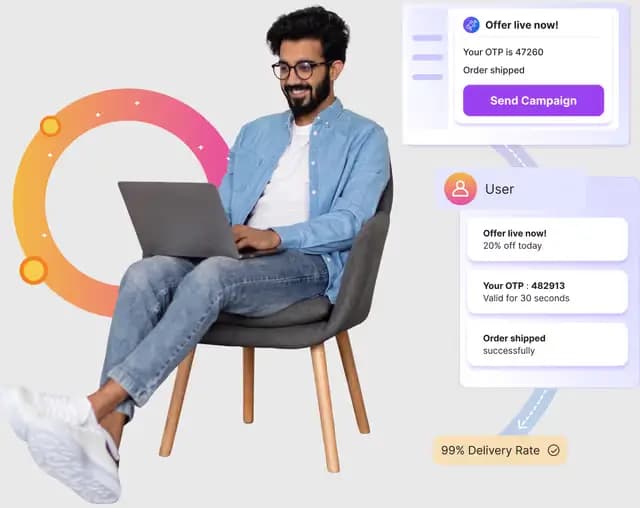
Trusted by 10,000+ businesses across India




















Bulk SMS, in One Paragraph
Bulk SMS is text messaging sent at scale through a DLT-registered gateway, reaching any mobile number directly over the cellular network. It needs no app, no notification permission, and no background process staying alive on the recipient's device- the message simply arrives in the phone's default messaging app. Pricing starts from approximately ₹0.09 per SMS on the transactional route.
Push Notifications, in One Paragraph
Push notifications are alerts sent to a mobile app through the device's operating system, appearing on the lock screen or notification tray of a customer who has your app installed. Sending them is free, but delivery only works if the customer installed the app, granted notification permission, and the OS hasn't force-killed the app in the background or quietly revoked that permission since- a chain of dependencies bulk SMS simply doesn't have.
Where Push Notifications Lose People, Step by Step
This funnel is the single biggest structural difference between the two channels. Bulk SMS has no equivalent funnel- a valid, DLT-registered number is reachable without any of these steps.
| Aspect | Bulk SMS | Push Notifications |
|---|---|---|
| Step 1 | None- any valid, DLT-registered mobile number can be sent an SMS immediately. | Customer must first discover, download, and install your app- a step many potential customers never complete. |
| Step 2 | None- transactional and service SMS need no separate permission beyond a valid number. | Customer must actively grant notification permission, either during onboarding or when prompted- a request a meaningful share of users decline or dismiss. |
| Step 3 | None- delivery doesn't depend on the phone's OS or background app state. | The OS must not have force-killed the app in the background or revoked the permission over time, which happens routinely on battery-optimised Android devices and after long periods of inactivity. |
| Net result | Delivery to the phone is near-universal for any valid number, independent of app behaviour. | Only the customers who survive all three steps- install, permission, and a live, permission-intact app- ever see the notification at all. |
Free to Send Isn't the Same as Free to Reach Someone
Push notifications carry no per-message fee, while bulk SMS runs from approximately ₹0.09 per SMS. But push's free sending sits on top of a real acquisition cost- getting someone to install your app and grant permission in the first place.
| Aspect | Bulk SMS | Push Notifications |
|---|---|---|
| Cost to send | A small per-message cost, from approximately ₹0.09 per SMS on the transactional route. | Free to send- push infrastructure has effectively no per-message cost. |
| Cost to reach someone | The per-message cost is the whole cost- no separate spend is required to make a phone number reachable. | Free sending hides a real upstream cost- acquiring the install through paid marketing or app store optimisation, then getting the user through the permission prompt- before a single notification can ever be delivered. |
| Cost if the channel goes unused | None- an unsent SMS costs nothing, and there's no sunk acquisition cost tied to the channel itself. | The app install and onboarding investment is sunk whether or not the user ever grants permission or keeps the app installed. |
| Practical takeaway | Cost scales directly and predictably with messages actually sent. | Cost is front-loaded into user acquisition- the notification itself is free, but reaching someone with one usually isn't. |
What Each Channel Is Actually Built For
Push for app-native engagement
Cart reminders, in-app promotions, and feature nudges for users who already have your app installed and active work well as push- fast, free, and contextual to what they're doing.
SMS for guaranteed-delivery alerts
OTPs, payment confirmations, delivery updates, and other transactional messages belong on SMS, where delivery doesn't depend on an app being installed or permission being granted.
SMS for users who won't install an app
Not every customer will download a business app, and many businesses don't have one at all- SMS reaches this entire segment that push notifications structurally cannot.
Push and SMS layered together
A common pattern: push notifications for engaged, already-installed users, with SMS as the fallback or complement that reaches everyone else, especially for anything transactional.
Why Push Delivery Quietly Declines Over Time
Even after a customer installs your app and grants notification permission, that permission isn't permanent. Aggressive battery optimisation on many Android devices can force-kill background apps, users can revisit and disable notification settings, and long stretches of inactivity often trigger the OS or the user to switch permissions off entirely. Each of these is invisible to the business sending the notification- it simply never arrives, with no bounce or error to flag the drop-off. Bulk SMS has no equivalent decay mechanism: a valid number stays reachable unless it's deactivated by the operator.
Which Is Better, Bulk SMS or Push? Honest Trade-offs
Bulk SMS
Reaches any valid mobile number- no app install required at all
No notification-permission gate to clear before delivery
Not affected by the OS silently revoking background permissions over time
From approximately ₹0.09 per SMS on the transactional route, DND-exempt for transactional content
Works identically whether or not the recipient has ever heard of your app
Carries a small per-message cost, unlike push's free sending
Plain text only- no rich in-app deep linking or interactive UI
Less suited to high-frequency, low-stakes nudges than push is
Push Notifications
Free to send, with no per-message cost once infrastructure is set up
Can deep-link directly into a specific in-app screen or action
Well suited to frequent, low-stakes engagement nudges for active users
Rich formatting and interactive actions on supported platforms
Only reaches users who installed the app in the first place
Requires an explicit notification-permission grant, which a meaningful share of users decline
The OS can silently revoke or throttle permission over time, especially on Android battery optimisation
Delivery stops entirely the moment a user uninstalls the app
Has a real, often significant acquisition cost baked into getting someone through the install-and-permission funnel
A Simple Decision Matrix
Choose Bulk SMS if you want...
- Guaranteed delivery for OTPs and time-critical transactional alerts
- To reach customers who haven't installed, or won't install, an app
- Delivery that doesn't depend on OS permission state
- Predictable per-message pricing with no acquisition funnel behind it
Choose Push Notifications if you want...
- Free, high-frequency engagement with already-installed, opted-in users
- Deep-linking directly into a specific in-app screen or action
- Low-stakes nudges where a missed notification isn't a real problem
- To supplement, not replace, your guaranteed-delivery channel
The common, sensible pattern is to run both together- push notifications for engaged app users, bulk SMS as the fallback and complement for everyone else, especially transactional messages. For businesses also weighing WhatsApp, our Bulk SMS vs WhatsApp comparison covers that channel too, and our blog looks at WhatsApp vs Push Notifications for a related angle on the same reach-versus-app-dependency trade-off.
Bulk SMS Infrastructure Built for Indian Businesses
Trusted by 10,000+ businesses across India for DLT-compliant messaging that reaches customers regardless of app install status.
DLT-registered, DND-exempt routing
Transactional templates registered on TRAI DLT with confirmed DND-exempt routing for OTPs and time-critical alerts.
No app dependency
Reach every valid mobile number directly, with no install funnel or permission gate standing between you and the customer.
Delivery analytics
Track delivery status and campaign performance from one dashboard, independent of app-side permission attrition.
Simple API integration
Trigger bulk SMS as a fallback when push delivery can't be confirmed, through one straightforward API.
Not sure whether SMS or push fits your notification?
Talk to our experts about running push and bulk SMS together, with SMS as the guaranteed-delivery fallback.

One message could
change your business.
Big or small, we power communication for all- talk to us today.
Bulk SMS vs Push Notifications FAQs
Bulk SMS reaches any valid mobile number directly over the cellular network, with no app, install, or permission step required. Push notifications only reach customers who have installed your app, granted notification permission, and haven't had that permission silently revoked by the OS over time. SMS wins on guaranteed, universal reach; push wins on cost-free, in-app-contextual engagement for users who've already cleared that funnel.
Push notifications depend on a multi-step funnel: the customer has to install your app, then actively grant notification permission, and the OS then has to not force-kill the app in the background or quietly revoke that permission over time- a real and common drop-off, especially on Android devices with aggressive battery optimisation. Bulk SMS skips this entire funnel- any valid, DLT-registered mobile number is reachable without an install or a permission prompt.
Sending a push notification has effectively no per-message cost, while bulk SMS runs from approximately ₹0.09 per message on the transactional route. But that comparison only covers the send itself. Push notifications carry a real upstream cost- the marketing spend or app-store effort needed to get someone to install your app and then grant notification permission- before you can ever reach them for free. SMS has no such acquisition funnel; the per-message cost is the entire cost of reaching that number.
No. Once a customer uninstalls your app, the device token used for push delivery is gone, and there is no way to send them a push notification again unless they reinstall. Bulk SMS has no such dependency- a valid phone number stays reachable regardless of what apps the customer has or hasn't installed.
Yes, generally. OTPs and other time-critical transactional alerts need to reach the customer reliably and fast, and bulk SMS on a DLT-registered transactional route does this without depending on the customer having your app installed, notification permission granted, or the OS keeping the app alive in the background. Push notifications can supplement OTP delivery for already-engaged app users, but shouldn't be the only channel for something this critical.
Yes, this is a real and common pattern, particularly on Android devices with aggressive battery-optimisation settings that force-kill or restrict background apps, and on both major platforms when a user hasn't engaged with an app in a while and the OS or the user manually revisits and disables its notification permission. Businesses relying solely on push often see delivery and open rates quietly decline over time as this attrition accumulates, without any obvious single cause.
It depends on the message and the audience. Use push notifications for frequent, low-stakes, in-app-contextual nudges aimed at users you know are actively engaged with your app right now. Use bulk SMS for anything transactional, time-critical, or where guaranteed delivery matters- and for reaching the portion of your customer base that hasn't installed your app or won't. Most businesses that run an app end up using both, assigned to different jobs.
Yes, and this is the most common pattern among Get Click Media clients running a mobile app- push notifications for engaged, already-installed users where the message is a nice-to-have nudge, and bulk SMS as the fallback or complement that reaches everyone else, especially for transactional and time-critical content where a missed notification has a real cost.
They simply can't be reached by push at all, even though your app is installed on their device- the OS blocks delivery entirely without an active permission grant. This is a meaningful and often underestimated gap in push-only strategies. Bulk SMS has no equivalent permission gate for transactional and service messages, which is why many businesses treat it as the reliable fallback for exactly this segment of users.
We help you map which message types belong on which channel- engagement nudges for opted-in app users on push, and guaranteed-delivery transactional alerts on bulk SMS- then handle DLT registration and API integration so your systems can trigger the right channel, or fall back to SMS automatically when push delivery can't be confirmed.
Still deciding between bulk SMS and push notifications?
Get Click Media runs guaranteed-delivery bulk SMS for 10,000+ Indian businesses- request a demo and we'll map out where push fits alongside it.