

SMS Fallback Strategy for WhatsApp & RCS Campaigns
WhatsApp and RCS never reach 100% of any customer base- a message sent only through them can silently fail to reach part of your audience. SMS fallback closes that gap automatically.
Official Meta BSP · Google RCS Partner · DLT-Registered · Noida, India
3
Channels, 1 Campaign
100%
Universal SMS Reach
0
Manual Fallback Logic Needed
24×7
Support
Trusted by 10,000+ businesses across India


















Rich channels have real reach limits
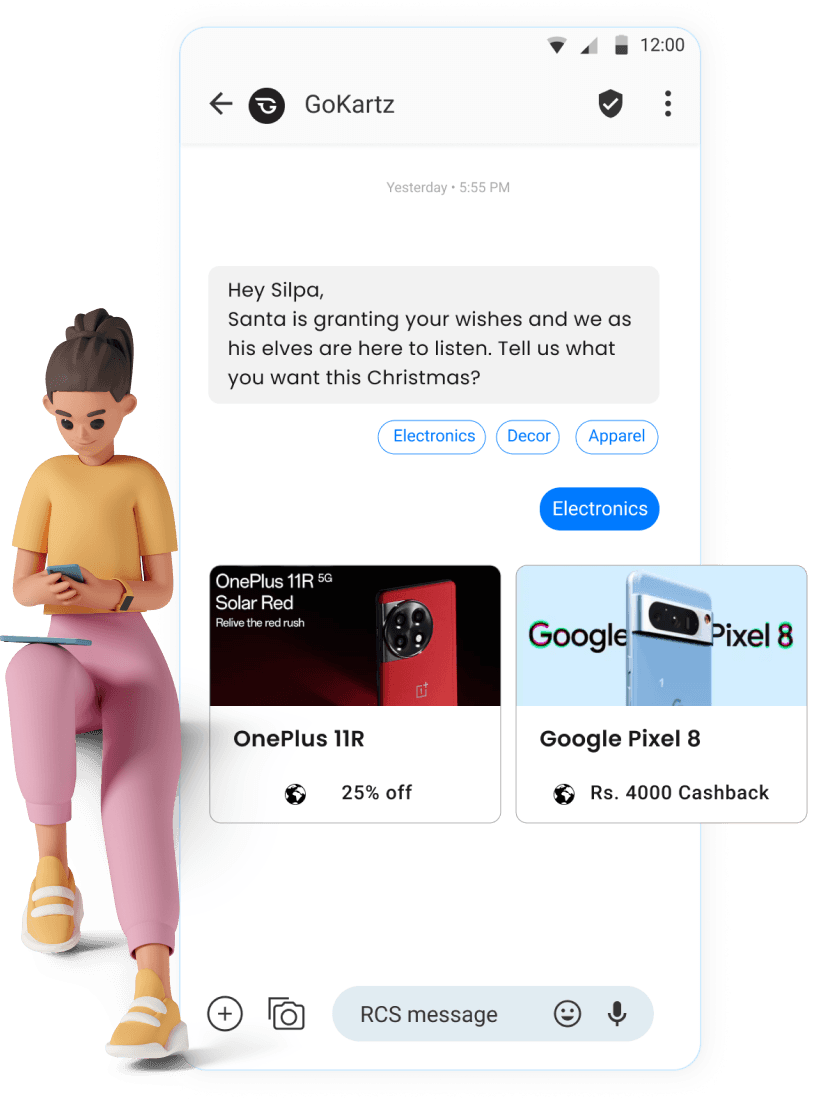
WhatsApp and RCS are both excellent for rich, high-engagement messaging- but both depend on conditions that not every customer meets. WhatsApp needs the app installed on the recipient's phone and an explicit opt-in. RCS needs an RCS-capable Android device running Google Messages as the default messaging app, and iOS support for RCS is still maturing. A message sent exclusively through either channel simply never arrives for customers outside that coverage- there's no automatic retry unless one is explicitly built into the campaign.
| Channel | Requirement to Receive | Coverage Gap |
|---|---|---|
| App installed AND opt-in given | Customers without the app, or who haven't opted in, are unreachable | |
| RCS | RCS-capable Android device with Google Messages as default app | iOS support is still maturing; non-RCS devices fall outside coverage |
| SMS | Any mobile number | Universal reach- the fallback layer for both channels above |
WhatsApp
- Requirement to Receive
- App installed AND opt-in given
- Coverage Gap
- Customers without the app, or who haven't opted in, are unreachable
RCS
- Requirement to Receive
- RCS-capable Android device with Google Messages as default app
- Coverage Gap
- iOS support is still maturing; non-RCS devices fall outside coverage
SMS
- Requirement to Receive
- Any mobile number
- Coverage Gap
- Universal reach- the fallback layer for both channels above
A fallback strategy in practice
- Attempt delivery on the primary rich channel first- WhatsApp or RCS.
- Check delivery and read status within a defined time window.
- If delivery fails or isn't confirmed in that window, automatically resend the same message via SMS as the universal-reach fallback.
- Log the outcome per channel, so campaign reporting shows what was delivered on the primary channel versus recovered via fallback.
What to fall back for- and what not to
A fallback adds complexity, so reserve it for messages where a miss has a real cost.
OTPs & Login Verification
Time-critical and transactional- a missed OTP blocks the customer entirely. Almost always needs a fallback.
Delivery & Shipping Alerts
Customers act on these in real time. A missed update has a real cost- fallback recommended.
Payment Confirmations
Financial confirmations customers rely on for records and trust. Fallback recommended.
Appointment & Booking Reminders
Time-sensitive- a missed reminder often means a missed appointment. Fallback recommended.
Promotional Offers
Lower stakes- a missed promo message costs less than the added complexity of a fallback. Often fine without one.
Newsletter-Style Updates
Not time-critical- customers who miss one update will likely see the next. Fallback usually optional.
3 steps to design your fallback window
There's no fixed universal duration- treat the window length as a business decision based on urgency.
Match the window to urgency
Time-critical messages like OTPs and delivery alerts warrant a short wait; lower-urgency updates can afford a longer one. There's no fixed universal number- it's a business decision based on what's actually being sent.
Trigger on a definitive signal
Fall back once you have a clear non-delivery or non-read result, not just the absence of a response yet- confirm the primary channel actually failed before resending via SMS.
Calibrate per channel
WhatsApp and RCS delivery/read confirmation timing can differ from each other, so tune the window separately for each rather than reusing one setting everywhere.
Prepare a plain-text equivalent in advance
A rich WhatsApp or RCS message with images, carousels, and tappable buttons doesn't translate directly to SMS- it needs a plain-text equivalent prepared before the campaign launches, not a raw dump of the same content when the fallback triggers.
- Keep the core information- what happened, what action is needed, any reference number.
- Replace buttons and rich CTAs with a short link or a clear instruction.
- Write within SMS's plain-text, character-limited format from the start, rather than trimming a rich message on the fly.
One campaign, channel priority, no manual logic
Instead of manually building fallback logic yourself, Get Click Media's unified platform lets you configure one campaign send with channel priority- WhatsApp or RCS first, SMS as the fallback- and handles the delivery checks and resend automatically.
- Set channel priority once per campaign, not per message.
- Delivery and read status checked automatically within your configured window.
- Undelivered messages resent via SMS without any manual intervention.
See how SMS, WhatsApp, and RCS compare on reach and delivery mechanics in our full channel comparison, or build custom fallback logic tied to your own systems with our webhook-based bulk SMS API.
One platform, three channels, zero missed customers
Get Click Media is an official Meta Business Solution Provider, Google RCS partner, and DLT-registered bulk SMS operator based in Noida, running unified WhatsApp, RCS, and SMS campaigns for 10,000+ Indian businesses. Configure channel priority once, and we handle delivery checks and automatic SMS fallback- so time-critical messages reach customers reliably, regardless of which channel they're actually reachable on.

One message could
change your business.
Big or small, we power communication for all- talk to us today.
Questions about SMS fallback strategy
WhatsApp requires the customer to have the app installed and have opted in, and RCS requires an RCS-capable Android device with Google Messages as the default app (iOS support is still maturing). Neither channel reaches 100% of any customer base, so a message sent only via WhatsApp or RCS silently fails to reach whoever falls outside that channel's coverage- unless you build a retry via SMS.
A message attempts delivery on the primary rich channel- WhatsApp or RCS- first. Delivery and read status are checked within a defined time window, and if delivery fails or isn't confirmed in that window, the same message is automatically resent via SMS as the universal-reach fallback.
Time-critical or transactional messages- OTPs, delivery alerts, payment confirmations, appointment reminders- almost always need a fallback, since a missed message has real consequences. Low-stakes marketing content is often fine without one, since a missed promotional message costs less than the added complexity of building fallback logic for it.
It depends on the urgency of the message, not a fixed industry-standard duration. Time-critical messages like OTPs warrant a short wait before falling back; lower-urgency updates can tolerate a longer window. Treat the window length as a configurable business decision, and calibrate it separately for WhatsApp and RCS since their delivery/read confirmation timing can differ.
No- a rich WhatsApp or RCS message with images and buttons needs a plain-text SMS equivalent prepared in advance, not a raw dump of the same content. The core information should carry over, but the format needs to be rebuilt for SMS's plain-text, character-limited format.
RCS clients on Google Messages can fall back to SMS automatically when the recipient's device or plan doesn't support RCS, but that's a device-level fallback, not a substitute for a business-level delivery/read-based fallback strategy across your full customer base. Compare SMS, WhatsApp, and RCS reach and delivery mechanics.
Customers outside your primary channel's coverage- no WhatsApp app or opt-in, or no RCS-capable device- simply never receive the message, with no automatic retry. For time-critical messages like OTPs or payment alerts, that can mean a failed transaction or a frustrated customer with no visibility into why.
Yes- fallback windows and even whether a fallback is used at all should typically differ by message type. Transactional and time-critical campaigns usually warrant a short window and an always-on fallback; marketing campaigns can use a longer window or skip the fallback entirely.
Get Click Media's unified platform lets you configure one campaign send with channel priority- WhatsApp or RCS first, SMS fallback- rather than manually building fallback logic yourself. For custom fallback logic tied to your own systems, our webhook-based bulk SMS API is also available. See webhook-based bulk SMS API integration.
Yes- OTPs and authentication messages are exactly the kind of time-critical, transactional message that almost always needs a fallback, since a missed OTP blocks the customer from completing whatever action they were trying to take.
Ready to stop losing customers to missed messages?
Get Click Media configures channel priority and automatic SMS fallback across WhatsApp, RCS, and SMS- one campaign, zero manual fallback logic.