

In this article
Explore the key concepts, practical considerations, and frequently asked questions related to whatsapp vs push & app notifications: which is better for your business? | gcm.
Key takeaways
- Push notifications only reach the 40-60% of app installs that grant permission, and stop working entirely once a customer uninstalls the app.
- In a worked 1,00,000-user example, WhatsApp generated roughly 86x more revenue than push despite costing ₹85,000 versus near-zero send cost.
- Push still wins for zero-cost, high-frequency in-app nudges like live order tracking, where per-conversation WhatsApp pricing would be uneconomical.
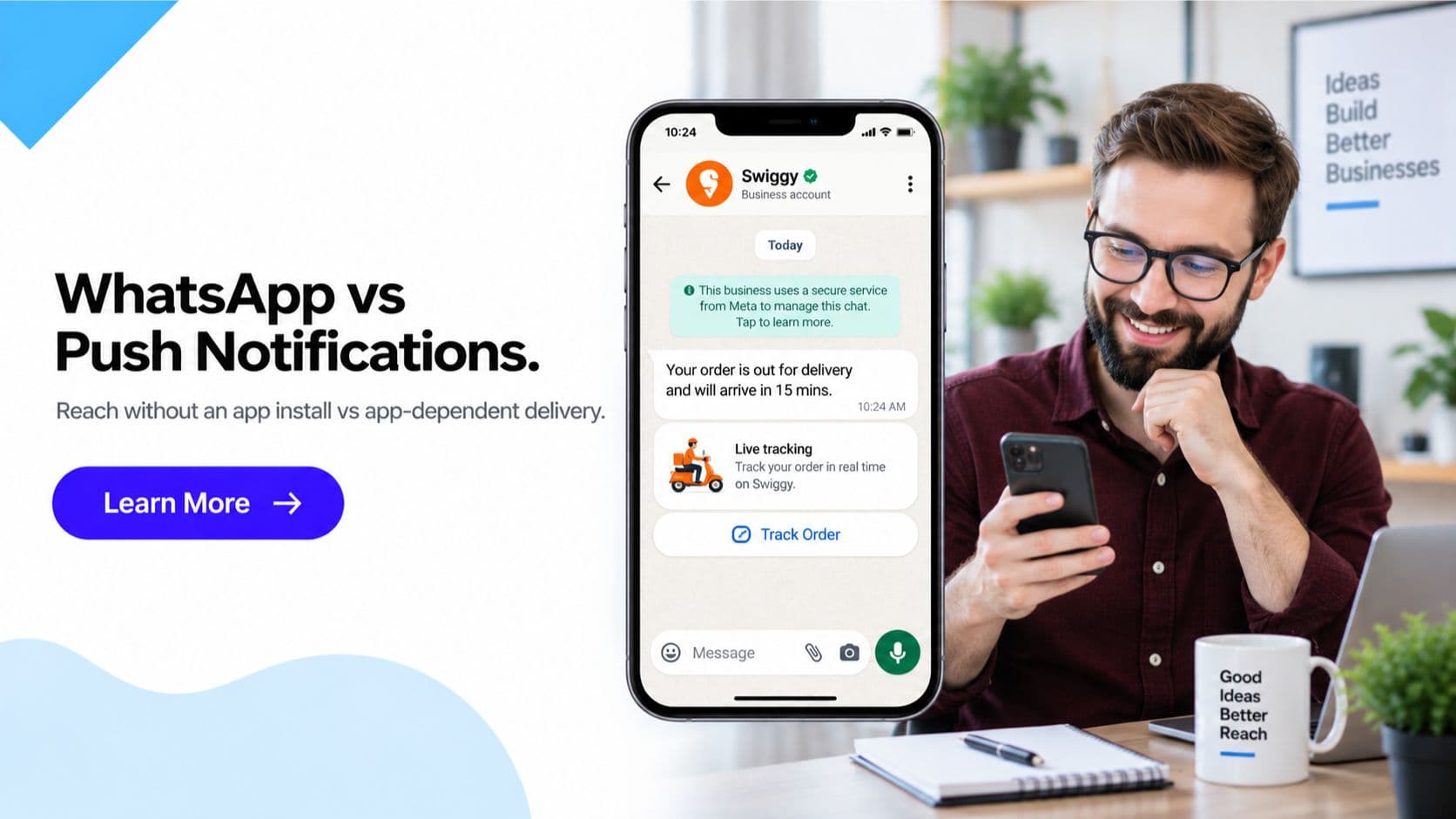
Push notifications and WhatsApp Business API solve a similar problem- getting a timely message in front of a customer- but they start from opposite premises. Push notifications only work if a customer has installed your app and granted notification permission, a combination that industry data pegs at 40-60% of installs in India and falling as permission fatigue spreads. WhatsApp works with nothing more than a phone number, reaching customers whether or not your business has ever built an app at all. Get Click Media helps Indian businesses run WhatsApp Business API as a reach and engagement channel, including full chatbot automation for two-way conversations that push notifications cannot support.
For businesses that already have a mature app with an engaged installed base- fintech, OTT, food delivery, ride-hailing- push notifications remain a genuinely useful, near-zero-cost engagement layer. But for the much larger set of Indian SMEs, D2C brands, and service businesses that do not have the budget or roadmap to build and maintain a mobile app, push notifications are simply not an available channel. WhatsApp is.
This page compares the two channels honestly- where push notifications win, where WhatsApp wins, and how businesses that do run an app should combine both rather than picking one exclusively.
Quick answer: Push notifications are free to send and deeply integrated into your app experience, but only reach the fraction of users who installed your app, granted permission, and haven't uninstalled. WhatsApp reaches any customer with a phone number, achieves dramatically higher open rates, and works whether or not you have an app at all. Businesses with an engaged app base use push for in-app nudges and WhatsApp for high-stakes communication and reach beyond the app.
Get WhatsApp Business API- 98% open rate · No app required · Chatbot
WhatsApp vs Push Notifications- 18-Point Comparison
| Dimension | WhatsApp Business API | Push & App Notifications |
|---|---|---|
| Requires a mobile app | No | Yes- notifications cannot exist without an app |
| Requires app install | No- works with just a phone number | Yes- customer must have installed the app |
| Requires notification permission | No separate OS permission- opt-in is the channel itself | Yes- OS-level permission prompt, often declined |
| India permission/opt-in rate | Opted-in customer base you build directly | ~40-60% of installs, declining due to permission fatigue |
| Average open rate | ~98% for opted-in users | ~4-8% industry-wide |
| Reach after app uninstall | Unaffected- phone number still valid | Zero- device token is gone permanently |
| Send cost per message | ₹0.14–0.91 per conversation depending on category | Near-zero (infra cost only, e.g. Firebase) |
| Cost to build the channel | None- works on day one with a number | Full app development and maintenance required |
| Rich media | Images, video, PDF, carousels, buttons | Limited- text, small image, deep link |
| Two-way conversation | Yes- native conversation thread | No- tap typically just opens the app |
| Chatbot/agent support | Full AI and rule-based chatbot | Not applicable |
| Personalisation basis | Purchase history, chat context, CRM data | In-app behavioural and session data |
| Works without internet at send time | Delivers when customer reconnects | Delivers when customer reconnects |
| Delivery outside app sessions | Yes- independent of app open state | Yes, but only if app still installed |
| Verified sender identity | Green Tick- Meta verified | App identity only, no independent verification |
| Impact of notification frequency | Managed via opt-out and template quality controls | High- excessive push is a leading cause of uninstalls |
| Platform dependency | Independent of app store policies | Subject to iOS/Android OS-level permission changes |
| Best engagement depth | Ongoing conversational relationship | Momentary nudge back into the app |
| Analytics | Full funnel- delivery, read, click, conversion | App-side open and click tracking only |
The Real Engagement Comparison- Re-Engagement Campaign, 1 Lakh Users
Here is a worked example for a D2C brand running a cart-abandonment re-engagement campaign to 1,00,000 app users/customers, comparing push notifications against WhatsApp for a comparably sized audience:
| Metric | Push Notifications | WhatsApp API |
|---|---|---|
| Total app installs / contacts | 1,00,000 | 1,00,000 |
| Notification permission / opt-in rate | 50% | Opted-in base assumed equal for comparison |
| Addressable audience | 50,000 (permission granted) | 1,00,000 (phone number is enough) |
| Send cost | ~₹0 (infra only) | ₹85,000 (₹0.85/conversation) |
| Average open rate | 6% | 98% |
| Notifications/messages opened | 3,000 | 98,000 |
| Average CTR (of opened) | 10% | 22% |
| Total clicks | 300 | 21,560 |
| Conversion rate (click to purchase) | 5% | 6% |
| Total orders generated | 15 | 1,294 |
| Average order value | ₹1,500 | ₹1,500 |
| Total revenue generated | ₹22,500 | ₹19,41,000 |
| Cost per order | ~₹0 (infra only) | ₹65.7 |
| Reach beyond app-installed base | None | Full- includes uninstalled/non-app customers |
What this shows: Push notifications cost almost nothing to send, but the addressable audience is capped at the 50% who granted permission, and the 4-8% industry-average open rate means only a small fraction ever see the message. WhatsApp costs ₹85,000 to send but reaches every customer with a valid number- including the half who never granted push permission and anyone who has since uninstalled the app- generating roughly 86x more revenue in this scenario. For apps with a smaller, highly engaged base, push economics improve; for reach and revenue at scale, WhatsApp wins decisively.
Where Push Notifications Beat WhatsApp- 5 Scenarios
Push notifications are not obsolete. Here are the 5 scenarios where they are genuinely the better tool for Indian businesses:
1. Mature apps with a highly engaged installed base
Fintech, OTT streaming, ride-hailing, and food-delivery apps with millions of daily active users and high permission opt-in among their power users get enormous value from push- the audience is already inside the app ecosystem and checking it multiple times a day. For this specific segment, push is a cheap, effective nudge layer.
2. Zero incremental cost at very high volume
Once the app and notification infrastructure exist, sending a push notification costs effectively nothing per message, regardless of whether you send to 10,000 or 10 million users. For extremely high-frequency, low-stakes nudges- "your session is about to expire," "new content available"- this cost structure is unbeatable, and WhatsApp's per-conversation pricing would be uneconomical at that frequency.
3. Deep in-app contextual actions
A push notification can deep-link a user directly into a specific in-app screen- a live match score, a half-filled cart, a specific product page- using session and behavioural data the app already holds. This tight loop between notification and app state is native to push in a way WhatsApp, which operates outside the app entirely, cannot replicate.
4. Real-time, high-frequency operational alerts
Ride status changes, live order tracking pings, OTT "new episode live" alerts, and stock-price tickers benefit from push's ability to fire dozens of times a day without per-message cost concerns. Sending this same frequency over WhatsApp would be both expensive and would quickly exhaust customer patience with template messaging.
5. Users who prefer not to share a phone number for marketing
Some app users are willing to grant notification permission but reluctant to opt in to WhatsApp marketing on their personal number. For apps with strong privacy-conscious user bases, push offers an engagement channel that does not require handing over a phone number for promotional contact.
Where WhatsApp Beats Push Notifications- 5 Scenarios
And here are the 5 scenarios where WhatsApp is clearly the stronger channel:
1. Any business without a mobile app
The large majority of Indian SMEs, service providers, and even mid-sized D2C brands do not have the budget, timeline, or technical resources to build and maintain a native app. For these businesses, push notifications simply do not exist as an option. WhatsApp requires no app at all- just a verified business number and Meta template approval- making it the only mobile-native rich-messaging channel available to them.
2. Reaching customers who never installed the app or already uninstalled it
Even businesses that do have an app inevitably have a much larger customer base who never installed it, or who installed it once and deleted it. Push notifications cannot reach either group- the device token simply does not exist. WhatsApp reaches them through their phone number regardless of app status, making it the only way to bring lapsed or app-less customers back into the funnel.
3. High-stakes communication that needs to be seen
Order confirmations, payment reminders, delivery failures, and appointment confirmations are messages a business cannot afford to have missed. At ~98% open rates versus 4-8% for push, WhatsApp is dramatically more reliable for anything where a missed message has real business or customer-trust consequences.
4. Two-way support and conversion journeys
Push notifications are fundamentally one-way- a tap typically just opens the app, with no conversation attached. WhatsApp supports a full two-way thread with chatbot qualification, agent handoff, document exchange, and payment links, all in the same conversation. Any journey that benefits from back-and-forth- support queries, lead qualification, high-consideration purchases- is better served by WhatsApp.
5. Avoiding uninstall risk from notification fatigue
Excessive or poorly targeted push notifications are one of the most common causes of app uninstalls, which then permanently cuts off that customer from any future push message. WhatsApp opt-outs remove a customer from future sends too, but do not destroy an entire app relationship- and WhatsApp's higher relevance and richer format generally produce lower fatigue for the same communication frequency.
WhatsApp vs Push Notifications- Use Case Recommendation Matrix
| Use case | Best channel | Why |
|---|---|---|
| Cart abandonment- app users, permission granted | Push, backed by WhatsApp | Push is free and instant for engaged users; WhatsApp catches the rest |
| Cart abandonment- full customer base | Reaches non-app and non-permission customers push cannot | |
| Order confirmation | High-stakes; 98% open rate vs 4-8% for push | |
| Live order/delivery tracking while app is open | Push | Tight in-app deep link, near-zero cost, high frequency |
| Re-engaging lapsed or uninstalled app users | Push cannot reach uninstalled users at all | |
| Customer support | Two-way conversation and chatbot; push is one-way | |
| Businesses without a mobile app | Push is not an available channel without an app | |
| High-frequency operational alerts (live scores, tickers) | Push | Zero incremental cost at very high send frequency |
| Payment/EMI reminder | Cannot afford to be missed; push open rates too low | |
| New feature announcement to power users | Push | Cheap, in-app context, acceptable to miss for some users |
| Lead qualification and onboarding | Chatbot qualification flow impossible over push | |
| Win-back campaign (lapsed customers) | Reaches customers regardless of app or permission status |
Compliance & Data Privacy- Push vs WhatsApp
Both channels involve customer consent, though the mechanism differs, and neither falls under TRAI's SMS-specific DND or DLT rules:
| Compliance requirement | Push Notifications | WhatsApp Business API |
|---|---|---|
| Consent mechanism | OS-level notification permission prompt | Explicit WhatsApp opt-in from the customer |
| DPDP Act 2023 | Applies- consent and data handling principles | Applies- opt-in consent required for marketing |
| TRAI DND applicability | Not applicable | Not applicable |
| TRAI DLT registration | Not applicable | Not required |
| Template/content approval | App store and platform notification policies | Meta template approval required |
| Revocability | Customer can disable permission anytime in device settings | Customer can opt out anytime via WhatsApp |
| Data required to send | Device push token (tied to app install) | Phone number only |
The Recommended Strategy- Push for Engagement, WhatsApp for Reach
For businesses that already run a mobile app, the two channels are complementary rather than competitive- the mistake is treating them as substitutes:
| Layer | Channel | Who | Message type |
|---|---|---|---|
| In-app engagement nudges | Push notifications | Users with app installed and permission granted | Low-stakes, high-frequency, in-app deep links |
| High-stakes communication | WhatsApp API | All customers, app or no app | Order, payment, support, appointment confirmations |
| Reach beyond the app | WhatsApp API | Non-app customers + uninstalled/lapsed app users | Re-engagement, win-back, full-funnel marketing |
| No app at all | WhatsApp API | All customers | Full primary messaging channel |
GCM note: Get Click Media builds and manages WhatsApp Business API deployments for Indian businesses- whether you already run a mobile app and want WhatsApp to carry your high-stakes and reach-beyond-app communication, or you have no app at all and need a single rich-messaging channel that works with nothing more than a customer's phone number. Our chatbot layer adds two-way conversation and qualification flows that push notifications structurally cannot support.
Frequently Asked Questions- WhatsApp vs Push Notifications
Is WhatsApp better than push notifications for business messaging? It depends on your audience. For customers who have installed your app and granted notification permission, push notifications are free to send and highly targeted. But push notifications only reach app users who opted in- typically 40-60% of installs in India and declining due to permission fatigue. WhatsApp reaches any customer with a phone number, with no app install required, and achieves ~98% open rates versus 4-8% for push. For businesses without a mobile app, or that want to reach users beyond their installed base, WhatsApp is the clear choice.
Do I need a mobile app to use WhatsApp Business API? No. This is WhatsApp's biggest structural advantage over push notifications. Push notifications require the business to build, maintain, and get customers to install a mobile app before any message can ever be sent. WhatsApp Business API works with just a customer's phone number- no app development, no app store approval, no install funnel. Most Indian SMEs and D2C brands without app development budgets use WhatsApp as their primary engagement channel for exactly this reason.
Why are push notification open rates so much lower than WhatsApp? Push notifications depend on three things all being true: the customer installed the app, granted notification permission, and still has the app installed today. Industry-wide push open rates average 4-8% because permission opt-in rates in India run 40-60% and are declining due to permission fatigue, and uninstalls silently cut off delivery entirely. WhatsApp messages go to opted-in customers on a channel they already check constantly, which is why open rates average around 98% for opted-in users.
Can push notifications reach customers who uninstalled my app? No. Once a customer uninstalls your app, push notifications can never reach them again- the device token is gone. This is a critical blind spot for apps with high uninstall or churn rates. WhatsApp has no such dependency- as long as the customer's phone number and opt-in remain valid, you can keep reaching them on WhatsApp even after they have deleted your app entirely.
Are push notifications cheaper than WhatsApp? At the infrastructure level, yes- push notifications sent via services like Firebase Cloud Messaging are effectively free per message, whereas WhatsApp conversations cost roughly ₹0.14 to ₹0.91 depending on category. But push notifications only reach your installed, opted-in app base, while WhatsApp reaches customers regardless of app install. When you factor in reach, engagement, and the app development and maintenance cost required just to have push notifications at all, WhatsApp often delivers a lower cost per engaged customer for most Indian businesses.
Should I use push notifications or WhatsApp for my e-commerce app? Use both, assigned to different jobs. Push notifications work well for low-stakes, high-frequency, in-app nudges to your most engaged users- cart reminders while they are actively browsing, price-drop alerts on wishlisted items. WhatsApp should carry high-stakes communication- order confirmations, shipping updates, payment reminders, and support- and any re-engagement of customers who have gone quiet or uninstalled the app, since push cannot reach them anymore.
Do push notifications and WhatsApp both require customer consent in India? Yes, though the mechanisms differ. Push notifications require the customer to grant OS-level notification permission on their device, which falls under India's DPDP Act 2023 consent principles. WhatsApp marketing messages require explicit opt-in consent from the customer before a business can send template messages. Neither channel is governed by TRAI's DND or DLT regulations, which apply only to SMS and voice calls.
Get Started
Whether you already run a mobile app and want to know where WhatsApp should carry the load push notifications cannot, or you have no app at all and need one rich-messaging channel that just works, Get Click Media can help you design the right setup. Compare WhatsApp against other channels in our guides on WhatsApp vs SMS and WhatsApp vs RCS, or explore our full WhatsApp Business API offering including chatbot automation.
Get WhatsApp Business API- 98% open rate · No app required · Chatbot
Article topics
Frequently Asked Questions
Is WhatsApp better than push notifications for business messaging?
It depends on your audience. For customers who have installed your app and granted notification permission, push notifications are free to send and highly targeted. But push notifications only reach app users who opted in- typically 40-60% of installs in India and declining due to permission fatigue. WhatsApp reaches any customer with a phone number, with no app install required, and achieves ~98% open rates versus 4-8% for push. For businesses without a mobile app, or that want to reach users beyond their installed base, WhatsApp is the clear choice.
Do I need a mobile app to use WhatsApp Business API?
No. This is WhatsApp's biggest structural advantage over push notifications. Push notifications require the business to build, maintain, and get customers to install a mobile app before any message can ever be sent. WhatsApp Business API works with just a customer's phone number- no app development, no app store approval, no install funnel. Most Indian SMEs and D2C brands without app development budgets use WhatsApp as their primary engagement channel for exactly this reason.
Why are push notification open rates so much lower than WhatsApp?
Push notifications depend on three things all being true: the customer installed the app, granted notification permission, and still has the app installed today. Industry-wide push open rates average 4-8% because permission opt-in rates in India run 40-60% and are declining due to permission fatigue, and uninstalls silently cut off delivery entirely. WhatsApp messages go to opted-in customers on a channel they already check constantly, which is why open rates average around 98% for opted-in users.
Can push notifications reach customers who uninstalled my app?
No. Once a customer uninstalls your app, push notifications can never reach them again- the device token is gone. This is a critical blind spot for apps with high uninstall or churn rates. WhatsApp has no such dependency- as long as the customer's phone number and opt-in remain valid, you can keep reaching them on WhatsApp even after they have deleted your app entirely.
Are push notifications cheaper than WhatsApp?
At the infrastructure level, yes- push notifications sent via services like Firebase Cloud Messaging are effectively free per message, whereas WhatsApp conversations cost roughly ₹0.14 to ₹0.91 depending on category. But push notifications only reach your installed, opted-in app base, while WhatsApp reaches customers regardless of app install. When you factor in reach, engagement, and the app development and maintenance cost required just to have push notifications at all, WhatsApp often delivers a lower cost per engaged customer for most Indian businesses.
Should I use push notifications or WhatsApp for my e-commerce app?
Use both, assigned to different jobs. Push notifications work well for low-stakes, high-frequency, in-app nudges to your most engaged users- cart reminders while they are actively browsing, price-drop alerts on wishlisted items. WhatsApp should carry high-stakes communication- order confirmations, shipping updates, payment reminders, and support- and any re-engagement of customers who have gone quiet or uninstalled the app, since push cannot reach them anymore.
Do push notifications and WhatsApp both require customer consent in India?
Yes, though the mechanisms differ. Push notifications require the customer to grant OS-level notification permission on their device, which falls under India's DPDP Act 2023 consent principles. WhatsApp marketing messages require explicit opt-in consent from the customer before a business can send template messages. Neither channel is governed by TRAI's DND or DLT regulations, which apply only to SMS and voice calls.
About the author
Get Click Media creates practical resources for businesses using messaging, automation, analytics, and digital communication to improve customer engagement. This article was published on .