

In this article
Explore the key concepts, practical considerations, and frequently asked questions related to whatsapp otp vs sms otp: which is more secure?.
Key takeaways
- WhatsApp OTP travels through an encrypted, Meta-verified profile, but it only works if the recipient has WhatsApp and internet access.
- SMS OTP reaches any GSM phone with no app needed, but its sender ID is easy to spoof and exposed to SIM-swap fraud.
- The recommended hybrid flow sends WhatsApp OTP first and automatically falls back to SMS within a 10-30 second delivery window.
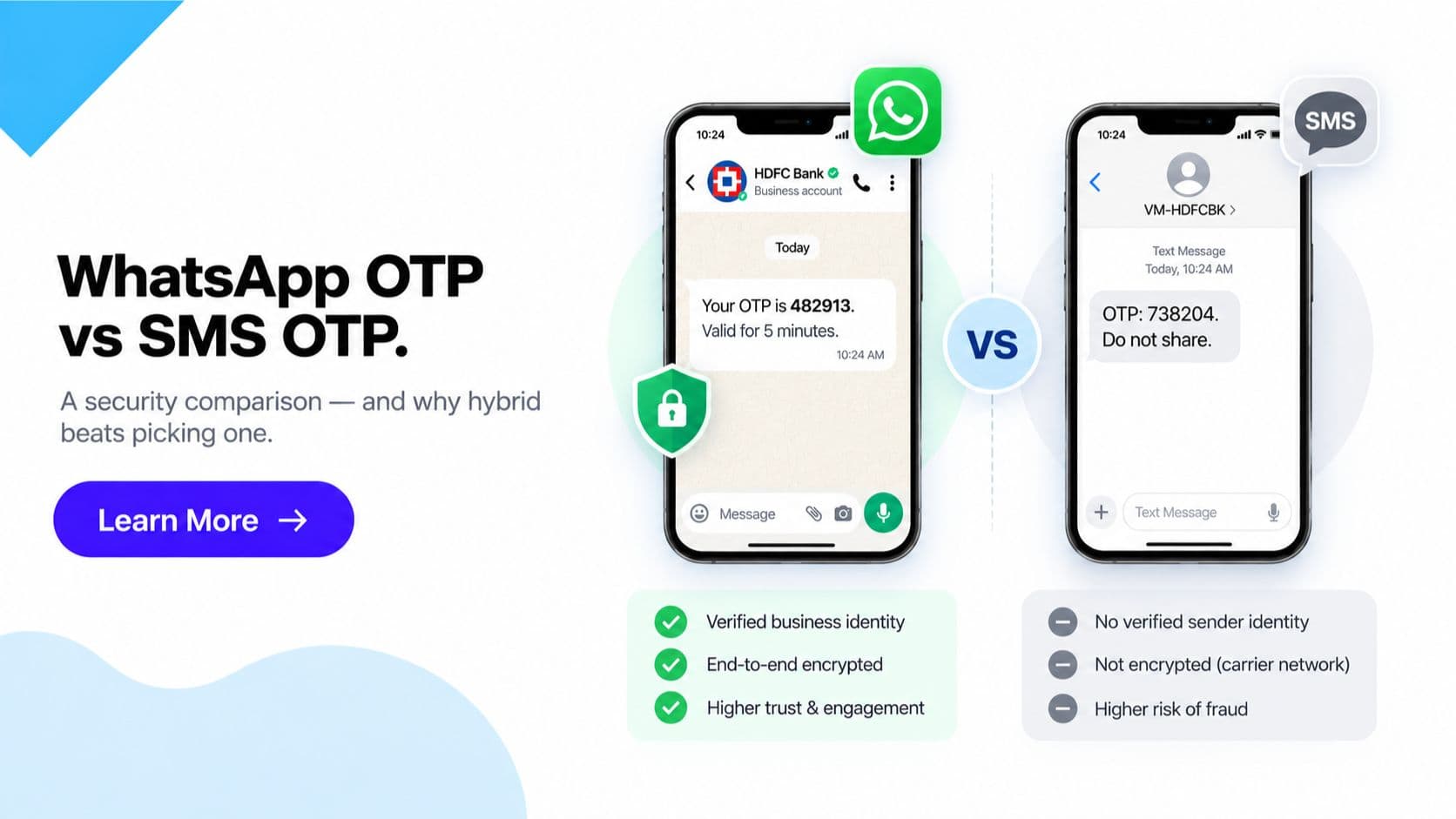
Neither WhatsApp OTP nor SMS OTP is unconditionally "more secure"- each reduces a different category of risk while carrying its own trade-off. WhatsApp OTP is delivered inside an end-to-end encrypted conversation from a verified business profile, which is materially harder to spoof than a generic SMS sender ID, but it depends on the recipient having WhatsApp installed and internet access. SMS OTP works on any phone with a GSM signal- no app, no data plan- but its sender IDs are easy to imitate and the channel is exposed to SIM-swap fraud.
Businesses evaluating WhatsApp OTP or reviewing SMS OTP security best practices often frame the decision as a straight either/or choice. It shouldn't be. This guide compares the two channels honestly, on their actual technical merits and weaknesses, and lays out the hybrid approach that Get Click Media recommends and supports for Indian businesses running login, payment, and verification flows.
Honest framing: This is not a "WhatsApp OTP wins" or "SMS OTP wins" guide. Both channels have real, documented weaknesses. The goal here is to help you understand the trade-offs clearly enough to make a defensible security decision- not to oversell either channel as unhackable.
How SMS OTP Delivery Works
An SMS OTP is generated by the business's backend and handed to an SMS gateway, which routes it through the telecom operator's SMSC (Short Message Service Centre) to the recipient's handset over the GSM signalling network. The message displays under a short alphanumeric sender ID- typically 6 characters, such as GCMDIA.
- Universal reach. SMS OTP works on any mobile phone, including basic feature phones with no data connection- it only requires an active SIM and GSM signal. This makes it the only OTP channel that reaches 100% of mobile numbers, regardless of smartphone ownership or app installation.
- SIM-swap exposure. In a SIM-swap attack, a fraudster socially engineers a telecom operator into reassigning a victim's mobile number to a new SIM card. Once the swap succeeds, all incoming SMS- including OTPs- are delivered to the attacker's device instead of the legitimate owner's. This is a real, recurring fraud pattern in India, particularly targeting banking and fintech accounts.
- Sender ID spoofing. A 6-character SMS sender ID carries no cryptographic verification. Phishing operations can and do register look-alike sender IDs that appear similar to legitimate brands, which is part of why Indian users have grown increasingly wary of unsolicited OTP-style SMS.
- Interception risk on compromised networks. In principle, unencrypted SMS traffic can be vulnerable to interception on a compromised or legacy telecom network- this is a lower-likelihood, more targeted threat than SIM swapping or sender spoofing, but it is a documented category of risk in the security literature and should not be dismissed as purely theoretical.
How WhatsApp OTP Delivery Works
A WhatsApp OTP is sent through the WhatsApp Business Platform using Meta's restricted "Authentication" template category, and it arrives inside an end-to-end encrypted WhatsApp conversation from the business's own Meta-verified profile.
- Encrypted transport, verified sender. Because the message travels through WhatsApp's end-to-end encrypted infrastructure and displays the business's verified profile name, it is materially harder for a phishing operation to convincingly imitate than a bare SMS sender ID.
- Requires WhatsApp and internet. The recipient must have WhatsApp installed and an active internet or mobile data connection at the moment of delivery. There is no equivalent to SMS's "works on any GSM connection"- a customer without WhatsApp, or with no connectivity, cannot receive a WhatsApp OTP at all.
- Inherits WhatsApp account security. The OTP's protection is only as strong as the security of the recipient's own WhatsApp account. If that account itself is compromised- through device theft, social engineering, or in some scenarios a fraudulent SIM-based account re-registration- the OTP becomes visible to whoever controls the account. WhatsApp OTP is not immune to account-takeover-style risk; it simply moves the attack surface from the SMS sender ID to the WhatsApp account itself.
- One-tap autofill. On supported Android devices, WhatsApp Authentication templates can include a one-tap or zero-tap autofill button, reducing manual entry errors compared to copying a code from an SMS.
WhatsApp OTP vs SMS OTP: Security Comparison
| Aspect | SMS OTP | WhatsApp OTP |
|---|---|---|
| Delivery channel | Telecom SMSC over GSM signalling | WhatsApp Business Platform over internet/data |
| Encryption in transit | Not end-to-end encrypted; carried over telecom signalling infrastructure | End-to-end encrypted within the WhatsApp conversation |
| Sender identity | Generic 6-character alphanumeric sender ID, no built-in verification | Meta-verified business profile name, harder to convincingly spoof |
| Dependency on app/internet | None- works on any GSM phone, no data required | Requires WhatsApp installed and an active internet connection |
| SIM-swap exposure | Directly exposed- a successful SIM swap redirects all OTP SMS to the attacker | Indirectly exposed only if the SIM swap is also used to attempt a WhatsApp account takeover |
| Universal reach | Reaches any active mobile number, including feature phones | Reaches only WhatsApp users with connectivity at the time of send |
| Typical use case | Fallback layer, feature-phone users, guaranteed-reach transactional flows | Primary channel for smartphone-first users, higher-trust verification moments |
Both columns carry genuine, non-trivial risk. The comparison above is not "WhatsApp OTP is safe, SMS OTP is not"- it is a picture of two different attack surfaces, each requiring its own mitigations regardless of which channel a business chooses.
The Practical Recommendation: Use Both, Not Either
Given that each channel closes a gap the other one leaves open, the sound approach for most Indian businesses is not to pick one OTP channel exclusively- it is to run a hybrid flow: WhatsApp OTP as the primary delivery method for customers who have WhatsApp active, with automatic SMS OTP fallback for users without WhatsApp, users with unreliable connectivity, or any case where WhatsApp delivery cannot be confirmed within a short window.
Why hybrid wins: WhatsApp OTP alone excludes every customer without WhatsApp or internet access at the moment of send. SMS OTP alone forgoes the verified-sender and encrypted-transport benefits that reduce phishing risk. Combining them- WhatsApp-first, SMS-fallback- captures the strengths of both without inheriting either one's single point of failure.
This is the pattern Get Click Media recommends and supports for Indian businesses running login/2FA, payment confirmation, password reset, and account verification flows. The system attempts WhatsApp OTP delivery first; if the message is undelivered within a short monitoring window, or the number isn't registered on WhatsApp at all, it automatically issues an SMS OTP through the same request- no manual intervention required, and a single verification endpoint validates the code regardless of which channel delivered it.
Channel choice, however, is only one layer of OTP security. Regardless of whether a business sends via WhatsApp, SMS, or both, the underlying implementation should still follow baseline hardening practices- cryptographically secure OTP generation, short expiry windows, attempt lockouts, and rate limiting against OTP bombing. See our OTP SMS security best practices guide for the full implementation checklist, and our WhatsApp OTP guide for how the WhatsApp-first fallback flow is configured in practice.
Frequently Asked Questions
Is WhatsApp OTP more secure than SMS OTP? WhatsApp OTP has meaningful security advantages- it is delivered inside an end-to-end encrypted conversation from a verified business profile, which is harder to spoof than a generic SMS sender ID. But it is not universally "more secure" in every dimension- it depends on the recipient having WhatsApp installed and an active internet connection, and it inherits the security of the recipient's own WhatsApp account. Neither channel is invulnerable, and the honest answer is that they carry different types of risk rather than one being strictly safer than the other.
Can WhatsApp OTP messages be intercepted? The OTP itself travels inside WhatsApp's end-to-end encrypted transport, so it cannot be read in transit the way an unencrypted SMS theoretically can be on a compromised network. However, if a user's WhatsApp account itself is compromised- for example through social engineering, a stolen device, or a fraudulent SIM-based WhatsApp re-registration- the OTP becomes visible to whoever controls that account. No delivery channel is immune to account-level compromise.
Is SMS OTP vulnerable to SIM-swap fraud? Yes. In a SIM-swap attack, a fraudster convinces a telecom operator to transfer a victim's mobile number to a new SIM card, after which all incoming SMS- including OTPs- are delivered to the attacker's device. This is a real, documented fraud pattern in India. It is worth noting that WhatsApp accounts are also tied to a mobile number, so a successful SIM swap can, in some cases, be used to attempt a WhatsApp account takeover as well- SIM-swap risk is not purely an SMS problem.
Does WhatsApp OTP need internet access to work? Yes. WhatsApp OTP requires the recipient to have WhatsApp installed and a working internet or mobile data connection at the moment of delivery. SMS OTP has no such requirement- it works over any GSM signal, including on basic feature phones with no data plan. This is SMS OTP's clearest structural advantage: universal reach regardless of app installation or connectivity.
Which OTP channel should Indian businesses use for login and payments? Most Indian businesses should not pick one channel exclusively. The recommended approach is WhatsApp OTP as the primary channel for customers who have WhatsApp active, since it offers a verified sender identity and a better user experience, with automatic SMS OTP fallback for users without WhatsApp or where WhatsApp delivery cannot be confirmed. This hybrid pattern captures the trust and speed benefits of WhatsApp while keeping SMS's universal reach as a safety net.
Can SMS sender IDs be spoofed by fraudsters? SMS sender IDs are a short alphanumeric header with no cryptographic verification tied to it, which makes it comparatively easy for phishing operations to register a look-alike sender ID that appears similar to a legitimate brand. WhatsApp Business profiles go through Meta's business verification process, which raises the bar for impersonation, though it does not make impersonation attempts impossible- fraudulent WhatsApp Business accounts do occasionally get created and later taken down.
Is either WhatsApp OTP or SMS OTP completely unhackable? No, and any claim that one is completely unhackable should be treated with skepticism. Both channels reduce certain risks and carry others. WhatsApp OTP reduces sender-spoofing risk but depends on account and device security plus internet access. SMS OTP has universal reach but is exposed to SIM-swap fraud and, on compromised or legacy telecom infrastructure, theoretical interception risk. Businesses should design for defense in depth- short OTP validity, rate limiting, and attempt lockouts- rather than relying on channel choice alone.
Does using both WhatsApp OTP and SMS OTP cost more? Not necessarily more than expected. In a hybrid setup, most opted-in smartphone users complete verification on WhatsApp OTP, and SMS is only triggered as a fallback when WhatsApp delivery cannot be confirmed- so SMS costs are only incurred for the subset of users who actually need them, rather than for every OTP sent. Get Click Media configures this WhatsApp-first-then-SMS-fallback flow as a single integration.
How quickly can a business set up hybrid WhatsApp OTP and SMS OTP delivery? As an official Meta Business Solution Provider, Get Click Media handles WhatsApp Authentication template submission, WhatsApp Business Platform setup, and SMS fallback routing together as one onboarding flow. Most businesses can go live within about 5 business days, subject to Meta's template approval turnaround.
Get Click Media configures WhatsApp-first, SMS-fallback OTP delivery as a single integration for Indian businesses- combining the verified-sender trust of WhatsApp OTP with the universal reach of SMS, hardened using the practices in our OTP SMS security guide. Talk to us about setting up hybrid OTP delivery.
Article topics
Frequently Asked Questions
Is WhatsApp OTP more secure than SMS OTP?
WhatsApp OTP has meaningful security advantages- it is delivered inside an end-to-end encrypted conversation from a verified business profile, which is harder to spoof than a generic SMS sender ID. But it is not universally 'more secure' in every dimension- it depends on the recipient having WhatsApp installed and an active internet connection, and it inherits the security of the recipient's own WhatsApp account. Neither channel is invulnerable, and the honest answer is that they carry different types of risk rather than one being strictly safer than the other.
Can WhatsApp OTP messages be intercepted?
The OTP itself travels inside WhatsApp's end-to-end encrypted transport, so it cannot be read in transit the way an unencrypted SMS theoretically can be on a compromised network. However, if a user's WhatsApp account itself is compromised- for example through social engineering, a stolen device, or a fraudulent SIM-based WhatsApp re-registration- the OTP becomes visible to whoever controls that account. No delivery channel is immune to account-level compromise.
Is SMS OTP vulnerable to SIM-swap fraud?
Yes. In a SIM-swap attack, a fraudster convinces a telecom operator to transfer a victim's mobile number to a new SIM card, after which all incoming SMS- including OTPs- are delivered to the attacker's device. This is a real, documented fraud pattern in India. It is worth noting that WhatsApp accounts are also tied to a mobile number, so a successful SIM swap can, in some cases, be used to attempt a WhatsApp account takeover as well- SIM-swap risk is not purely an SMS problem.
Does WhatsApp OTP need internet access to work?
Yes. WhatsApp OTP requires the recipient to have WhatsApp installed and a working internet or mobile data connection at the moment of delivery. SMS OTP has no such requirement- it works over any GSM signal, including on basic feature phones with no data plan. This is SMS OTP's clearest structural advantage: universal reach regardless of app installation or connectivity.
Which OTP channel should Indian businesses use for login and payments?
Most Indian businesses should not pick one channel exclusively. The recommended approach is WhatsApp OTP as the primary channel for customers who have WhatsApp active, since it offers a verified sender identity and a better user experience, with automatic SMS OTP fallback for users without WhatsApp or where WhatsApp delivery cannot be confirmed. This hybrid pattern captures the trust and speed benefits of WhatsApp while keeping SMS's universal reach as a safety net.
Can SMS sender IDs be spoofed by fraudsters?
SMS sender IDs are a short alphanumeric header with no cryptographic verification tied to it, which makes it comparatively easy for phishing operations to register a look-alike sender ID that appears similar to a legitimate brand. WhatsApp Business profiles go through Meta's business verification process, which raises the bar for impersonation, though it does not make impersonation attempts impossible- fraudulent WhatsApp Business accounts do occasionally get created and later taken down.
Is either WhatsApp OTP or SMS OTP completely unhackable?
No, and any claim that one is completely unhackable should be treated with skepticism. Both channels reduce certain risks and carry others. WhatsApp OTP reduces sender-spoofing risk but depends on account and device security plus internet access. SMS OTP has universal reach but is exposed to SIM-swap fraud and, on compromised or legacy telecom infrastructure, theoretical interception risk. Businesses should design for defense in depth- short OTP validity, rate limiting, and attempt lockouts- rather than relying on channel choice alone.
Does using both WhatsApp OTP and SMS OTP cost more?
Not necessarily more than expected. In a hybrid setup, most opted-in smartphone users complete verification on WhatsApp OTP, and SMS is only triggered as a fallback when WhatsApp delivery cannot be confirmed- so SMS costs are only incurred for the subset of users who actually need them, rather than for every OTP sent. Get Click Media configures this WhatsApp-first-then-SMS-fallback flow as a single integration.
How quickly can a business set up hybrid WhatsApp OTP and SMS OTP delivery?
As an official Meta Business Solution Provider, Get Click Media handles WhatsApp Authentication template submission, WhatsApp Business Platform setup, and SMS fallback routing together as one onboarding flow. Most businesses can go live within about 5 business days, subject to Meta's template approval turnaround.
About the author
Get Click Media creates practical resources for businesses using messaging, automation, analytics, and digital communication to improve customer engagement. This article was published on .