

In this article
Explore the key concepts, practical considerations, and frequently asked questions related to whatsapp otp.
Key takeaways
- WhatsApp OTP uses Meta's restricted Authentication template category, which bars promotional content and shows the business's verified profile name.
- One-tap or zero-tap autofill on Android devices cuts login OTP completion time by roughly 35% versus manual SMS code entry.
- TRAI's DND and DLT rules don't apply to WhatsApp OTP since it runs on Meta's platform, though the DPDP Act 2023 still applies.
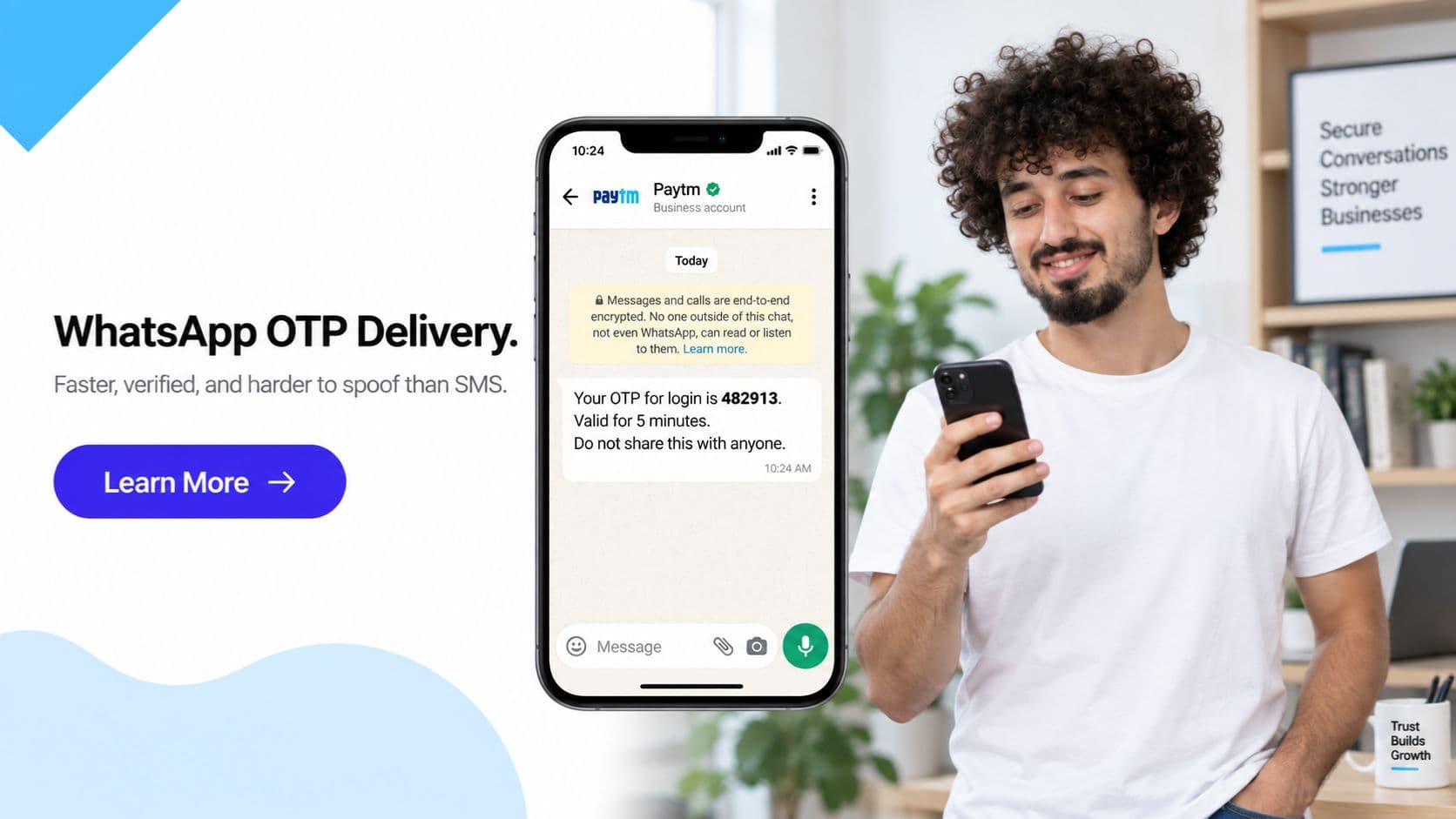
WhatsApp OTP delivers your one-time password or verification code through your business's own verified WhatsApp Business Platform number, using Meta's restricted "Authentication" template category- instead of an anonymous 6-character SMS sender ID that any phishing operation can imitate. For Indian businesses running login, payment, or account-verification flows, that difference in trust translates directly into fewer failed verifications and fewer fraud complaints.
OTP delivery is a trust-critical moment- it's the exact instant a customer decides whether a message is really from you or from someone impersonating you. SMS sender IDs are trivially easy to spoof in phishing messages, and Indian users have grown wary of unsolicited OTP-style SMS as a result. A WhatsApp message from a business's verified profile- with the business name and, where applicable, a green tick displayed- carries a level of visible authenticity that a generic SMS header cannot match.
Get Click Media manages WhatsApp OTP setup end-to-end as an official Meta Business Solution Provider- Authentication template submission, WhatsApp Business API provisioning, and automatic SMS fallback configuration, so verification codes reach every customer regardless of whether they have WhatsApp installed.
This guide covers what WhatsApp OTP is, how it compares to SMS OTP, how the WhatsApp-first-then-SMS-fallback flow works in practice, and the Indian business use cases where it delivers the clearest results.
Set Up WhatsApp OTP with Get Click Media- Official Meta BSP · Authentication templates + SMS fallback · Go live in 5 days. Set Up WhatsApp OTP · Request a Demo · See WhatsApp API Pricing
What Is WhatsApp OTP?
WhatsApp OTP is a one-time password or verification code sent through the WhatsApp Business Platform using Meta's "Authentication" template category- a restricted message type reserved specifically for OTPs and verification codes. Unlike Marketing or Utility templates, Authentication templates cannot include any promotional content, offers, or additional links in the same message. Meta enforces this restriction with stricter approval rules than other template categories, which keeps authentication messages predictable and clean for the end customer.
Because the message arrives from the business's own verified WhatsApp Business Platform number- the same profile the customer may already have saved or recognises from prior conversations- it is materially harder to spoof than an SMS sender ID, which is just a 6-character alphanumeric header with no verification tied to it. Phishing operations can and do register look-alike SMS sender IDs; they cannot as easily impersonate a business's verified WhatsApp profile.
On supported Android devices, WhatsApp Authentication templates can include a one-tap or zero-tap autofill button. With zero-tap, the OTP fills into the requesting app automatically. With one-tap, the customer taps a single button and the code fills in- no manual switching between apps to copy a code, no transcription errors. This shaves real seconds off verification time and reduces the failed-OTP-entry rate that plagues manual-copy SMS flows.
WhatsApp OTP does have one structural limitation: it requires the recipient to have WhatsApp installed and a working internet connection at the moment of delivery. That's why every production WhatsApp OTP deployment should be paired with an automatic SMS fallback, covered below.
WhatsApp OTP vs SMS OTP
| Factor | WhatsApp OTP | SMS OTP |
|---|---|---|
| Sender identity | Verified business profile- name + optional green tick | Generic 6-character alphanumeric sender ID |
| Spoofing risk | Low- tied to a verified, Meta-approved business profile | High- sender IDs are trivially easy to imitate in phishing SMS |
| Delivery speed | Near-instant over internet/data | Near-instant over telecom SMSC, but subject to operator queuing |
| Requires internet | Yes | No- works on any GSM connection |
| Requires WhatsApp installed | Yes | No |
| Autofill support | One-tap / zero-tap on supported Android devices | Manual copy or OS-level SMS autofill only |
| Message restrictions | Authentication template- no promo content allowed | No content restriction, but carriers apply spam filtering |
| Fallback behaviour | Falls back to SMS automatically if undelivered | N/A- SMS is typically the fallback layer itself |
| Cost per message | Lower authentication-category rate under Meta pricing | Per-SMS telecom operator rate |
| Cost at scale (WA-first + SMS fallback) | Lower total cost- majority resolve on WhatsApp | Higher total cost when used as the sole channel |
| DND/DLT applicability | Not applicable- delivered via WhatsApp Business Platform | TRAI DND/DLT registration required for transactional routes |
| Delivery guarantee | Depends on WhatsApp presence- needs fallback for 100% reach | Reaches any active mobile number |
| Best for | Smartphone-first users, higher-trust verification moments | Universal reach, feature phones, guaranteed fallback |
| Compliance scope | DPDP 2023 applies to the underlying data | DPDP 2023 + TRAI DLT/DND apply |
The practical conclusion for Indian businesses: WhatsApp OTP wins on trust, speed-to-verify, and cost per successful verification, but it cannot stand alone. SMS OTP remains the universal-reach layer underneath it.
How WhatsApp OTP Fallback Works
- Verification request triggers WhatsApp OTP first. When a customer initiates login, checkout, password reset, or any verification-gated action, your system requests an OTP send through Get Click Media's API, which first attempts delivery via the WhatsApp Authentication template.
- Meta attempts delivery to the customer's WhatsApp number. The system checks whether the number is registered on WhatsApp and sends the Authentication template message, including the one-tap/zero-tap autofill button where supported.
- A short delivery window is monitored- typically 10-30 seconds. The system waits for a delivery or read receipt from Meta within this window rather than assuming success, since a customer without an active WhatsApp session or with a poor connection may not receive it immediately.
- If undelivered or the number isn't on WhatsApp, SMS fallback fires automatically. No manual intervention or customer action is needed- the system automatically issues an SMS OTP through the same request, using your existing DLT-registered SMS route.
- The customer receives one working OTP, on whichever channel succeeded. The system does not send both messages by default- it sends WhatsApp first, and only issues SMS if WhatsApp delivery could not be confirmed, keeping the customer experience clean and cost controlled.
- A single verification endpoint validates the code regardless of channel. Your application logic doesn't need to know or care which channel delivered the OTP- Get Click Media's API returns a consistent success/failure response either way, so integration work stays minimal.
WhatsApp OTP Use Cases- 6 Indian Business Types
1. App & Website Login / 2FA
Replace or supplement password-based login with a WhatsApp OTP as a second factor, sent the moment a user attempts to sign in from a new device or after a session timeout. The verified business profile reassures users the request is genuine rather than a credential-phishing attempt. Result: login OTP completion time drops by roughly 35% with one-tap autofill, versus manual-copy SMS entry.
2. E-commerce Payment & Transaction Confirmation
Send a WhatsApp OTP to confirm high-value cart checkouts or saved-card transactions before payment is authorised, with SMS fallback ensuring no checkout stalls due to a missed WhatsApp delivery. Customers recognise the verified store profile rather than a generic payment-gateway SMS header. Result: checkout abandonment at the OTP step falls by around 20% compared to SMS-only verification.
3. Password Reset Flows
Trigger a WhatsApp OTP when a customer requests a password reset, reducing the risk of a phishing SMS impersonating the reset flow and tricking the user into handing over a code to an attacker. The verified sender identity is itself a deterrent to social-engineering attempts. Result: reported password-reset phishing complaints drop measurably once WhatsApp OTP replaces SMS as the primary reset channel.
4. Account Creation & KYC Verification
Verify a new user's mobile number at sign-up via WhatsApp OTP before allowing account activation, with automatic SMS fallback for users who haven't yet installed WhatsApp. This keeps the onboarding funnel fast for the majority of smartphone-first Indian users. Result: sign-up verification drop-off improves by up to 25% with one-tap autofill removing manual code entry.
5. High-Value Transaction Approval- Fund Transfers
For actions like large fund transfers, beneficiary addition, or limit changes, send a WhatsApp OTP as an explicit approval step, timestamped and tied to the verified business profile so the customer can be confident the approval request is legitimate and not an intercepted SMS. Result: fraudulent high-value transaction attempts flagged at the OTP step increase, since spoofed approval requests are far less convincing over a verified WhatsApp profile than over SMS.
6. Fintech & NBFC Lending Platforms
Use WhatsApp OTP across loan application verification, disbursement confirmation, and repayment authorisation, where trust in the sender directly affects completion rates given how frequently fintech users are targeted by SMS-based phishing. Pairing this with WhatsApp Business API for the rest of the customer journey- application status, EMI reminders, repayment links- keeps the full lending lifecycle in one verified channel. Result: loan application OTP verification completion improves by roughly 30%, with SMS fallback maintaining 100% reach for non-WhatsApp numbers.
Frequently Asked Questions- WhatsApp OTP
What is WhatsApp OTP and how is it different from SMS OTP? WhatsApp OTP delivers a one-time password through a business's verified WhatsApp Business Platform number using Meta's restricted Authentication template category, instead of an SMS from a generic 6-character sender ID. Because the customer sees the business's verified profile name- and optionally a green tick- rather than an anonymous alphanumeric header, WhatsApp OTP is significantly harder to spoof in a phishing attempt than SMS OTP.
What is a WhatsApp Authentication template? Authentication is a restricted Meta template category built specifically for one-time passwords and verification codes. It has stricter approval rules than Marketing or Utility templates- no promotional content, offers, or links are allowed in the same message. This restriction is what keeps authentication messages clean and trustworthy, which is part of why they carry lower spoofing risk than SMS.
What happens if a customer doesn't have WhatsApp installed? Get Click Media's WhatsApp OTP setup includes automatic SMS fallback. The system attempts WhatsApp delivery first and waits a short window- typically 10-30 seconds. If the message is undelivered in that window, or the number isn't registered on WhatsApp at all, the system automatically falls back to SMS OTP so verification is still guaranteed to reach any Indian mobile number.
What is one-tap or zero-tap OTP autofill? On supported Android devices, WhatsApp OTP messages can include an autofill button that reads the code and fills it into your app automatically (zero-tap) or with a single tap (one-tap), instead of the customer manually switching apps to copy the code. This reduces manual entry errors and cuts time-to-verify compared to a standard SMS OTP flow.
Is WhatsApp OTP cheaper than SMS OTP? Meta prices WhatsApp Authentication conversations lower than Marketing conversations. For high-volume OTP senders, combining WhatsApp-first delivery with SMS as a fallback usually reduces total OTP cost compared to an SMS-only approach, since a majority of opted-in smartphone users complete verification on WhatsApp before the SMS fallback would ever need to fire.
Does TRAI DND or DLT registration apply to WhatsApp OTP? No. TRAI's DND and DLT (Distributed Ledger Technology) regime is specific to SMS sent over Indian telecom operator routes. WhatsApp OTP is delivered over Meta's WhatsApp Business Platform and is not subject to DND or DLT registration. The DPDP Act 2023 still applies to the underlying verification data, the same as it would for any personal data your business processes.
Which businesses should use WhatsApp OTP? WhatsApp OTP suits any business with login/2FA flows, payment or transaction confirmations, password resets, account creation, or high-value action approvals- fintech apps, e-commerce checkouts, NBFC and lending platforms, and general app or website sign-in. Get Click Media configures WhatsApp OTP with SMS fallback across all of these flows as part of WhatsApp Business API onboarding.
How fast can I go live with WhatsApp OTP? As an official Meta Business Solution Provider, Get Click Media handles Authentication template submission, WhatsApp Business Platform setup, and SMS fallback configuration end-to-end. Most businesses go live within 5 days, subject to Meta's template approval turnaround.
Get Started
WhatsApp OTP gives Indian businesses a verification channel that's harder to spoof than SMS, faster to complete with one-tap autofill, and- when paired with automatic SMS fallback- loses none of SMS's universal reach. For a deeper technical look at building out the underlying OTP infrastructure, see OTP SMS security best practices and the OTP SMS API integration guide. Get Click Media configures Authentication templates, WhatsApp Business Platform access, and SMS fallback together as part of WhatsApp Business API onboarding.
Set Up WhatsApp OTP with Get Click Media- Official Meta BSP · Authentication templates + SMS fallback · Go live in 5 days. Set Up WhatsApp OTP · Request a Demo · See WhatsApp API Pricing
Article topics
Frequently Asked Questions
What is WhatsApp OTP and how is it different from SMS OTP?
WhatsApp OTP delivers a one-time password through a business's verified WhatsApp Business Platform number using Meta's restricted Authentication template category, instead of an SMS from a generic 6-character sender ID. Because the customer sees the business's verified profile name- and optionally a green tick- rather than an anonymous alphanumeric header, WhatsApp OTP is significantly harder to spoof in a phishing attempt than SMS OTP.
What is a WhatsApp Authentication template?
Authentication is a restricted Meta template category built specifically for one-time passwords and verification codes. It has stricter approval rules than Marketing or Utility templates- no promotional content, offers, or links are allowed in the same message. This restriction is what keeps authentication messages clean and trustworthy, which is part of why they carry lower spoofing risk than SMS.
What happens if a customer doesn't have WhatsApp installed?
Get Click Media's WhatsApp OTP setup includes automatic SMS fallback. The system attempts WhatsApp delivery first and waits a short window- typically 10-30 seconds. If the message is undelivered in that window, or the number isn't registered on WhatsApp at all, the system automatically falls back to SMS OTP so verification is still guaranteed to reach any Indian mobile number.
What is one-tap or zero-tap OTP autofill?
On supported Android devices, WhatsApp OTP messages can include an autofill button that reads the code and fills it into your app automatically (zero-tap) or with a single tap (one-tap), instead of the customer manually switching apps to copy the code. This reduces manual entry errors and cuts time-to-verify compared to a standard SMS OTP flow.
Is WhatsApp OTP cheaper than SMS OTP?
Meta prices WhatsApp Authentication conversations lower than Marketing conversations. For high-volume OTP senders, combining WhatsApp-first delivery with SMS as a fallback usually reduces total OTP cost compared to an SMS-only approach, since a majority of opted-in smartphone users complete verification on WhatsApp before the SMS fallback would ever need to fire.
Does TRAI DND or DLT registration apply to WhatsApp OTP?
No. TRAI's DND and DLT (Distributed Ledger Technology) regime is specific to SMS sent over Indian telecom operator routes. WhatsApp OTP is delivered over Meta's WhatsApp Business Platform and is not subject to DND or DLT registration. The DPDP Act 2023 still applies to the underlying verification data, the same as it would for any personal data your business processes.
Which businesses should use WhatsApp OTP?
WhatsApp OTP suits any business with login/2FA flows, payment or transaction confirmations, password resets, account creation, or high-value action approvals- fintech apps, e-commerce checkouts, NBFC and lending platforms, and general app or website sign-in. Get Click Media configures WhatsApp OTP with SMS fallback across all of these flows as part of WhatsApp Business API onboarding.
How fast can I go live with WhatsApp OTP?
As an official Meta Business Solution Provider, Get Click Media handles Authentication template submission, WhatsApp Business Platform setup, and SMS fallback configuration end-to-end. Most businesses go live within 5 days, subject to Meta's template approval turnaround.
About the author
Get Click Media creates practical resources for businesses using messaging, automation, analytics, and digital communication to improve customer engagement. This article was published on .