

In this article
Explore the key concepts, practical considerations, and frequently asked questions related to ivr vs ai chatbot: choosing the right automation | gcm.
Key takeaways
- At 50,000 monthly calls, an AI voicebot lifts self-serve completion from 38% to 68% and cuts total monthly cost from ₹13.1 lakh to ₹8.75 lakh.
- IVR still wins for very simple, low-variance flows, tight budgets, and regulated steps needing an exact, auditable script.
- The recommended 2026 strategy is AI voicebot and chatbot as the primary layer, with a lean, fixed-menu IVR kept for simple routing and low-connectivity fallback.
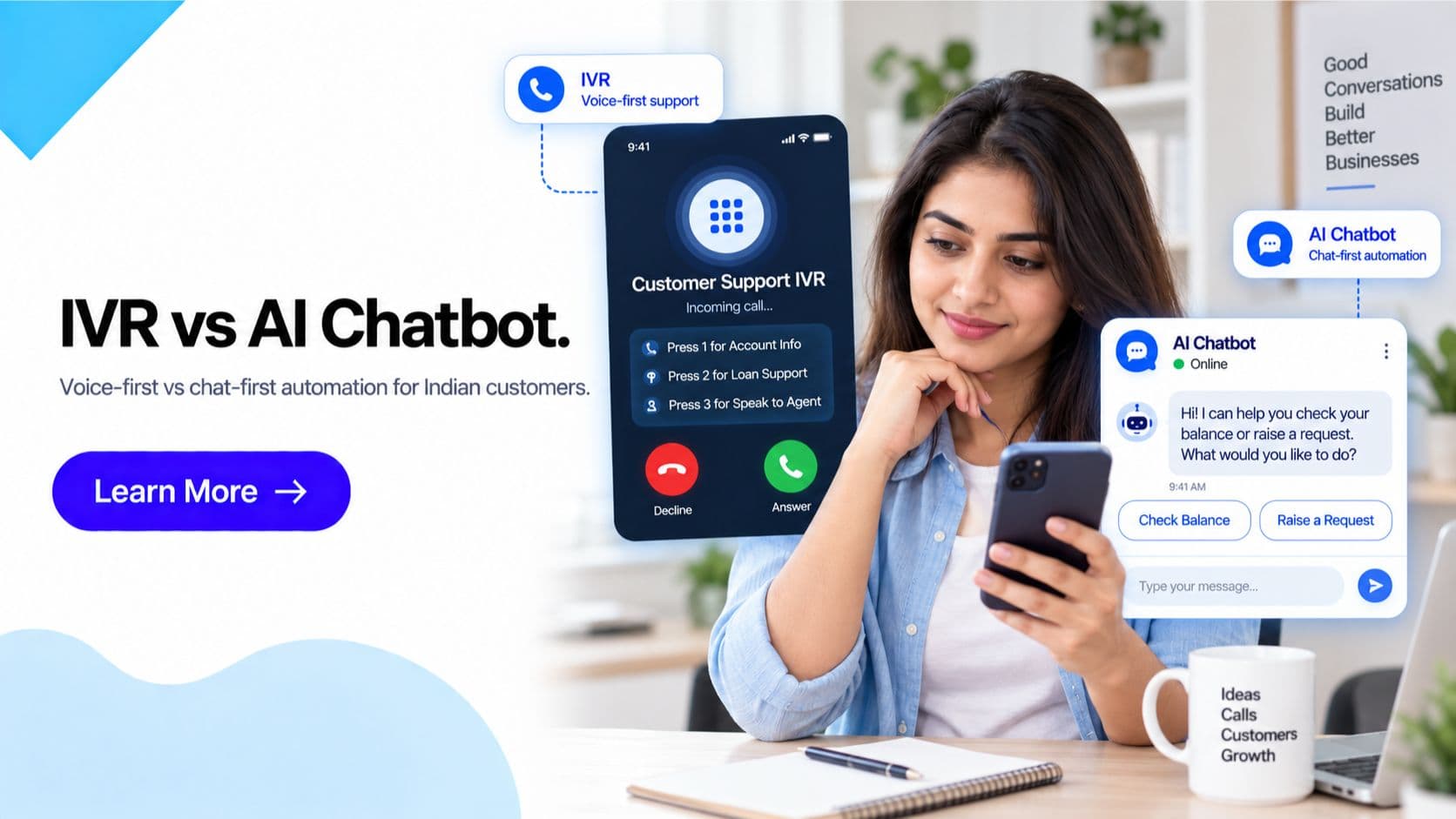
For two decades, if an Indian business wanted to automate a customer phone interaction without adding more agents, the answer was IVR- press 1 for this, press 2 for that. It still runs on nearly every business phone line in the country. But a newer automation layer has matured alongside it: AI-driven natural-language automation, which comes in two forms- an AI voicebot that holds a natural spoken conversation over the same phone line, and a text-based WhatsApp chatbot that does the same over chat. Get Click Media builds IVR flows, AI voicebots, and WhatsApp chatbots on one platform, which is a useful vantage point for comparing all three honestly rather than pushing whichever one happens to be easiest to sell.
"AI chatbot" in this comparison is deliberately broad- it spans both the voice and text/chat versions of natural-language automation, contrasted against IVR's rigid, menu-driven model. Some customers and queries are genuinely voice-first and are better served by an AI voicebot that is still phone-based but understands natural speech instead of key presses. Others are chat-first and are better served by a text-based AI chatbot they can tap through at their own pace. Both share the same structural advantage over IVR: they resolve what the customer actually wants instead of requiring the customer to translate their request into a pre-defined menu path.
This page compares traditional IVR against AI chatbot and voicebot automation across flexibility, resolution speed, cost, and compliance, so Indian businesses can decide where each genuinely fits- rather than defaulting to a bigger IVR menu because that is what has always been there, or ripping out a working phone system in favour of AI everywhere.
Quick answer: AI chatbot/voicebot automation wins decisively for natural-language flexibility, faster resolution of anything beyond the simplest request, and a materially better customer experience- whether the customer is on a call or in a chat thread. Traditional IVR still wins for very simple, low-variance call flows, lower setup complexity, and businesses not yet ready to invest in AI infrastructure. Most mature Indian businesses in 2026 run AI-driven automation as the primary layer, with a lean, fixed-menu IVR kept for simple routing and fallback.
Get an AI Voicebot- Natural-language calls · Faster resolution · IVR System
IVR vs AI Chatbot & Voicebot- 18-Point Comparison
| Dimension | Traditional IVR | AI Chatbot / Voicebot |
|---|---|---|
| How the customer interacts | Navigates fixed numeric menus- "press 1, press 2" | Speaks or types naturally, in their own words |
| Flexibility | Limited to pre-defined menu paths | Understands varied phrasing and intent within scope |
| Resolution speed- simple queries | Fast, if the option is near the top of the menu | Fast- typically resolved in one exchange |
| Resolution speed- complex queries | Slow- often needs several nested menu levels | Faster- parses intent directly, fewer steps |
| Setup complexity | Lower- fixed flow, no AI tuning required | Higher- needs intent design, testing, and tuning |
| Cost to build | Lower upfront cost | Higher upfront cost, offset by lower ongoing load |
| Cost to maintain at scale | Rises with call volume and menu complexity | Scales more efficiently once flows are tuned |
| Underlying infrastructure | Cloud telephony and call-routing platform | Same cloud telephony and call-routing platform |
| Multilingual handling | Requires a separate recorded menu per language | Can be configured to converse across languages |
| Handling unexpected phrasing | Cannot- caller must match a listed option | Designed to parse varied, unscripted phrasing |
| Escalation to human agent | "Zeroing out" to a separate queue, context often lost | Hands off with conversation context preserved |
| Analytics depth | Menu option usage, drop-off, and loop points | Same call analytics, plus resolved-intent tracking |
| Menu navigation memory load | High- caller must remember a spoken sequence | None- caller just says or types what they want |
| Scalability across channels | Voice only | Voice (voicebot) and chat (chatbot) both available |
| Personalisation | Minimal- generic menu tree for all callers | Deeper- can factor in order history and context |
| Works without AI infrastructure investment | Yes | No- requires an AI/intent layer to be configured |
| Auditability of the exact script | High- every path is fixed and predictable | Lower- responses vary within the AI's scope |
| Best-for use cases | Simple, low-variance, high-volume routing | Varied, complex, or multi-step self-service |
Self-Service Completion- IVR vs AI Voicebot
Here is a worked comparison for a mid-sized Indian support line handling a mix of routine and non-trivial queries:
| Metric | Traditional IVR | AI Voicebot |
|---|---|---|
| Monthly call volume | 50,000 calls | 50,000 calls |
| Self-serve completion rate | 38% | 68% |
| Queries resolved without human agent | 19,000 | 34,000 |
| Average handling time (self-serve) | 4.1 minutes | 1.8 minutes |
| Escalation-to-agent rate | 62% | 30% |
| Agent-handled queries | 31,000 | 15,000 |
| Average agent cost per handled query | ₹35 | ₹35 |
| Total agent cost | ₹10,85,000 | ₹5,25,000 |
| Telephony + AI platform cost per interaction | ₹4.50 | ₹7.00 |
| Total channel infrastructure cost | ₹2,25,000 | ₹3,50,000 |
| Total monthly cost | ₹13,10,000 | ₹8,75,000 |
What this shows: At identical call volume, the AI voicebot resolves nearly twice as many queries without a human agent, cuts average handling time by more than half, and reduces escalation load by roughly half- even after accounting for the extra per-interaction cost of running the AI layer on top of the same telephony line. Total monthly cost drops from ₹13.1 lakh to ₹8.75 lakh, a reduction of roughly 33%- smaller than the savings a channel switch to chat can produce, since voice minutes are still voice minutes, but the agent-cost reduction alone justifies the AI layer at this volume, and the gap widens further as escalation-heavy, complex queries make up a larger share of the mix.
Where IVR Still Wins- 5 Scenarios
IVR is not obsolete, and a bigger menu tree is not always the wrong answer. Here are 5 scenarios where traditional IVR remains the better choice:
1. Very simple, low-variance call flows
A flow that only ever needs to answer "what are your store hours" or "where is your nearest branch" does not need an AI layer to understand intent- there is only one intent. A single fixed menu option, or even a single recorded message, resolves this faster and more cheaply than configuring, testing, and maintaining an AI conversation flow for a request that never varies.
2. Extremely tight budget or no appetite for AI infrastructure
Building and tuning an AI voicebot or chatbot flow takes upfront investment in intent design, testing, and ongoing monitoring. A business with a genuinely tight budget, or simply not ready to take on an AI project this year, can still run an effective, low-cost automation layer on a well-designed IVR menu- it is a smaller lift operationally and financially.
3. Highly regulated flows requiring an exact, auditable script
Certain regulated confirmation steps- specific account changes, policy confirmations, and similar verification moments in banking and insurance- benefit from a fixed, word-for-word script that never varies and is trivially auditable after the fact. An AI layer's responses, even when well-scoped, introduce variability that some compliance teams are not yet comfortable auditing for a single mandated step.
4. Low query diversity where a fixed menu covers 95%+ of intents
If a call center's actual query pattern is already narrow- most callers want one of three or four things- a well-tuned IVR menu can capture the overwhelming majority of intents without needing natural-language understanding at all. The cost of building an AI layer is hardest to justify precisely when the query diversity it is designed to handle barely exists.
5. Legacy systems where AI integration is not yet feasible
Some businesses run call center infrastructure or CRM systems old enough that integrating a real-time AI intent layer is not currently practical without a broader modernisation project. For these businesses, a well-maintained IVR menu remains the realistic automation layer until the surrounding systems catch up.
Where AI Chatbot & Voicebot Win- 5 Scenarios
And here are 5 scenarios where AI-driven automation clearly outperforms traditional IVR:
1. High query diversity and unpredictable phrasing
When customers can ask about dozens of different things, in dozens of different ways, a fixed menu tree either grows unmanageably deep or simply fails to cover the request. An AI voicebot or chatbot parses the actual phrasing- "I want to check when my order is arriving" and "where's my package" both resolve to the same intent- without needing a separate menu branch for every possible wording.
2. Multilingual customer bases
Supporting Hindi and regional languages on IVR typically means recording and maintaining a separate menu tree per language. An AI voicebot or chatbot can be configured to converse across languages within the same flow, adapting to whichever language the customer starts in rather than routing them through a language-selection menu first.
3. Reducing average handling time and escalation load
Because the AI layer resolves intent directly instead of requiring the caller to navigate several menu levels, average handling time drops and fewer calls need to zero out to a live agent in frustration. This is the single biggest lever for reducing call center load without adding headcount.
4. Omnichannel context-carryover between voicebot and chatbot
A customer who starts an issue on an AI voicebot call and later follows up on WhatsApp does not need to repeat themselves if the voicebot and the WhatsApp chatbot share customer context. IVR has no equivalent- each call is an isolated event with no persistent thread, whereas AI-driven automation across voice and chat can carry the same conversation context forward.
5. Complex multi-step self-service
Booking an appointment with date and time flexibility, or troubleshooting a multi-step technical issue, involves back-and-forth that a rigid menu tree handles poorly- each new variable needs its own branch. An AI voicebot or chatbot can hold that back-and-forth as a natural conversation, asking follow-up questions only where genuinely needed instead of forcing the customer through every branch in sequence.
IVR vs AI Chatbot- Use Case Recommendation Matrix
| Use case | Best approach | Why |
|---|---|---|
| Store hours / branch location lookup | IVR | Single fixed answer, zero query variance |
| Balance / account status check | AI Voicebot or Chatbot | Natural phrasing, faster resolution than menu navigation |
| Complex troubleshooting (e.g. connectivity issue) | AI Voicebot or Chatbot | Multi-step diagnostic dialogue, not a single branch |
| Appointment booking or rescheduling | AI Voicebot or Chatbot | Flexible date/time understanding, no rigid sub-menus |
| Regulated account-change confirmation | IVR | Fixed, unchanging, auditable script required |
| Multilingual customer base | AI Voicebot | Configurable natural-language handling across languages |
| Outbound telemarketing / OBD campaign | IVR | Established fixed-script regulatory framework already in place |
| Order or shipment tracking | AI Chatbot (WhatsApp) | Rich content and tracking links, no phone-tree navigation |
| First-time contact with an unclear issue | AI Voicebot or Chatbot | Handles unpredictable phrasing and routes correctly |
| Legacy telephony with no AI budget | IVR | Lower setup complexity, works on existing stack as-is |
| High-volume top-level department routing | Hybrid- IVR + AI Voicebot | IVR routes quickly at the top level; AI resolves within it |
| Omnichannel support (voice + WhatsApp) | AI Voicebot + Chatbot together | Shared customer context carries across channels |
Compliance- IVR vs AI Chatbot & Voicebot in India
| Compliance requirement | Traditional IVR | AI Chatbot / Voicebot |
|---|---|---|
| DPDP Act 2023 (data protection) | Applies- call recordings require consent and secure handling | Applies- call and chat data both require consent and secure handling |
| TRAI DND regulations | Applies to outbound telemarketing calls | Applies equally to outbound AI voicebot calls- the channel does not exempt the call |
| TRAI telemarketing regulations | Applies to outbound IVR-based campaigns | Applies to outbound AI voicebot campaigns in the same way |
| TRAI DLT registration | Not applicable (DLT is SMS-specific) | Not applicable (DLT is SMS-specific) |
| Consent for outbound contact | Required per telemarketing regulations | Required per telemarketing regulations, regardless of automation type |
| Regulator-mandated voice steps | Native fit- fixed script is easy to audit | Can be scoped to defer to a fixed IVR step where specifically mandated |
See our detailed guides on the DPDP Act and voice compliance and TRAI voice call regulations for the full requirements.
The Recommended Strategy- AI-First Automation, IVR as Lean Fallback
For most Indian businesses in 2026, the highest-leverage move is not to rip out IVR entirely, nor to leave it untouched- it is to rebalance which layer carries the default load:
| Layer | Channel | Who | Purpose |
|---|---|---|---|
| Primary automation layer | AI Voicebot (phone) + AI Chatbot (WhatsApp) | Customers with varied, complex, or multi-step queries | Natural-language resolution across whichever channel the customer prefers |
| Lean fixed-menu layer | Traditional IVR | Simple, low-variance requests and low-connectivity fallback | Fast, predictable routing without AI overhead |
| Regulation-mandated step | IVR | Any customer at the specific point requiring a fixed voice script | The single mandated step only- not the entire journey |
| Escalation | Live agent | Any unresolved query from either automation layer | Full context carried over wherever technically possible |
GCM approach: Get Click Media builds AI voicebot and WhatsApp chatbot automation designed to absorb the query volume that currently strains an oversized IVR menu tree- while keeping your existing IVR system intact as a lean, purpose-built layer for the simple, regulated, and low-connectivity cases that genuinely still need it.
Frequently Asked Questions- IVR vs AI Chatbot
What is the core difference between IVR and an AI chatbot? IVR routes callers through fixed, pre-recorded menus- "press 1 for Sales, press 2 for Support"- where every path the caller can take was decided in advance by whoever built the flow. An AI chatbot, whether it is a voice-based AI voicebot or a text-based chatbot, understands what the customer actually says or types in their own words and works out the intent directly, instead of forcing the customer to find the matching menu option. The core difference is structured, pre-defined navigation versus flexible, natural-language understanding.
Is an AI chatbot always better than IVR? No. AI-driven automation wins on flexibility, speed for anything beyond the simplest request, and customer experience, but it is not automatically the right answer for every business. A very simple call flow with only two or three fixed outcomes, a tight budget with no appetite for AI infrastructure investment, or a highly regulated process that requires an exact, unchanging, auditable script can all still be better served by a traditional IVR menu than by a more flexible AI layer.
Does a business need to choose only one- IVR or AI chatbot? No, and most mature Indian businesses do not. The realistic approach is a blended model- AI voicebot and AI chatbot automation as the primary layer for common and varied queries, with a lean, fixed-menu IVR kept for the simplest low-variance requests, low-connectivity fallback, and any step that specifically mandates a fixed voice script. The two are not mutually exclusive, and in practice they usually run on the same underlying telephony infrastructure.
How does an AI voicebot differ from a text-based AI chatbot? This comparison is really about an automation philosophy- structured, menu-driven IVR versus flexible, natural-language AI handling- rather than one specific product. An AI voicebot applies that philosophy to phone calls, using speech-to-text, an AI intent layer, and text-to-speech to hold a spoken conversation. A text-based AI chatbot, such as a WhatsApp chatbot, applies the same underlying philosophy to a chat thread instead of a call. Which one a given customer or query should use depends on whether they are voice-first or chat-first, not on which technology is "better" in the abstract.
What does it cost to move from IVR to an AI-driven automation layer? Cost depends on call and chat volume, how many conversation flows and use cases the AI layer needs to cover, and what systems it needs to integrate with- booking systems, CRM, order databases, and so on. Because an AI voicebot typically runs on the same underlying telephony and IVR infrastructure a business already has, moving to AI-driven automation is usually a layered addition rather than a full rip-and-replace of existing phone systems, which keeps the incremental cost lower than building a new stack from scratch.
Which industries in India benefit most from AI chatbot and voicebot automation over traditional IVR? Industries with high query diversity, multilingual customer bases, or complex multi-step self-service needs see the biggest gains- BFSI (banking, NBFCs, insurance) for account and policy queries, e-commerce and D2C for order and delivery support, healthcare and clinics for appointment scheduling, telecom for plan and billing queries, and travel and hospitality for booking and itinerary changes. These are exactly the sectors where a fixed IVR menu tends to run out of options fastest and callers most often zero out to a human agent.
Get Started
If your IVR menu has grown into a source of caller frustration, the fix is rarely a deeper menu tree- it is shifting the queries that genuinely vary from customer to customer onto a natural-language layer built for exactly that. Get Click Media builds AI voicebot automation for the phone channel and WhatsApp chatbot automation for chat, both designed to sit alongside your existing IVR system rather than replace it outright. See how voice automation compares against another common outbound channel in our Voice Broadcast vs Bulk SMS breakdown.
Get an AI Voicebot- Natural-language calls · Faster resolution · IVR System
Article topics
Frequently Asked Questions
What is the core difference between IVR and an AI chatbot?
IVR routes callers through fixed, pre-recorded menus- "press 1 for Sales, press 2 for Support"- where every path the caller can take was decided in advance by whoever built the flow. An AI chatbot, whether it is a voice-based AI voicebot or a text-based chatbot, understands what the customer actually says or types in their own words and works out the intent directly, instead of forcing the customer to find the matching menu option. The core difference is structured, pre-defined navigation versus flexible, natural-language understanding.
Is an AI chatbot always better than IVR?
No. AI-driven automation wins on flexibility, speed for anything beyond the simplest request, and customer experience, but it is not automatically the right answer for every business. A very simple call flow with only two or three fixed outcomes, a tight budget with no appetite for AI infrastructure investment, or a highly regulated process that requires an exact, unchanging, auditable script can all still be better served by a traditional IVR menu than by a more flexible AI layer.
Does a business need to choose only one- IVR or AI chatbot?
No, and most mature Indian businesses do not. The realistic approach is a blended model- AI voicebot and AI chatbot automation as the primary layer for common and varied queries, with a lean, fixed-menu IVR kept for the simplest low-variance requests, low-connectivity fallback, and any step that specifically mandates a fixed voice script. The two are not mutually exclusive, and in practice they usually run on the same underlying telephony infrastructure.
How does an AI voicebot differ from a text-based AI chatbot?
This comparison is really about an automation philosophy- structured, menu-driven IVR versus flexible, natural-language AI handling- rather than one specific product. An AI voicebot applies that philosophy to phone calls, using speech-to-text, an AI intent layer, and text-to-speech to hold a spoken conversation. A text-based AI chatbot, such as a WhatsApp chatbot, applies the same underlying philosophy to a chat thread instead of a call. Which one a given customer or query should use depends on whether they are voice-first or chat-first, not on which technology is "better" in the abstract.
What does it cost to move from IVR to an AI-driven automation layer?
Cost depends on call and chat volume, how many conversation flows and use cases the AI layer needs to cover, and what systems it needs to integrate with- booking systems, CRM, order databases, and so on. Because an AI voicebot typically runs on the same underlying telephony and IVR infrastructure a business already has, moving to AI-driven automation is usually a layered addition rather than a full rip-and-replace of existing phone systems, which keeps the incremental cost lower than building a new stack from scratch.
Which industries in India benefit most from AI chatbot and voicebot automation over traditional IVR?
Industries with high query diversity, multilingual customer bases, or complex multi-step self-service needs see the biggest gains- BFSI (banking, NBFCs, insurance) for account and policy queries, e-commerce and D2C for order and delivery support, healthcare and clinics for appointment scheduling, telecom for plan and billing queries, and travel and hospitality for booking and itinerary changes. These are exactly the sectors where a fixed IVR menu tends to run out of options fastest and callers most often zero out to a human agent.
About the author
Get Click Media creates practical resources for businesses using messaging, automation, analytics, and digital communication to improve customer engagement. This article was published on .