

In this article
Explore the key concepts, practical considerations, and frequently asked questions related to voice broadcast (obd) vs bulk sms: which wins for time-sensitive alerts?.
Key takeaways
- An answered voice broadcast call closes the attention gap instantly, while a delivered SMS can still sit unread for hours during a fast-moving situation.
- For the highest-stakes alerts, the recommended pattern fires voice broadcast and SMS simultaneously- voice for immediate attention, SMS as a written backup record.
- Under urgency, an SMS needs the critical fact in its first line, while a voice message has more room to build urgency through tone before the fact.
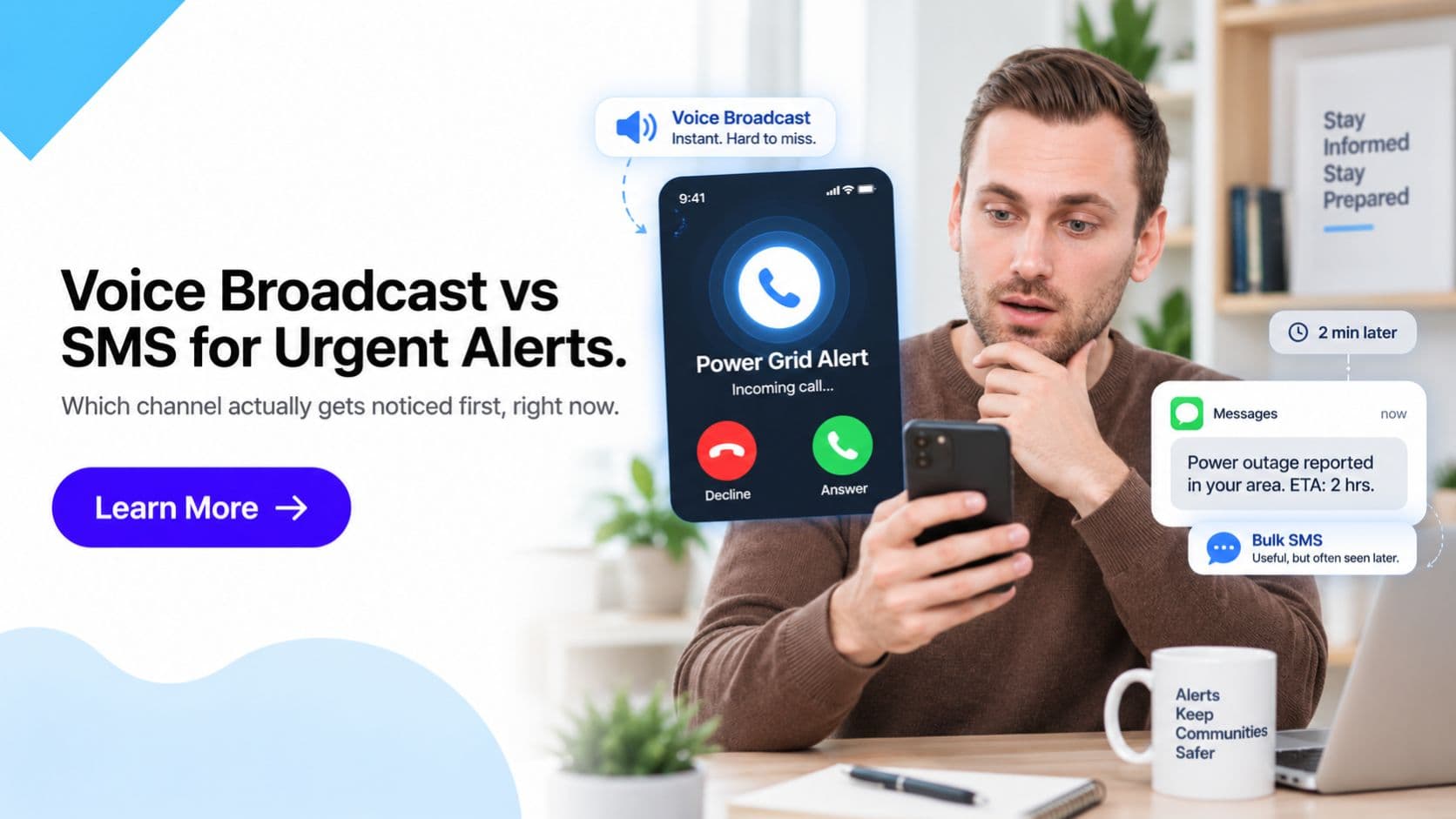
When something needs to be acted on in the next few minutes, not the next few hours, the channel that reaches the recipient fastest matters more than the channel that reaches the most recipients. Get Click Media runs both Voice Broadcast (OBD) and bulk SMS from the same platform, and for time-sensitive alerts specifically, the two behave very differently once a message actually lands. For the full cost-per-send and reach comparison between these two channels, see Voice Broadcast vs Bulk SMS- this piece focuses specifically on which channel wins when a message is time-critical.
Quick answer: Voice broadcast wins when a message must be heard immediately and a missed or ignored notification has real consequences- an active outage, a same-day deadline, a genuine emergency. Bulk SMS wins when the message just needs to be delivered and available for reference quickly, even if it isn't opened the instant it arrives.
Urgency-Specific Comparison- Voice Broadcast vs Bulk SMS
This table is scoped only to the dimensions that matter when a message is time-critical- not the cost-per-send or reach numbers already covered in our broader comparison.
| Dimension | Voice Broadcast (OBD) | Bulk SMS |
|---|---|---|
| Typical time-to-open/hear | Immediate if answered- message is heard the moment the call connects | Delivered in seconds, but opened whenever the recipient next checks their phone |
| Interrupts what the recipient is doing right now | Yes- a ringing phone forces an immediate answer/decline decision | No- sits as a notification until glanced at or dismissed |
| Works if the phone is on silent/DND/focus mode | Partially- a call can still visibly ring or vibrate depending on device settings | Yes- delivered silently regardless of focus mode, but easy to miss if notifications are muted too |
| Delivery confirmation depth | Answered, unanswered, and call duration per number | Delivered and read-receipt status per number |
| Effectiveness for elderly/low-literacy audiences in an emergency | High- a spoken alert in a familiar tone is understood immediately, no reading required | Lower- depends on the recipient reading and comprehending text under time pressure |
| Retry behavior if the first attempt goes unanswered/unread | Can be re-dialed on a schedule until answered | Sits in the inbox- no re-send needed, but no guarantee it's seen sooner |
| Cost premium for the urgency benefit | Higher per attempt, and unanswered calls still cost without delivering the message | Lower, and the cost doesn't rise even if the recipient doesn't open it right away |
| Risk of the message sitting unseen for hours | Low if answered- either it's heard now or the call is missed, no in-between | Real risk- a delivered SMS can go unread for hours during a fast-moving situation |
| Best for | The single most time-critical alert in a list, where being missed has immediate consequences | Fast, silent delivery paired with a written record the recipient can check when they look |
When Urgency Justifies the Higher Cost of Voice Broadcast
Some situations make the extra cost of a voice broadcast call an easy call, because the downside of the message being missed is immediate and specific:
- An active service outage happening right now- customers are affected at this exact moment, and a ringing phone reaches them faster than waiting for someone to open a text app.
- A same-day payment or EMI deadline- there's no lead time left for the recipient to notice a text later in the day; the deadline is today, and the message needs to register today.
- A weather or safety emergency alert- when the situation is changing in real time, a spoken alert conveys both the information and the urgency of the tone in a way flat text cannot.
- A last-minute appointment cancellation needing an immediate reschedule- the recipient needs to know and respond within a narrow window, not whenever they happen to check their phone next.
When SMS Is Fast Enough Even for Urgent Messages
Not every time-sensitive message needs a call- for a specific set of urgent scenarios, SMS's near-instant, silent delivery is already the right speed:
- OTPs and time-boxed codes- the recipient is actively waiting for the message at the exact moment it's sent, so SMS's few-second delivery is already effectively immediate; there's no attention gap to close.
- Simple deadline reminders with enough lead time- if the recipient has hours or days to act, SMS delivers fast enough and leaves a written reference they can return to before the deadline arrives.
- Any alert already paired with a voice call as backup- when voice broadcast is the primary attention-getter, SMS firing alongside it doesn't need to be the fast channel- it just needs to be the persistent written record for later.
- Follow-up confirmations after the urgent moment has passed- once the emergency call has been made or answered, a text summarizing the details is fast enough because the urgency has already been handled.
The Combined Approach- Voice for Attention, SMS for the Record
For the handful of alerts in any business where missing the message truly matters- an outage affecting live customers, a payment deadline expiring today, a genuine safety notice- the highest-performing setup isn't picking one channel, it's firing both at once. Voice Broadcast (OBD) acts as the primary attention-getter, interrupting the recipient in real time with a spoken message and optional "press 1 to confirm" element, while SMS fires simultaneously as an instant backup that lands regardless of whether the call is answered, and stays in the inbox as a written record the recipient can check back against. Neither channel alone closes both gaps- the attention gap and the reliability gap- that a genuinely urgent alert needs closed.
Frequently Asked Questions- Voice Broadcast vs SMS for Time-Sensitive Alerts
Why does a phone call get noticed faster than a text in a genuine emergency? A ringing phone forces an in-the-moment decision- answer or decline- while a text notification is easy to glance at and mentally defer, even when the recipient registers that it arrived. In a genuine emergency, that difference matters: a voice broadcast call interrupts whatever the recipient is doing right now, whereas an SMS competes with every other notification already sitting in their inbox. The call doesn't guarantee it's answered, but if it is, the message has been heard in real time rather than queued for later attention.
Is voice broadcast worth the extra cost for time-critical alerts specifically? For the highest-stakes time-critical alerts- an active outage, a same-day payment deadline, a safety notice- yes, because the cost of the message being missed or delayed usually outweighs the per-call premium. This is a narrower question than whether voice broadcast is worth it in general, which comes down to reach and cost-per-contact economics- that comparison is covered in full in our Voice Broadcast vs Bulk SMS post. Here, the calculation is specifically about urgency: what does it cost the business if this particular message isn't acted on in the next few minutes, not the next few hours?
What's the realistic time-to-attention gap between an SMS notification and an answered voice call? An SMS is typically delivered to the device within seconds, but time-to-attention depends entirely on when the recipient next looks at their phone- that could be seconds or hours later, and there's no way to know which. An answered voice broadcast call, by contrast, puts the message in the recipient's ears within the length of the call itself, with zero gap between delivery and attention once picked up. The trade-off is that a voice call can go fully unanswered, while an SMS almost always lands even if it isn't opened right away.
Should a business use both channels together for the most urgent alerts? Yes, for the alerts where missing the message has real consequences. A practical pattern is firing both at once- voice broadcast as the primary attention-getter that interrupts the recipient in real time, and SMS as an instant backup that lands regardless of whether the call is answered and stays as a written record the recipient can refer back to. Neither channel alone covers both the urgency and the reliability of delivery that a genuine emergency alert needs.
What industries most need this urgency-first approach? Utilities and infrastructure providers need it for outage notices where customers are actively affected in real time. BFSI needs it for same-day payment or EMI deadlines where the next few hours change the outcome. Healthcare needs it for appointment changes and emergency notices where a missed message has direct consequences for a patient. Logistics needs it for delivery-window changes where the recipient has to be present at a specific time. In each case, the message is only useful if it's noticed before a fast-approaching moment passes.
Does message length matter more for one channel in an urgent scenario? Yes- SMS length matters more under urgency because a recipient skimming a notification needs the critical fact (what's happening, what to do) in the first line, or it risks being read as routine and set aside. A voice broadcast message has more room to establish urgency through tone and pacing before delivering the core fact, since the recipient is already listening rather than deciding whether to keep reading. Either way, the time-sensitive detail- the deadline, the outage, the changed time- belongs at the very start of the message on both channels.
Get Started
If your business sends time-sensitive alerts through a single channel today, the fastest improvement isn't switching entirely- it's reserving Voice Broadcast (OBD) for the specific messages where being heard immediately actually changes the outcome, and letting SMS handle everything else. For the broader cost, reach, and use-case picture between the two channels, read Voice Broadcast vs Bulk SMS.
Get Voice Broadcast (OBD) set up for your most time-critical alerts today.
Article topics
Frequently Asked Questions
Why does a phone call get noticed faster than a text in a genuine emergency?
A ringing phone forces an in-the-moment decision- answer or decline- while a text notification is easy to glance at and mentally defer, even when the recipient registers that it arrived. In a genuine emergency, that difference matters: a voice broadcast call interrupts whatever the recipient is doing right now, whereas an SMS competes with every other notification already sitting in their inbox. The call doesn't guarantee it's answered, but if it is, the message has been heard in real time rather than queued for later attention.
Is voice broadcast worth the extra cost for time-critical alerts specifically?
For the highest-stakes time-critical alerts- an active outage, a same-day payment deadline, a safety notice- yes, because the cost of the message being missed or delayed usually outweighs the per-call premium. This is a narrower question than whether voice broadcast is worth it in general, which comes down to reach and cost-per-contact economics- that comparison is covered in full in our [Voice Broadcast vs Bulk SMS](/blog/voice-broadcast-vs-bulk-sms) post. Here, the calculation is specifically about urgency: what does it cost the business if this particular message isn't acted on in the next few minutes, not the next few hours?
What's the realistic time-to-attention gap between an SMS notification and an answered voice call?
An SMS is typically delivered to the device within seconds, but time-to-attention depends entirely on when the recipient next looks at their phone- that could be seconds or hours later, and there's no way to know which. An answered voice broadcast call, by contrast, puts the message in the recipient's ears within the length of the call itself, with zero gap between delivery and attention once picked up. The trade-off is that a voice call can go fully unanswered, while an SMS almost always lands even if it isn't opened right away.
Should a business use both channels together for the most urgent alerts?
Yes, for the alerts where missing the message has real consequences. A practical pattern is firing both at once- voice broadcast as the primary attention-getter that interrupts the recipient in real time, and SMS as an instant backup that lands regardless of whether the call is answered and stays as a written record the recipient can refer back to. Neither channel alone covers both the urgency and the reliability of delivery that a genuine emergency alert needs.
What industries most need this urgency-first approach?
Utilities and infrastructure providers need it for outage notices where customers are actively affected in real time. BFSI needs it for same-day payment or EMI deadlines where the next few hours change the outcome. Healthcare needs it for appointment changes and emergency notices where a missed message has direct consequences for a patient. Logistics needs it for delivery-window changes where the recipient has to be present at a specific time. In each case, the message is only useful if it's noticed before a fast-approaching moment passes.
Does message length matter more for one channel in an urgent scenario?
Yes- SMS length matters more under urgency because a recipient skimming a notification needs the critical fact (what's happening, what to do) in the first line, or it risks being read as routine and set aside. A voice broadcast message has more room to establish urgency through tone and pacing before delivering the core fact, since the recipient is already listening rather than deciding whether to keep reading. Either way, the time-sensitive detail- the deadline, the outage, the changed time- belongs at the very start of the message on both channels.
About the author
Get Click Media creates practical resources for businesses using messaging, automation, analytics, and digital communication to improve customer engagement. This article was published on .