
In this article
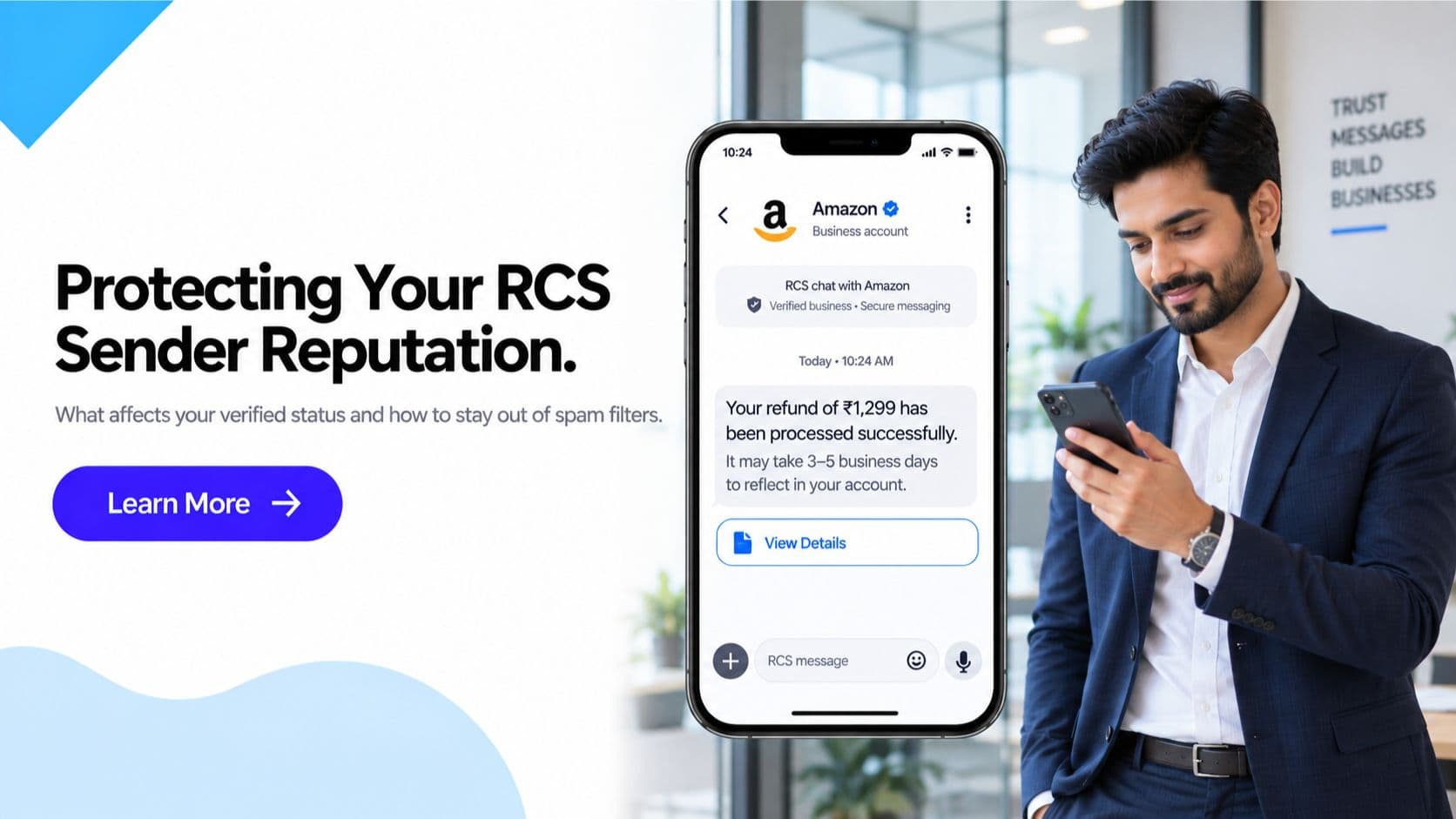
Explore the key concepts, practical considerations, and frequently asked questions related to rcs agent reputation & spam guidelines: protecting your verified sender status.
Key takeaways
- A suspended or degraded RCS agent loses its verified badge entirely and falls back to being treated like an unverified sender with no branded header.
- Honouring opt-out requests immediately and completely is described as the single biggest protector of RCS sender reputation, ahead of any other factor.
- Transactional messages like OTPs and order updates carry far less reputation risk than promotional content, which should never be disguised as transactional.
Getting your RCS agent verified is only the starting point. Once your agent carries Google's verified badge, how you send matters just as much as being approved to send in the first place. This guide covers what affects your RCS agent's reputation, the do's and don'ts for staying out of spam filters, and what to do if your standing starts to slip.
Quick answer: RCS agent reputation is the standing your verified sending agent builds up based on how recipients respond to it- how often they block it, report it as spam, or opt out. A healthy reputation keeps your messages delivering normally with full verified features; a degraded one can mean reduced delivery, a review of your verified status, or being treated like an unverified sender.
Verification Gets You In- Reputation Keeps You There
A suspended or degraded agent loses the verified badge and rich messaging features it worked to earn, and can fall back to being treated like an unverified sender- no branded header, no verification checkmark, and a meaningful hit to deliverability and recipient trust.
Reputation isn't a one-time approval- it's earned over time through consistent, respectful sending behaviour, in much the same way email sender reputation is built and lost. A single campaign rarely breaks it, but a pattern of high complaint rates, ignored opt-outs, or misleading content will, and it takes longer to rebuild than it does to lose.
What Affects Your RCS Agent Reputation
- Recipient block & report rate- how often recipients block your agent or report a message as spam is one of the clearest engagement signals platforms weigh when judging a sender's standing.
- Opt-out compliance & speed- how completely and how quickly you honour a STOP or opt-out request. Slow or partial opt-out handling is one of the fastest ways to accumulate complaints.
- Message frequency & relevance- sending more often than recipients expect, or sending content that doesn't match what they signed up for, tends to raise block rates over time.
- Content quality- misleading claims, deceptive links, or bait-and-switch messaging erode trust fast and are exactly what spam-detection systems are built to catch.
- Brand identity consistency- your verified name, logo, and message content should match. An agent that sends content unrelated to its registered brand identity looks suspicious by design.
- Complaint volume relative to send volume- a handful of complaints on a small send is very different from the same number on a campaign of millions- reputation is read as a rate, not a raw count.
Do's and Don'ts for Staying Out of Spam Filters
Do:
- Honour opt-out requests immediately and completely, across every future campaign.
- Keep links transparent and pointed at your verified domain, not obscured redirect chains.
- Segment your audience so uninterested recipients aren't blanket-blasted with every send.
- Monitor engagement and block-rate trends, and pause underperforming campaigns early.
- Keep message content consistent with your verified brand identity and what recipients signed up for.
Don't:
- Disguise promotional content as a transactional or account message.
- Use misleading or bait-and-switch preview text to inflate open rates.
- Ignore or delay an opt-out request, even by a single follow-up send.
- Send at a frequency recipients haven't agreed to or wouldn't expect.
- Route links through unfamiliar shorteners or redirect chains that obscure the destination.
Opt-Out and Consent Handling
Of everything that affects reputation, how you handle opt-outs is the single biggest protector. A recipient who asks to stop and keeps receiving messages almost always ends up blocking or reporting the sender instead- both of which hurt your standing far more than the lost recipient would have. Honouring an opt-out quickly, completely, and across every campaign is the simplest, highest-leverage thing a sender can get right.
Consent-based sending also overlaps with good data hygiene more broadly- only messaging recipients who have actually opted in, keeping suppression lists current, and being able to show that consent when asked. That broader data protection picture is its own subject, covered in our DPDP Act & RCS compliance guide; this section focuses specifically on what keeps an RCS agent's sending reputation healthy.
What Happens if Your Agent's Reputation Degrades
- Reduced delivery or visibility- a rising complaint rate is treated as a negative signal, and messages can start reaching fewer recipients before any formal action is taken.
- Review or suspension of verified status- a sustained pattern can trigger a review of the agent, and in persistent cases, suspension of its verified badge and rich features.
- A practical remediation path- pause the campaign, review what changed, tighten targeting and opt-out handling, then work with your provider to request a review.
The exact review process sits with Google as the platform operator, so this is general guidance rather than a fixed procedure- in practice, the fastest path back is fixing the underlying sending behaviour, not just waiting it out.
How Get Click Media Helps Protect Your Sending Reputation
- Automatic suppression list management- opt-outs are captured and suppressed across future sends automatically, so a recipient who has opted out never receives another campaign message by accident.
- Engagement monitoring dashboards- dashboards that surface block-rate and report-rate trends per campaign, so a problem is visible while it's still small and easy to correct.
- Pre-send campaign review- support reviewing content, targeting, and frequency before a large send goes out, catching the kind of issue that's expensive to fix after the fact.
- Onboarding guidance on best practices- dedicated account guidance during onboarding on content, consent, and frequency best practices, so good sending habits are built in from day one.
This sits alongside the agent verification process Get Click Media manages during onboarding- getting your agent approved is step one, keeping its reputation healthy is the ongoing part.
The Bottom Line
Verification opens the door; reputation is what keeps you in the room. The businesses that get the most out of RCS treat opt-out handling, frequency, and content quality as ongoing discipline rather than a one-time setup step- because a healthy agent reputation is far easier to maintain than it is to rebuild once lost.
Get Click Media is one of India's leading RCS messaging service providers, pairing verified agent onboarding with engagement monitoring and automatic opt-out suppression so your sending reputation stays healthy as you scale. Request a demo to see how our platform protects your verified status.
Article topics
Frequently Asked Questions
What is RCS agent reputation?
RCS agent reputation is the overall standing your verified sending agent builds up based on how recipients engage with it- block rates, spam reports, and opt-out behaviour all feed into it, similar in spirit to how email sender reputation works.
What can cause an RCS agent to be suspended?
In practice, agents that generate a high rate of recipient blocks or spam reports, ignore opt-out requests, or send content that misrepresents the registered brand tend to draw review or restriction. Google's RCS Business Messaging content and agent guidelines are designed to protect recipients from exactly this kind of behaviour, so persistent violations can lead to a suspended or degraded agent.
How do I keep my RCS sender reputation healthy?
Honour opt-outs immediately, keep message frequency reasonable, send content that matches what recipients actually signed up for, use transparent links to your verified domain, and monitor engagement trends so a dip gets addressed while it's still small.
What happens if too many recipients report my RCS messages as spam?
A rising report rate is treated as a strong negative signal. In practice this can mean reduced delivery or visibility for future messages, and if the pattern continues, a review of the agent's verified status- which is why it's worth pausing and investigating a campaign the moment report rates start climbing.
Does message frequency affect my RCS agent's standing?
Yes- sending more frequently than recipients expect is one of the more common triggers for blocks and opt-outs, even when the content itself is relevant. Segmenting your audience and pacing sends to match expectations helps keep engagement healthy.
How fast should I honour an RCS opt-out request?
As close to immediately as your systems allow. Honouring opt-outs quickly and completely is one of the single biggest protections for sender reputation, and it overlaps with good consent-based data hygiene more broadly.
Can a suspended RCS agent be reinstated?
Reinstatement generally depends on addressing the underlying cause- reviewing and correcting the campaigns, targeting, or opt-out handling that led to the suspension, then working with your messaging provider to request a review. Get Click Media supports businesses through that remediation process where it's needed.
Do promotional and transactional RCS messages carry the same reputation risk?
Not quite- recipients generally expect transactional messages (like OTPs or order updates) and are far less likely to block or report them. Promotional content carries more reputation risk, which is why it should never be disguised as transactional and should always respect opt-out preferences.
Does Get Click Media monitor my agent's reputation for me?
Yes- opt-out suppression is handled automatically, and engagement monitoring dashboards flag rising block or report rates early so campaigns can be adjusted before reputation takes a real hit.
About the author
Get Click Media creates practical resources for businesses using messaging, automation, analytics, and digital communication to improve customer engagement. This article was published on .