

In this article
Explore the key concepts, practical considerations, and frequently asked questions related to toll-free number vs virtual number: which do you need? | gcm.
Key takeaways
- On a toll-free number the business pays for every call; on a virtual number the caller pays standard rates- the core structural difference.
- A worked comparison shows a toll-free support line can cost roughly 4-5x more per call than a virtual-number sales team at similar volumes.
- Virtual numbers typically go live within hours, while toll-free numbers take a few business days for 1800-prefix provisioning and IVR routing setup.
Almost every Indian business eventually asks the same question: should our main phone number be a toll-free number or a virtual number? The two get confused constantly because both run on cloud telephony, both support IVR routing, and both can look identical to a caller dialling in. But they solve genuinely different problems, and picking the wrong one means either overpaying for a feature you don't need or under-investing in the credibility signal your customers are looking for.
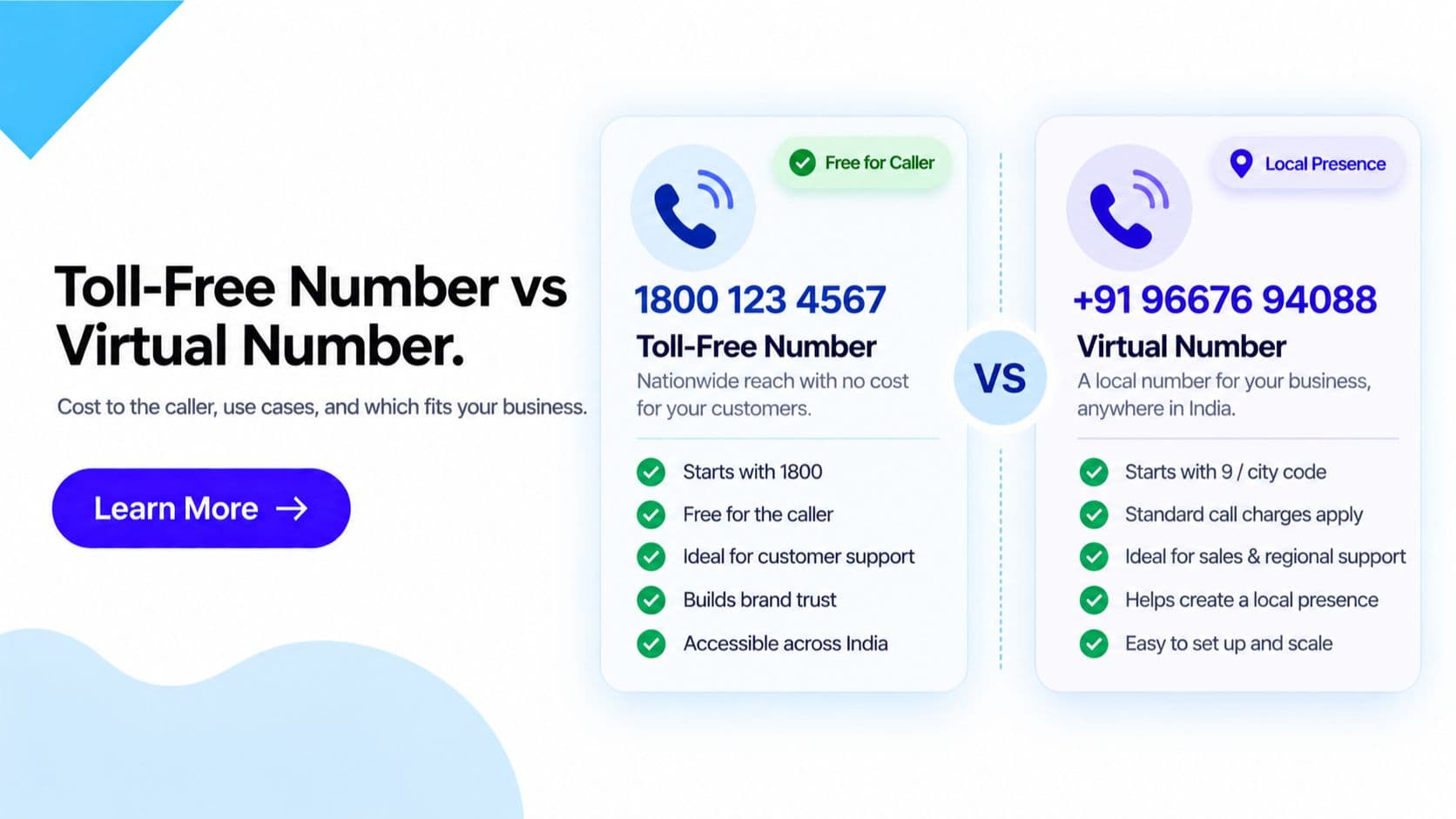
The real difference isn't features- it's who pays for the call, and what that payment structure signals. A toll-free number puts the entire cost of the call on the business, which is precisely why it works so well for consumer-facing support and sales lines where you want zero friction between a customer and a call. A virtual number bills like a normal business number, which is precisely why it's cheaper, faster to deploy, and better suited to internal team routing, sales reps working from personal phones, and number masking. This page walks through both in detail so you can match the number to the job, not the other way round.
Quick answer: Choose a toll-free number if you're running a consumer-facing support or sales helpline where removing call cost for the customer matters, or if you want to project a large, national, established brand. Choose a virtual number if you need fast, low-cost setup for internal team routing, sales reps on personal devices, number masking, or multi-location call handling. Most growing businesses eventually run both- a toll-free front door with virtual numbers handling the routing behind it.
Get a Toll-Free Number or a Virtual Number- Cloud telephony · No hardware · Live in days or hours
Toll-Free Number vs Virtual Number- 16-Point Comparison
| Dimension | Toll-Free Number | Virtual Number |
|---|---|---|
| Who pays for the call | The business- caller pays nothing | Billed like a normal number- caller pays standard rates |
| Caller's perceived cost | Zero- removes hesitation to call in | Same as calling any other business line |
| Typical number format | 1800-prefix, instantly recognizable in India | Local or virtual mobile-style number |
| Setup speed | A few business days- number plus IVR routing | Often live within hours |
| Cost to the business | Higher- absorbs every caller's per-minute charge | Lower- billed at standard local/STD telephony rates |
| Best for | Consumer-facing support and sales lines meant to be answered | Internal team routing, sales reps, number masking |
| Works on personal devices | Yes- via IVR menu routing to an agent's device | Yes- routes directly to any configured device |
| Number masking capability | Not the primary use case | Yes- commonly used to mask real numbers on both ends |
| Multi-agent/team routing | Yes- via IVR menu to departments | Yes- core use case, with time and availability-based rules |
| IVR integration | Included by default | Available, and commonly the number underlying an IVR flow |
| Call recording/analytics | Included | Available |
| Brand perception | Signals a large, established, national-scale brand | Neutral- reads as a normal business number |
| Portability | Tied to the 1800 series, provider-managed | Easily reassigned or reconfigured without new hardware |
| Hardware/SIM required | No- runs on cloud telephony | No- runs on cloud telephony |
| Regulatory prefix requirement | Yes- 1800 prefix in India | No special prefix required |
| Scalability for national campaigns | Strong- one memorable, free-to-call number everywhere | Works, but doesn't carry the same free-to-call signal |
Support Line vs Sales Team- A Worked Cost Comparison
Here's a worked comparison between a national consumer support helpline running on a toll-free number and a 12-person sales team routed through virtual numbers, at realistic monthly call volumes:
| Metric | Toll-Free Support Line | Virtual Number Sales Team |
|---|---|---|
| Use case | Consumer support helpline, national brand | 12-person sales team on personal phones |
| Monthly call volume | 30,000 inbound calls | 22,000 inbound + outbound calls |
| Who pays the per-minute charge | The business- caller pays nothing | The business, at standard local/STD rates |
| Average call duration | 4.0 minutes | 2.5 minutes |
| Per-minute telephony cost | ₹0.90/min | ₹0.35/min |
| Monthly telephony cost | ₹1,08,000 | ₹19,250 |
| Number rental/platform fee | ₹5,000/month (1800-prefix line + IVR) | ₹4,500/month (routing across 12 lines) |
| Total monthly cost | ₹1,13,000 | ₹23,750 |
| Cost per call | ₹3.77 | ₹1.08 |
| Typical setup time | A few business days | Live within hours |
| Hardware/SIM needed | No- cloud telephony | No- routes to existing smartphones |
What this shows: At comparable call volumes, the toll-free support line costs roughly 4-5x more per call than the virtual number setup- almost entirely because the business is absorbing 100% of the caller's telephony cost rather than the caller's own plan covering it. That premium isn't wasted money, though- it buys something the cheaper channel can't: zero cost friction for a price-sensitive or first-time customer to dial in, plus the credibility signal of a national 1800 number on every ad and package. For an internal sales team where the goal is flexible routing rather than brand projection, a virtual number delivers the same call-handling capability- IVR, recording, analytics- at a fraction of the running cost.
When You Need a Toll-Free Number- 5 Scenarios
1. Consumer support helplines
Any support line where customers are expected to call in with account issues, order problems, or complaints benefits from removing cost as a barrier entirely. A toll-free number means a customer never hesitates to call because they're worried about their own balance- which typically translates into more customers reaching out before a small issue becomes a churn risk.
2. National brand credibility
A local virtual number tied to one city code reads as a small, regional operation. A 1800-prefix toll-free number reads as a large, established, national business- regardless of how many people actually staff the line. For businesses trying to project scale to a pan-India customer base, the number itself does some of that work before a single call is even answered.
3. Marketing campaigns where removing call cost matters
Print ads, TV spots, packaging, and outdoor campaigns all rely on a customer choosing to dial in on their own initiative. A toll-free number removes any friction from that decision- there's no calculation in the customer's head about what the call will cost them. For campaigns measured on response rate, that removed friction can materially change how many people actually pick up the phone.
4. Government and regulated services
Citizen helplines, regulated financial services, and public-facing government or utility lines commonly default to toll-free numbers specifically because the audience includes price-sensitive callers who should never be discouraged from reaching out over the cost of a call. The free-to-call structure signals public trust as much as it removes an actual cost barrier.
5. High call-volume centralized support
Once a support operation is handling large volumes centrally- tens of thousands of calls a month- the toll-free premium gets justified by scale and brand consistency. A single, memorable, free-to-call number across every market the business serves is easier to advertise and easier for customers to remember than city-specific virtual numbers.
When You Need a Virtual Number- 5 Scenarios
1. Sales reps working from personal phones
A sales team calling and receiving leads on their own smartphones shouldn't be handing out personal mobile numbers to prospects. A virtual number lets each rep make and take business calls from the device they already carry, while the number the customer sees stays a professional business line, not a personal one.
2. Number masking for marketplace, delivery, and gig platforms
Marketplaces, delivery apps, and gig platforms need to connect a customer and a rider or vendor without either side seeing the other's real mobile number. A virtual number handles this natively- both parties dial a masked number, the platform routes the call, and neither phone number is ever exposed.
3. Multi-location businesses needing one number routed to many branches
A business with several branches or regional offices can advertise a single virtual number and route incoming calls by the caller's location, time of day, or agent availability- without needing a separate number for every branch or a customer having to know which one to dial.
4. Quick setup for startups and SMBs
A startup or small business that needs a working, professional call setup today- not in a few business days- is almost always better served by a virtual number. It runs on existing cloud telephony infrastructure, needs no new SIM or hardware, and can be live with IVR routing within hours.
5. Click-to-call on websites and ads
A click-to-call button on a website or digital ad typically connects the visitor to a virtual number that routes straight to a sales or support team. There's no need for the toll-free cost premium here- the visitor initiated the call themselves by clicking, so the friction a toll-free number removes doesn't apply in the same way.
Toll-Free vs Virtual Number- Use Case Recommendation Matrix
| Use case | Best number type | Why |
|---|---|---|
| Consumer support helpline | Toll-free | Removes cost friction, encourages every customer to call in |
| National ad or packaging campaign number | Toll-free | One memorable, free-to-call number across every market |
| Sales rep calling from a personal phone | Virtual number | Masks the personal number, routes through a business line |
| Marketplace/delivery/gig platform masking | Virtual number | Hides both customer and rider/vendor real numbers |
| Multi-location business, one public number | Virtual number | Routes one number to many branches by rule |
| Startup or SMB needing a number live today | Virtual number | Fastest, cheapest setup- no dedicated 1800 line needed |
| Click-to-call button on a website or ad | Virtual number | Connects an already-motivated visitor without a cost premium |
| Government or regulated citizen helpline | Toll-free | Removes cost barrier for citizens, projects public trust |
| High call-volume centralized support center | Toll-free | Cost premium justified by scale and brand consistency |
| Internal department or agent-level routing | Virtual number | Runs the routing logic behind a public-facing front door |
Using Both Together- Toll-Free Front Door, Virtual Numbers Behind It
The two aren't mutually exclusive, and most businesses that scale past a certain size end up running both- not as a compromise, but because each does the part of the job the other isn't built for.
| Layer | Number type | Purpose |
|---|---|---|
| Public-facing entry point | Toll-free number | The one number customers see and dial for free |
| Department/agent-level routing | Virtual numbers | Route the incoming call to the right team, branch, or agent |
| Individual sales or support agent | Virtual number | Agent takes the call on a personal device without exposing their own number |
| Escalation | Virtual number or live agent transfer | Context carried through, still under the same toll-free front door |
A common pattern: a national brand advertises one toll-free number for support. Behind it, an IVR system routes the call, and virtual numbers connect it to the specific agent, department, or branch that should actually handle it- the customer never knows or needs to know that multiple numbers are involved. The toll-free number does the brand and cost-removal job; the virtual numbers do the operational routing job.
Frequently Asked Questions- Toll-Free Number vs Virtual Number
Who pays for the call on a toll-free number versus a virtual number? On a toll-free number, the business absorbs the entire cost of the call- the caller pays nothing, regardless of how long the call lasts. On a virtual number, the call is billed like any normal business number- the caller pays their own standard local or STD calling rate as determined by their telecom plan, while the business only covers its own outbound and platform costs. This is the single biggest structural difference between the two.
Which is cheaper and faster to set up- a toll-free number or a virtual number? A virtual number is typically both cheaper and faster to set up. Since it runs on existing cloud telephony infrastructure and doesn't need a dedicated 1800-prefix line, a virtual number can often go live within hours. A toll-free number involves choosing a 1800-prefix number and defining IVR routing, which usually takes a few business days, and because the business absorbs 100% of the caller's cost, its ongoing per-minute telephony spend is meaningfully higher at the same call volume.
Can a business use both a toll-free number and virtual numbers at the same time? Yes, and this is one of the most common setups. A business runs one toll-free number as its public-facing support or sales line, then uses virtual numbers behind the scenes to route calls to individual agents, departments, or branch locations. The caller only ever dials the one toll-free number- the virtual numbers handle the internal routing logic invisibly.
Is a virtual number the same as a regular mobile number? No. A virtual number isn't tied to any physical SIM card or handset- it exists in the cloud and routes calls to whichever device, app, or team member you configure, and that routing can be changed anytime without swapping hardware. A regular mobile number is fixed to one SIM and one device. A virtual number can still ring a mobile phone, but the number itself isn't bound to it.
Does a toll-free number require special registration or an 1800 prefix? In India, toll-free numbers carry the recognizable 1800 prefix, and provisioning one runs through your telephony provider rather than a walk-in SIM purchase. There's no physical line installation since it runs on cloud telephony infrastructure, but because the business is billed for every incoming call, providers typically require you to define your expected call volume and IVR routing upfront as part of setup.
Which is better for a small business versus a large consumer brand? A small business or startup is usually better served starting with a virtual number- it's faster and cheaper to set up, works on the personal phones your team already carries, and adds professional routing without new hardware. A large consumer brand running high-volume support, sales, or marketing lines typically layers in a toll-free number once it needs to remove call cost as a barrier and project a national, established presence- often running both, with virtual numbers still doing the internal routing behind the toll-free front door.
Get Started
If you're still deciding, the shortcut is this: are you trying to remove cost friction for a consumer calling in, or are you trying to route calls flexibly across a team without new hardware? The first points to a toll-free number; the second points to a virtual number. Get Click Media provisions both on cloud telephony infrastructure- no physical installation, IVR routing and call recording included- so you can start with the one you need today and add the other as you scale. For a related comparison on capturing calls versus answering them, see our IVR vs missed call service breakdown.
Get a Toll-Free Number or a Virtual Number- Cloud telephony · No hardware · Live in days or hours
Article topics
Frequently Asked Questions
Who pays for the call on a toll-free number versus a virtual number?
On a toll-free number, the business absorbs the entire cost of the call- the caller pays nothing, regardless of how long the call lasts. On a virtual number, the call is billed like any normal business number- the caller pays their own standard local or STD calling rate as determined by their telecom plan, while the business only covers its own outbound and platform costs. This is the single biggest structural difference between the two.
Which is cheaper and faster to set up- a toll-free number or a virtual number?
A virtual number is typically both cheaper and faster to set up. Since it runs on existing cloud telephony infrastructure and doesn't need a dedicated 1800-prefix line, a virtual number can often go live within hours. A toll-free number involves choosing a 1800-prefix number and defining IVR routing, which usually takes a few business days, and because the business absorbs 100% of the caller's cost, its ongoing per-minute telephony spend is meaningfully higher at the same call volume.
Can a business use both a toll-free number and virtual numbers at the same time?
Yes, and this is one of the most common setups. A business runs one toll-free number as its public-facing support or sales line, then uses virtual numbers behind the scenes to route calls to individual agents, departments, or branch locations. The caller only ever dials the one toll-free number- the virtual numbers handle the internal routing logic invisibly.
Is a virtual number the same as a regular mobile number?
No. A virtual number isn't tied to any physical SIM card or handset- it exists in the cloud and routes calls to whichever device, app, or team member you configure, and that routing can be changed anytime without swapping hardware. A regular mobile number is fixed to one SIM and one device. A virtual number can still ring a mobile phone, but the number itself isn't bound to it.
Does a toll-free number require special registration or an 1800 prefix?
In India, toll-free numbers carry the recognizable 1800 prefix, and provisioning one runs through your telephony provider rather than a walk-in SIM purchase. There's no physical line installation since it runs on cloud telephony infrastructure, but because the business is billed for every incoming call, providers typically require you to define your expected call volume and IVR routing upfront as part of setup.
Which is better for a small business versus a large consumer brand?
A small business or startup is usually better served starting with a virtual number- it's faster and cheaper to set up, works on the personal phones your team already carries, and adds professional routing without new hardware. A large consumer brand running high-volume support, sales, or marketing lines typically layers in a toll-free number once it needs to remove call cost as a barrier and project a national, established presence- often running both, with virtual numbers still doing the internal routing behind the toll-free front door.
About the author
Get Click Media creates practical resources for businesses using messaging, automation, analytics, and digital communication to improve customer engagement. This article was published on .