

In this article
Explore the key concepts, practical considerations, and frequently asked questions related to ivr vs missed call service: which should you use? | gcm.
Key takeaways
- A missed-call campaign can generate 80,000 leads a month at roughly ₹0.15 per response, since the call never actually connects.
- IVR needs a connected call and carries per-minute telephony cost, while a missed call disconnects after one or two rings at zero cost to anyone.
- Missed call suits ad-response lead capture and rural low-literacy audiences; IVR suits account self-service, order/EMI checks, and multi-department routing.
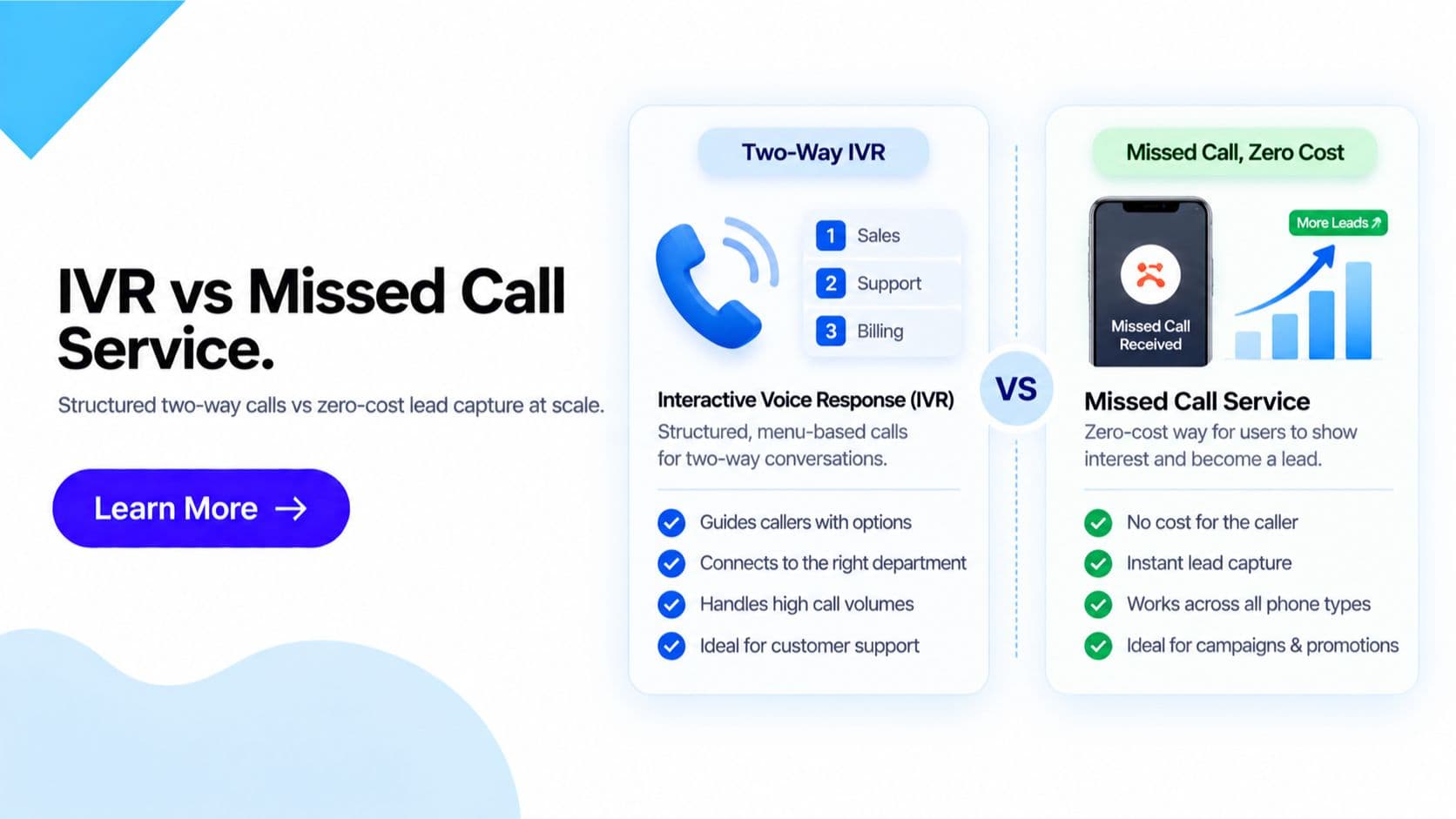
"Give us a missed call to register" and "Press 1 for Sales, 2 for Support" are both instantly recognisable to any Indian phone user- and both are voice-based automation tools that Get Click Media builds for businesses across the country. But they solve genuinely different problems, and treating them as interchangeable is where most businesses go wrong. An IVR system gives you structured, two-way self-service- menus, routing, account queries- while a missed call alert service gives you zero-cost-to-caller lead capture at scale, with no connection ever made.
This isn't a case of one channel replacing the other, the way a newer messaging channel might replace an older one. Both are voice products, both run on the same cloud telephony account, and a large share of Get Click Media's customers end up using both- often for the same campaign, at different stages of the same customer journey. The question worth answering isn't "which one should I switch to," it's "which one fits the specific interaction I need right now."
This page compares IVR and missed call service across setup, cost, caller experience, and use case, and lays out a clear decision framework for when to deploy each- and when to run them together.
Quick answer: Use a missed call service when you need the lowest-friction possible call-to-action for lead capture at volume- ad response, opt-ins, "give us a missed call" campaigns- where the caller does nothing beyond dialing and hanging up. Use an IVR system when the caller needs to actually do something during the call- navigate a menu, check an account, reach the right department, or complete a structured multi-step interaction. Most businesses running both acquisition and support end up needing both, connected: missed call captures the lead, IVR (or SMS/WhatsApp) carries the follow-up.
Explore IVR System · Explore Missed Call Alert Service- Same account · Same dashboard · Toll-Free Numbers
IVR vs Missed Call Service- 16-Point Comparison
| Dimension | IVR System | Missed Call Service |
|---|---|---|
| Purpose | Structured two-way self-service and call routing | Zero-cost lead-capture trigger |
| Caller action | Stays on the line, presses keys, navigates menus | Dials and hangs up- call disconnects automatically |
| Who pays for the call | The business (typically via toll-free number) | No one- the call disconnects before it connects |
| Connection required | Yes- the call actually connects and is answered by the system | No- built specifically to disconnect after one or two rings |
| Conversation depth | Multi-level menus, sub-menus, self-service lookups | None- the missed call event itself is the entire signal |
| Best for | Account queries, department routing, order/EMI checks, surveys | Ad response, opt-ins, polling, high-volume registration |
| Typical cost structure | Per-minute telephony + platform/flow-builder cost | Flat cost per number/campaign- no per-call telephony charge to anyone |
| Setup complexity | Moderate- design a call tree, record greetings, define routing | Low- provision a number, define the auto-trigger, go live |
| Lead data captured | Caller identity plus whatever the menu path reveals | Caller number and timestamp only, at the moment of the missed call |
| Follow-up mechanism | Live agent transfer, voicemail, or self-service resolution in-call | Automated SMS/WhatsApp reply, CRM entry, or outbound callback- after the call |
| Compliance angle | Toll-free/telemarketing rules apply if used for outbound calling | Inbound-only by design- lowest regulatory friction of any voice channel |
| Integration options | CRM lookups, order-status APIs, self-service data pulls mid-call | CRM lead entry, SMS/WhatsApp trigger, outbound dialer trigger |
| Works on any phone | Yes- any phone that can make and hold a call | Yes- any phone that can dial and hang up |
| Response effort for the caller | Moderate- must listen, remember options, press keys | Minimal- dial and disconnect, no menu to navigate |
| Analytics available | Menu usage, drop-off points, call-path data | Call volume, response rate, time-of-day patterns |
| Number type typically used | Toll-free (1800-prefix) or local virtual number | Dedicated missed-call number, often advertised alongside toll-free |
| Scales to high volume campaigns | Yes, but each connected call carries telephony cost | Yes- and cost per response stays near zero regardless of volume |
A Worked Comparison- Acquisition Campaign vs Support Line
Here's a side-by-side for two common deployments running in the same month for a mid-size Indian business: a missed-call lead-capture campaign advertised on packaging and radio, and a support IVR line handling existing customer account queries.
| Metric | Missed Call Campaign | Support IVR Line |
|---|---|---|
| Monthly call attempts | 80,000 | 40,000 |
| Cost to caller per attempt | ₹0 | ₹0 (toll-free) |
| Calls that connect | 0- by design | 40,000 |
| Leads/records captured | 80,000 (number + timestamp) | Not applicable- these are existing customers |
| Self-serve queries resolved in-call | Not applicable | 15,600 (39%) |
| Escalated to agent/callback | Not applicable | 24,400 (61%) |
| Automated follow-up sent | 80,000 SMS/WhatsApp replies | Not applicable- resolution happens in-call |
| Telephony/platform cost per attempt | ₹0.15 (number rental + auto-trigger only) | ₹4.20 (connected minutes + platform) |
| Total monthly telephony/platform cost | ₹12,000 | ₹1,68,000 |
| Average agent cost per escalated query | Not applicable at this stage | ₹35 |
| Total agent cost | Not applicable at this stage | ₹8,54,000 |
| Total monthly cost | ₹12,000 | ₹10,22,000 |
What this shows: These two numbers aren't in competition- they're not measuring the same thing. The missed call campaign generates 80,000 raw leads at a cost of roughly ₹0.15 each, because no call ever actually connects. The support IVR line resolves genuine two-way queries for 40,000 existing customers at a materially higher per-interaction cost, because every one of those calls connects, is handled by a system (or an agent), and requires real telephony minutes. Trying to run the support line's query volume through a missed-call number would fail immediately, since a missed call carries no information beyond "this number called"- and trying to run the acquisition campaign through IVR would multiply its cost by roughly 100x for no added benefit, since the campaign's entire value is in its zero-friction, zero-cost simplicity.
When Missed Call Service Wins- 5 Scenarios
1. Ad-response lead capture
"Give us a missed call to know more"- printed on a hoarding, packaging, a newspaper ad, or read out in a radio spot- is the lowest-friction response mechanism available to an Indian audience reacting to an ad in the moment. There's no form, no app, no website to remember; a missed call number captures the response instantly and triggers an automated SMS or WhatsApp follow-up with more details.
2. Zero-cost-to-customer campaigns
Whenever the campaign's core promise depends on costing the customer nothing- "call to enter," "call to register," "call to claim"- a missed call number is the only voice mechanism that genuinely delivers on that promise. Even a toll-free number, while free to the caller, still involves an actual connected call and a wait; a missed call number involves neither.
3. Simple yes/no opt-ins and polling
Registering a vote, an opinion, or a binary opt-in ("call this number to subscribe to alerts") doesn't need a menu, a spoken prompt, or any navigation- it needs a single unambiguous action from the respondent. A missed call to a dedicated number is exactly that action, and it scales to any audience size without adding agent load or connected-call cost.
4. High-volume, low-friction registration
Event registrations, contest entries, and service activations that need to handle tens of thousands of simultaneous responses benefit from a channel with effectively no marginal cost per response and no connection to manage. A missed call number handles this volume the same way at 1,000 or 1,000,000 calls, since no call is ever actually held open.
5. Rural and low-literacy audiences
A missed call requires no reading, no menu comprehension, and no ability to navigate spoken options- just dialing a number that's often printed in large digits on a hoarding or packaging. For audiences where literacy or language comprehension of a spoken IVR menu could be a barrier, a missed call CTA remains accessible in a way a multi-level voice menu is not.
When IVR Wins- 5 Scenarios
1. Multi-department call routing
The moment a business needs to route callers to Sales, Support, Billing, or a specific regional team based on what the caller actually wants, that requires a menu the caller can respond to in real time- something a missed call, by definition, cannot provide since the call never connects. IVR's drag-and-drop flow designer handles this routing without a human needing to manually transfer every call.
2. Account self-service
Balance checks, plan details, and account status queries need the caller to identify themselves and navigate to the specific information they want- a structured, in-call interaction. This is squarely IVR territory: a connected call, a menu, and (increasingly) a self-service lookup against account data, all within the same call.
3. Order status and EMI checks
Checking an order's delivery status or an EMI due date requires the system to look up specific caller-provided information (an order number, an account number) and read back a real-time answer- something that needs an actual connected, interactive call rather than a one-way missed-call signal.
4. Structured surveys and feedback collection
A survey with more than a single yes/no question- rating a service 1 to 5, then optionally leaving detailed feedback- needs a caller to respond to sequential prompts across a single call. IVR supports this natively; a missed call number can capture, at most, the fact that someone called, not a structured multi-question response.
5. Regulated confirmation steps
Certain banking and insurance processes still default to a voice-based confirmation step as part of account changes or policy verification. These need an actual connected call where the caller affirmatively responds to a specific prompt- a requirement a missed call, which never connects, cannot satisfy on its own.
IVR vs Missed Call- Use Case Recommendation Matrix
| Use case | Best channel | Why |
|---|---|---|
| "Call to know more" ad response | Missed Call | Zero cost, zero friction, works for any audience |
| Multi-department call routing | IVR | Needs real-time caller choice mid-call |
| Contest entry / voting | Missed Call | Single unambiguous action, no menu needed |
| Account balance/status check | IVR | Requires caller identification and structured lookup |
| Service activation opt-in | Missed Call | Confirms opt-in with zero commitment beyond a dial |
| Order status / EMI due-date check | IVR | Needs a live, interactive data lookup during the call |
| Rural/low-literacy lead capture | Missed Call | No reading or menu comprehension required |
| Structured customer satisfaction survey | IVR | Needs sequential, multi-question in-call responses |
| High-volume event registration | Missed Call | Scales with no marginal connected-call cost |
| Regulated account-change confirmation | IVR | Requires an actual connected, affirmative voice response |
| First response to an offline ad campaign | Missed Call | Lowest-friction possible response mechanism |
| Existing customer support line | IVR | Needs real routing, self-service, and escalation paths |
Using Both Together
Since Get Click Media runs IVR and missed call alert service on the same cloud telephony account, the two are frequently deployed as a connected pair rather than a single choice:
- Missed call captures the lead from an ad, hoarding, or packaging CTA, logging the caller's number and timestamp with zero cost or friction to them.
- An automated SMS or WhatsApp message fires immediately, giving the lead more information or a next step without requiring any human to be watching a dashboard.
- An outbound IVR call or agent callback can be triggered from the same missed-call event, moving the lead from a raw signal into a structured, two-way interaction- qualifying the lead, booking an appointment, or routing them to the right department, using the same IVR flow designer that runs your support line.
- The same toll-free number infrastructure that answers your support IVR calls can sit right alongside the missed-call number advertised in the same campaign, so a customer who wants to skip the automated follow-up and call in directly always has that option too.
This combined pattern- missed call for top-of-funnel capture, IVR for the structured interaction that follows- covers the acquisition-to-resolution journey without asking either product to do a job it wasn't built for.
Frequently Asked Questions- IVR vs Missed Call Service
Can a business use IVR and a missed call service together? Yes- and for most businesses running both an acquisition campaign and a support line, that's the recommended setup rather than an either-or choice. A missed call number typically sits at the top of the funnel capturing leads at zero cost to the caller, while an IVR system handles the structured, two-way interaction that follows- account routing, order status, or a callback flow. Get Click Media runs both on the same account, so a missed call can trigger an outbound IVR call, SMS, or WhatsApp follow-up automatically.
What's the real cost difference between IVR and a missed call service? A missed call number costs the caller nothing- the call disconnects automatically after one or two rings, before it ever connects, so there's no per-minute charge to anyone on that leg. An IVR system involves an actual connected call, which carries per-minute telephony cost plus platform/flow-builder costs, usually absorbed by the business through a toll-free or local number. Missed call is cheaper per lead captured; IVR costs more per interaction but delivers a resolved query or a completed multi-step flow, not just a raw lead signal.
Which is better for lead generation- IVR or missed call service? Missed call service is generally the better lead-generation tool, particularly for offline and ad-driven campaigns- "give us a missed call to know more" asks nothing of the respondent beyond dialing and hanging up, which drives materially higher response rates than a form, an app download, or even answering an IVR menu. IVR is better suited to interactions that need structure once a lead or customer is already engaged, such as qualifying a lead through a menu or routing a callback request to the right department.
Does a missed call service support two-way conversation? No. A missed call number is built to disconnect, not connect- the caller never actually speaks to anyone or navigates a menu. The missed call event itself is the entire signal; everything after it (an SMS reply, a WhatsApp message, a CRM entry, or an outbound callback) happens automatically, outside that original call. If you need the caller to make choices during the call itself- like pressing 1 for Sales or 2 for Support- that requires IVR, not a missed call number.
Does IVR cost the caller anything to use? Usually not. Most Indian businesses run their IVR system on a toll-free (1800-prefix) number, where the business absorbs the cost and the caller pays nothing to call in- the same model used for support and sales lines. Where IVR runs on a local or standard virtual number instead of toll-free, the caller may incur their own carrier's standard call charges, though the IVR platform and flow itself do not add any extra cost on top of a normal phone call.
How do I decide which one to deploy first? Start with what the immediate use case actually needs. If the goal is generating high-volume, low-friction leads from an ad, hoarding, packaging, or radio spot, deploy a missed call number first- it's faster to set up and matches the low-commitment nature of that channel. If the goal is handling existing customer queries with structure- account status, order tracking, department routing- deploy IVR first. Many businesses end up needing both within the first few months, at which point connecting them (missed call triggers IVR callback or WhatsApp/SMS follow-up) becomes the natural next step rather than a separate project.
Get Started
Neither channel is the "upgrade" from the other- they're built for different moments in the same customer journey. Get Click Media designs and provisions both the IVR system that handles your structured self-service and support routing, and the missed call alert service that captures leads at zero cost to your customers, on a single account that connects the two together. If you're also weighing voice automation against a live support team, see our companion piece on IVR vs live agent support.
Explore IVR System · Explore Missed Call Alert Service- Same account · Same dashboard · Voice & IVR Solutions
Article topics
Frequently Asked Questions
Can a business use IVR and a missed call service together?
Yes- and for most businesses running both an acquisition campaign and a support line, that's the recommended setup rather than an either-or choice. A missed call number typically sits at the top of the funnel capturing leads at zero cost to the caller, while an IVR system handles the structured, two-way interaction that follows- account routing, order status, or a callback flow. Get Click Media runs both on the same account, so a missed call can trigger an outbound IVR call, SMS, or WhatsApp follow-up automatically.
What's the real cost difference between IVR and a missed call service?
A missed call number costs the caller nothing- the call disconnects automatically after one or two rings, before it ever connects, so there's no per-minute charge to anyone on that leg. An IVR system involves an actual connected call, which carries per-minute telephony cost plus platform/flow-builder costs, usually absorbed by the business through a toll-free or local number. Missed call is cheaper per lead captured; IVR costs more per interaction but delivers a resolved query or a completed multi-step flow, not just a raw lead signal.
Which is better for lead generation- IVR or missed call service?
Missed call service is generally the better lead-generation tool, particularly for offline and ad-driven campaigns- 'give us a missed call to know more' asks nothing of the respondent beyond dialing and hanging up, which drives materially higher response rates than a form, an app download, or even answering an IVR menu. IVR is better suited to interactions that need structure once a lead or customer is already engaged, such as qualifying a lead through a menu or routing a callback request to the right department.
Does a missed call service support two-way conversation?
No. A missed call number is built to disconnect, not connect- the caller never actually speaks to anyone or navigates a menu. The missed call event itself is the entire signal; everything after it (an SMS reply, a WhatsApp message, a CRM entry, or an outbound callback) happens automatically, outside that original call. If you need the caller to make choices during the call itself- like pressing 1 for Sales or 2 for Support- that requires IVR, not a missed call number.
Does IVR cost the caller anything to use?
Usually not. Most Indian businesses run their IVR system on a toll-free (1800-prefix) number, where the business absorbs the cost and the caller pays nothing to call in- the same model used for support and sales lines. Where IVR runs on a local or standard virtual number instead of toll-free, the caller may incur their own carrier's standard call charges, though the IVR platform and flow itself do not add any extra cost on top of a normal phone call.
How do I decide which one to deploy first?
Start with what the immediate use case actually needs. If the goal is generating high-volume, low-friction leads from an ad, hoarding, packaging, or radio spot, deploy a missed call number first- it's faster to set up and matches the low-commitment nature of that channel. If the goal is handling existing customer queries with structure- account status, order tracking, department routing- deploy IVR first. Many businesses end up needing both within the first few months, at which point connecting them (missed call triggers IVR callback or WhatsApp/SMS follow-up) becomes the natural next step rather than a separate project.
About the author
Get Click Media creates practical resources for businesses using messaging, automation, analytics, and digital communication to improve customer engagement. This article was published on .