

In this article
Explore the key concepts, practical considerations, and frequently asked questions related to trai dnd rules for voice calls: what every business must know.
Key takeaways
- DND/NCPR blocks only unsolicited promotional calls- transactional and service calls like OTPs or appointment reminders get more leeway under TRAI rules.
- Businesses placing promotional calls at any real scale need a Registered Telemarketer (RTM) number rather than an ordinary unregistered business line.
- Voice calling compliance sits under TCCCPR/RTM rules, a separate framework from SMS DLT registration- being DLT-compliant says nothing about voice compliance.
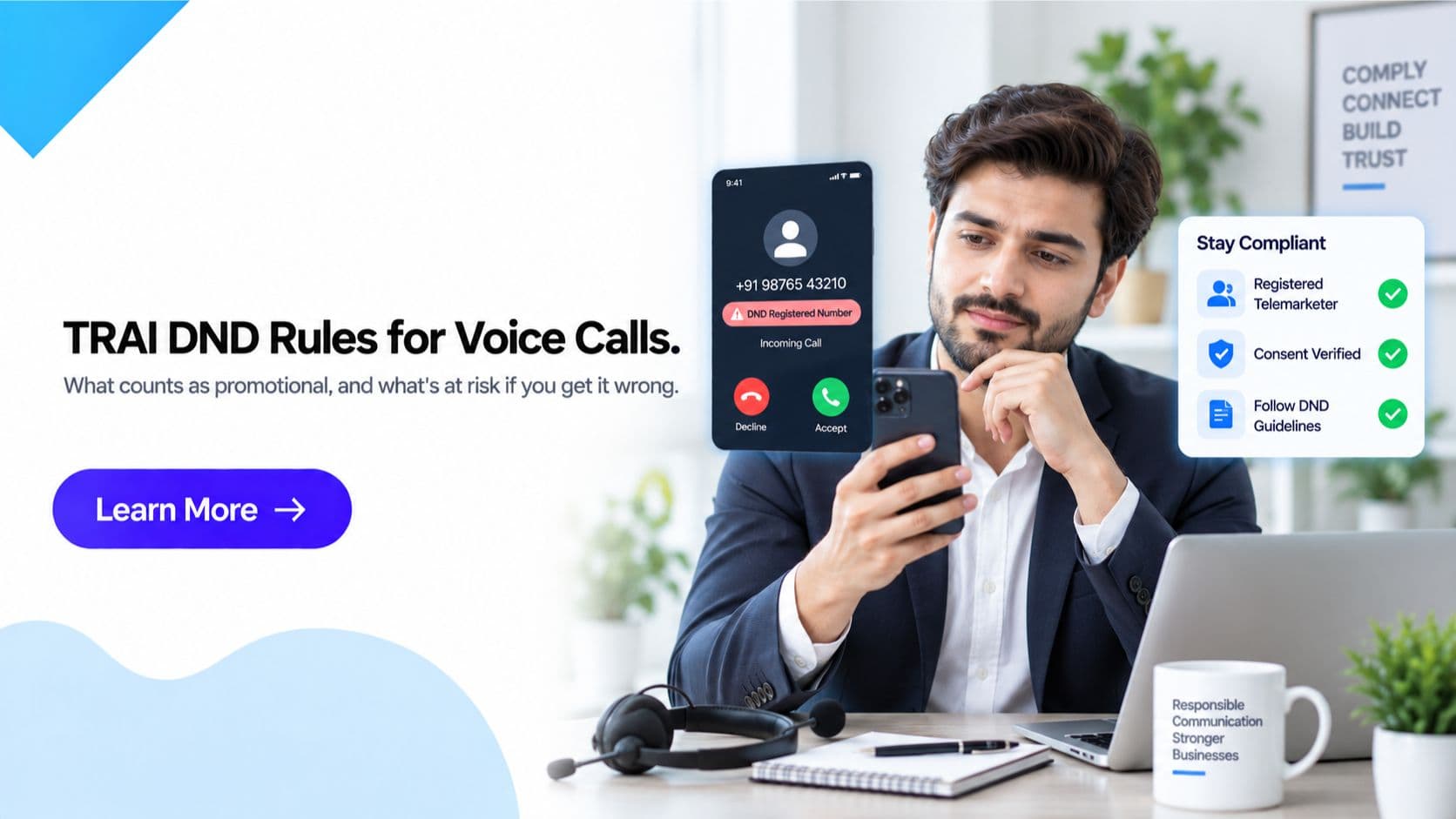
If your business places outbound voice calls to customers in India- sales calls, promotional offers, renewal reminders- TRAI's DND rules apply to you, whether or not you've thought about them yet. The short version: promotional calls need to come from a registered telemarketer number, and they need to respect customers who've opted out of promotional contact. For the full compliance checklist and detailed breakdown, see our TRAI Voice Call Regulations Guide. This post is the quicker, plainer-English version- the things every business actually needs to know before picking up the dialer.
The Short Version
- DND/NCPR blocks promotional calls to numbers registered on it- not all calls, just unsolicited marketing and telemarketing calls.
- Transactional and service calls have more leeway. OTPs, order updates, and appointment reminders to existing customers are treated differently from cold promotional calling- but you should still honor any explicit opt-out a customer gives you directly.
- Promotional callers need an RTM-registered number. An ordinary, unregistered business line isn't the right setup for outbound marketing calls at scale.
- Unregistered numbers used for promotional calling carry real risk- customer complaints and the number getting flagged or blacklisted by operators.
- This is not the same as SMS DLT compliance. Voice calling and SMS sit under different parts of TRAI's framework- one doesn't cover the other.
Promotional vs Transactional- Why the Distinction Matters
This is the single most common point of confusion for businesses, so it's worth spelling out plainly. A promotional call is unsolicited outreach- a cold sales pitch, a "check out our new offer" call, a renewal upsell the customer didn't ask about. These are the calls DND/NCPR is built to block for customers who've registered their preference not to receive them.
A transactional or service call is different in kind, not just in content. An OTP verification call, an order-confirmation call, a delivery update, or an appointment reminder to someone who is already your customer- these exist to complete or support a transaction the customer initiated. They're generally treated with more leeway than promotional calling.
The line isn't always obvious in practice. A "your order has shipped, and here's a discount on your next one" call blurs the two- and that's exactly the kind of call flow that gets businesses in trouble. Keeping promotional and transactional calling structurally separate in how you route, script, and record your outbound campaigns is the single best habit you can build.
What Happens If You Get It Wrong
We're not going to invent specific penalty figures here, because they're not ours to guess at. In general terms: calling DND-registered numbers with promotional content, or placing promotional calls from a number that isn't properly registered, creates real exposure- customer complaints, and the risk of your calling number being flagged, blocked, or blacklisted by telecom operators. Regulatory consequences can scale with the nature and frequency of the violation. For the specifics that apply to your business, consult TRAI's official regulations or legal counsel- this post, like the rest of our compliance content, isn't a substitute for that.
Getting Compliant
Getting compliant starts with two things: placing promotional calls from a properly RTM-registered number, and checking your dialing lists against DND/NCPR before a promotional campaign goes live. Our TRAI Voice Call Regulations Guide has the full practical checklist- number registration, list scrubbing, consent documentation, and keeping transactional call flows structurally separate from promotional ones.
If you'd rather not piece this together on your own, Get Click Media can help provision RTM-registered numbers for your outbound campaigns and build DND/NCPR-aware dialing into your voice broadcast and IVR setups from the start, so registration and preference-checking are the default rather than something bolted on after a complaint.
Frequently Asked Questions
What does DND/NCPR actually mean for a business?
DND (Do Not Disturb) is the common name for TRAI's National Customer Preference Register (NCPR)- a list of phone numbers whose owners have said they don't want unsolicited promotional or telemarketing contact. If a customer's number is on that list, promotional voice calls to it are off-limits unless they've separately opted in to hear from you.
Does DND block all business calls, or just promotional ones?
Just promotional ones. DND/NCPR is aimed at unsolicited marketing and telemarketing calls. Transactional and service calls to existing customers- things like OTP verification, order confirmations, or appointment reminders- are generally treated differently from cold promotional calling, though it's still good practice to respect any explicit opt-out a customer has given your business directly.
What is a registered telemarketer (RTM) number, and who needs one?
A registered telemarketer (RTM) number is a calling number that's been registered with TRAI specifically for placing promotional or telemarketing calls. If your business- or a calling partner working on your behalf- makes outbound promotional calls at any real scale, that calling should be done from an RTM-registered number rather than an ordinary, unregistered connection.
What happens if a business calls DND-registered numbers without proper registration?
In general terms, it creates real risk: customer complaints, and the calling number being flagged, blocked, or blacklisted by telecom operators- on top of whatever regulatory exposure applies to your situation. The exact consequences and figures aren't something we'll guess at here- for the specifics, consult TRAI's official regulations or legal counsel.
How is this different from TRAI's DLT rules for SMS?
They're separate frameworks entirely. DLT (Distributed Ledger Technology) governs commercial SMS- registering senders, headers, and message templates on a blockchain-based platform. Voice calling sits under TCCCPR instead, covering RTM number registration and DND/NCPR preference checking. Being DLT-compliant for your SMS program says nothing about whether your voice calling is compliant, and vice versa.
Where can a business go to get properly registered and compliant?
Start with our TRAI Voice Call Regulations Guide, which walks through the full compliance checklist in detail. From there, Get Click Media's team can help provision RTM-registered numbers and build DND/NCPR-aware calling into your outbound voice campaigns from day one.
For the complete checklist, the full application areas breakdown, and more detail than a blog post can comfortably hold, head to our TRAI Voice Call Regulations Guide. If your outbound calling already runs through Voice Broadcast (OBD) or you're setting it up now, this is exactly the point to get the registration and DND-checking right before you scale.
Not sure if your current calling setup is DND-ready? Talk to Get Click Media's team and we'll help you check.
Article topics
Frequently Asked Questions
What does DND/NCPR actually mean for a business?
DND (Do Not Disturb) is the common name for TRAI's National Customer Preference Register (NCPR)- a list of phone numbers whose owners have said they don't want unsolicited promotional or telemarketing contact. If a customer's number is on that list, promotional voice calls to it are off-limits unless they've separately opted in to hear from you.
Does DND block all business calls, or just promotional ones?
Just promotional ones. DND/NCPR is aimed at unsolicited marketing and telemarketing calls. Transactional and service calls to existing customers- things like OTP verification, order confirmations, or appointment reminders- are generally treated differently from cold promotional calling, though it's still good practice to respect any explicit opt-out a customer has given your business directly.
What is a registered telemarketer (RTM) number, and who needs one?
A registered telemarketer (RTM) number is a calling number that's been registered with TRAI specifically for placing promotional or telemarketing calls. If your business- or a calling partner working on your behalf- makes outbound promotional calls at any real scale, that calling should be done from an RTM-registered number rather than an ordinary, unregistered connection.
What happens if a business calls DND-registered numbers without proper registration?
In general terms, it creates real risk: customer complaints, and the calling number being flagged, blocked, or blacklisted by telecom operators- on top of whatever regulatory exposure applies to your situation. The exact consequences and figures aren't something we'll guess at here- for the specifics, consult TRAI's official regulations or legal counsel.
How is this different from TRAI's DLT rules for SMS?
They're separate frameworks entirely. DLT (Distributed Ledger Technology) governs commercial SMS- registering senders, headers, and message templates on a blockchain-based platform. Voice calling sits under TCCCPR instead, covering RTM number registration and DND/NCPR preference checking. Being DLT-compliant for your SMS program says nothing about whether your voice calling is compliant, and vice versa.
Where can a business go to get properly registered and compliant?
Start with our TRAI Voice Call Regulations Guide, which walks through the full compliance checklist in detail. From there, Get Click Media's team can help provision RTM-registered numbers and build DND/NCPR-aware calling into your outbound voice campaigns from day one.
About the author
Get Click Media creates practical resources for businesses using messaging, automation, analytics, and digital communication to improve customer engagement. This article was published on .