

In this article
Explore the key concepts, practical considerations, and frequently asked questions related to voice otp vs sms otp: when each one makes sense.
Key takeaways
- Voice OTP is designed as an automatic fallback triggered only after an SMS OTP fails to deliver or times out, not as a default channel.
- A text-to-speech call reads the code aloud digit by digit with a repeat option, filling gaps SMS OTP misses in poor coverage, roaming, or accessibility cases.
- Voice OTP costs more per attempt than SMS OTP, so the recommended pattern runs SMS first and escalates to voice automatically only on failure.
SMS OTP works over any active GSM signal and is the default verification channel for most businesses- no app, no data plan, no installation required. But "default" isn't the same as "flawless": poor network coverage, carrier congestion, and international roaming all cause real SMS OTP delivery failures and delays. Voice OTP is a different delivery path entirely- an automated outbound call that reads the code aloud- and it can succeed in some of the exact cases where an SMS OTP doesn't land, which is why it's most commonly used as an automatic fallback rather than a business's primary channel.
This isn't a "which channel wins" comparison. Voice OTP was never designed to out-compete SMS OTP on speed or cost for the ordinary case- SMS wins that comparison outright. The useful question isn't which channel is better in the abstract, but which one is doing its job at the moment a specific verification attempt is made- and that's a "when," not a "which," decision.
How Each One Actually Works
An SMS OTP arrives as a short text message- the code sits in the customer's inbox, and they copy or read it into your app or website. There's no interaction required beyond that; it's silent and works even with the phone locked.
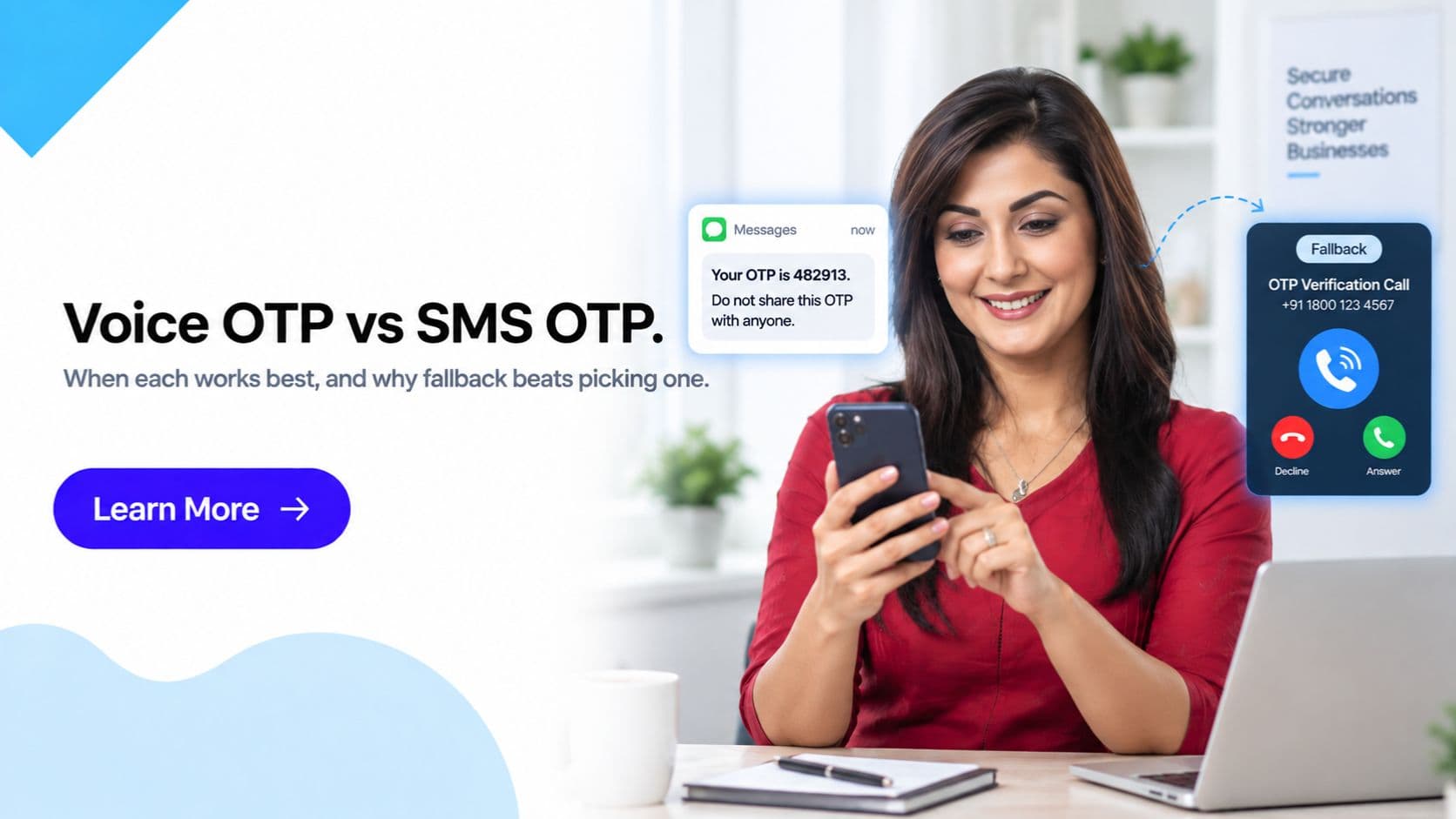
A Voice OTP works differently. An automated call is placed to the customer's number- typically only after an SMS OTP attempt has already failed to deliver or timed out. A text-to-speech system reads the numeric code aloud, slowly and digit by digit, and usually offers a repeat option (commonly "press 1 to hear it again"). The customer then enters that code into your app or website exactly as they would with an SMS OTP- only the delivery step changes, not the verification step.
That last point is worth sitting with: nothing about the verification logic on the backend needs to change because a code arrived by voice instead of text. The same code, the same expiry window, the same input field on your app or website- the only difference is how the customer received the digits in the first place.
When SMS OTP Is Enough
For the large majority of verification attempts, SMS OTP is the right and sufficient channel:
- Good network coverage. Where signal quality is reliable, SMS OTP delivers in seconds with no added friction.
- Domestic, non-roaming users. Customers on their home network rarely see the delivery issues that roaming introduces.
- Cost-sensitive, high-volume flows. SMS OTP costs less per attempt than a voice call, which matters when you're sending verification codes at scale.
When Voice OTP Earns Its Place
Voice OTP isn't meant to compete with SMS for every send- it fills specific gaps SMS leaves open:
- SMS delivery failure or delay in poor-coverage areas. In weak-signal regions or during carrier congestion, SMS OTPs can arrive late or not at all- a voice call over the same network sometimes still connects.
- Roaming or SMS-disabled users. International roaming can make SMS OTP slow, costly, or unreliable, and some users disable SMS entirely- a voice call reaches them through a different delivery path.
- Accessibility needs. Some customers prefer or need audio delivery over reading a text- Voice OTP reads the code aloud at a deliberate pace, with a repeat option built in.
- The fallback tier in a layered OTP strategy. Most businesses trigger Voice OTP automatically only after an SMS OTP attempt fails to deliver- one extra chance to reach the customer before the verification flow breaks entirely.
The Recommended Pattern- SMS First, Voice as Fallback
Given that Voice OTP costs more per attempt and requires the customer to answer a live call, the sound approach for most businesses isn't to choose one channel outright- it's to run SMS OTP as the primary channel for speed and cost, with Voice OTP triggered automatically only when an SMS OTP attempt fails to deliver or times out.
Why this pattern works: Running Voice OTP as the default for every verification adds unnecessary cost, since the vast majority of SMS OTPs deliver successfully on their own. Running SMS OTP alone leaves the coverage-gap, roaming, and accessibility cases with no working fallback. Triggering voice automatically- and only- after an SMS failure captures SMS's cost efficiency for the common case while still giving the harder cases a working path to verification.
This is the pattern Get Click Media configures for businesses layering Voice OTP underneath their existing SMS OTP delivery: the system attempts SMS OTP first, monitors delivery status for a short window, and automatically places an outbound voice call reading the code aloud only if that SMS attempt fails or times out- no manual intervention, and the same verification endpoint validates the code regardless of which channel delivered it.
Voice OTP can also sit alongside other fallback channels- WhatsApp OTP or RCS OTP, where a customer has opted in- as one tier in a broader layered delivery strategy rather than the only backup option. Which tier fires first, and in what order, is a configuration choice based on your customer base, not a fixed rule.
Frequently Asked Questions
Is Voice OTP more reliable than SMS OTP? Not universally, no. Voice OTP is a different delivery path- an automated call instead of a text message- and it has its own failure modes, such as the call going unanswered. It isn't a strictly "better" channel in every scenario; it's most useful as a fallback that can succeed in specific cases where SMS OTP didn't get through, not as a wholesale replacement.
Why would a business bother with Voice OTP if SMS already works most of the time? Because "most of the time" isn't "all of the time." SMS delivery isn't 100% reliable- poor network coverage, carrier congestion, and international roaming all cause real OTP delays or outright failures. A voice call routed over the same telecom network can sometimes still connect when the text message doesn't, which is exactly the gap Voice OTP is built to fill.
Does Voice OTP work for accessibility needs? Yes. Voice OTP reads the code aloud at a deliberate, digit-by-digit pace and typically offers a repeat option, such as pressing a key to hear it again. This makes it a useful option for users who struggle to read or quickly locate a code in a text message.
Does Voice OTP cost more than SMS OTP per attempt? Typically, yes- a live voice call costs more per attempt than a single SMS. This is exactly why Voice OTP is usually positioned as a fallback triggered only after an SMS OTP attempt fails, rather than as the default channel for every verification sent.
Can a business run Voice OTP as its only verification channel? Technically yes, but it's rarely a good default. Most businesses get better overall reach and lower cost running SMS OTP as the primary channel, with Voice OTP triggered automatically only for the delivery failures and edge cases SMS misses- not as the everyday channel for every OTP.
How fast does the Voice OTP fallback trigger after an SMS failure? In a well-configured layered strategy, the system waits a short monitoring window after the SMS OTP is sent- long enough to confirm delivery status- and if the message hasn't been delivered or has timed out, the outbound voice call is placed automatically, with no manual step required from the business or the customer.
Get Click Media configures SMS-first, Voice OTP-fallback delivery as a single integration- so verification codes still reach customers when an SMS OTP doesn't land, without adding voice-call cost to every routine send. Talk to us about adding Voice OTP as a fallback channel.
Article topics
Frequently Asked Questions
Is Voice OTP more reliable than SMS OTP?
Not universally, no. Voice OTP is a different delivery path- an automated call instead of a text message- and it has its own failure modes, such as the call going unanswered. It isn't a strictly 'better' channel in every scenario; it's most useful as a fallback that can succeed in specific cases where SMS OTP didn't get through, not as a wholesale replacement.
Why would a business bother with Voice OTP if SMS already works most of the time?
Because 'most of the time' isn't 'all of the time.' SMS delivery isn't 100% reliable- poor network coverage, carrier congestion, and international roaming all cause real OTP delays or outright failures. A voice call routed over the same telecom network can sometimes still connect when the text message doesn't, which is exactly the gap Voice OTP is built to fill.
Does Voice OTP work for accessibility needs?
Yes. Voice OTP reads the code aloud at a deliberate, digit-by-digit pace and typically offers a repeat option, such as pressing a key to hear it again. This makes it a useful option for users who struggle to read or quickly locate a code in a text message.
Does Voice OTP cost more than SMS OTP per attempt?
Typically, yes- a live voice call costs more per attempt than a single SMS. This is exactly why Voice OTP is usually positioned as a fallback triggered only after an SMS OTP attempt fails, rather than as the default channel for every verification sent.
Can a business run Voice OTP as its only verification channel?
Technically yes, but it's rarely a good default. Most businesses get better overall reach and lower cost running SMS OTP as the primary channel, with Voice OTP triggered automatically only for the delivery failures and edge cases SMS misses- not as the everyday channel for every OTP.
How fast does the Voice OTP fallback trigger after an SMS failure?
In a well-configured layered strategy, the system waits a short monitoring window after the SMS OTP is sent- long enough to confirm delivery status- and if the message hasn't been delivered or has timed out, the outbound voice call is placed automatically, with no manual step required from the business or the customer.
About the author
Get Click Media creates practical resources for businesses using messaging, automation, analytics, and digital communication to improve customer engagement. This article was published on .