

In this article
Explore the key concepts, practical considerations, and frequently asked questions related to ai voicebots in india: replacing human agents or assisting them?.
Key takeaways
- Voicebots handle FAQ answers, order status lookups, and simple booking well, but complex complaints and regulated verification steps still need a human agent.
- A fully loaded live agent in India costs roughly ₹15-40+ per minute, which is why voicebot adoption gets budget attention in the first place.
- Voicebot adoption usually cuts workload per agent before it cuts headcount- fewer repetitive calls reach agents, not an empty call center.
Whether an AI voicebot should handle a call or hand it to a human agent is not an all-or-nothing question- it comes down to the task on the other end of the line. Well-defined, repetitive calls (FAQ answers, order status, booking within fixed rules) are genuinely suited to an AI voicebot; complex complaints, emotionally sensitive conversations, and anything requiring judgment still belong with a human agent. Getting this split wrong in either direction has a real cost- automate too much and you frustrate callers who eventually reach a human anyway; automate too little and agents burn their day on questions a voicebot could resolve in seconds.
Why This Matters
Voicebot adoption on a call center line is not a switch you flip once. Two failure modes show up repeatedly:
- Over-automating routes complex or emotionally sensitive calls- disputes, anything outside a defined script- through a rigid voicebot flow. Callers get stuck repeating themselves to a system that can't help, before eventually reaching a human anyway, having wasted time that a direct transfer would have saved.
- Under-automating sends every call to a human agent, including simple, repetitive questions a voicebot could resolve instantly. This wastes agent time on low-value calls and increases wait times for every caller in the queue, not just the ones asking complex questions.
The businesses that get the most value from voicebot adoption are the ones that draw this line deliberately, task by task, rather than defaulting to "automate every call" or "keep every call on a human agent."
What AI Voicebots Handle Well
An AI voicebot works through a speech-to-text layer, an AI intent layer, and a text-to-speech response- it understands what a caller says in natural language rather than requiring a menu press, and that makes it genuinely capable on a specific set of call types:
- FAQ answering - common questions on hours, locations, policies, and pricing basics, without tying up a live agent.
- Order or appointment status lookup - looking up a record from your system and reading the result back to the caller directly.
- Simple booking within fixed rules - scheduling, rescheduling, or confirming an appointment slot where the available options are already defined.
- Basic support triage - resolving simple queries outright, or gathering the right context before routing to a human agent.
| Task type | Handle with |
|---|---|
| FAQ answering (hours, location, pricing basics) | Voicebot |
| Order or appointment status lookup | Voicebot |
| Simple booking within fixed slots/rules | Voicebot |
| Basic support triage before handoff | Voicebot |
| Complex complaints or disputes | Human |
| Emotionally sensitive conversations | Human |
| High-value sales negotiation | Human |
| Regulated verification steps (banking, insurance) | Human |
| Caller explicitly asks for a human | Human, always |
Rule of thumb: if the correct response can be looked up or matched from a fixed set of possibilities, it's a voicebot task. If the correct response depends on judgment, empathy, or a decision the business hasn't pre-scripted, it's a human task.
What Still Needs a Human Agent
Not every call type shrinks well into a voicebot flow, and treating all of them as eventually automatable is where over-automating starts:
- Complex complaints or disputes that require weighing specifics and making a judgment call, not matching a scripted response.
- Emotionally sensitive conversations- a caller who is upset, anxious, or dealing with a difficult situation needs to feel heard, which a scripted voicebot flow cannot reliably deliver.
- High-value sales negotiation, where reading tone, hesitation, and unstated objections matters more than following a script.
- Regulated verification steps in banking and insurance, where compliance teams often expect a trained human on specific confirmation moments- consistent with the same auditability concerns that keep a lean, fixed-menu IVR in place for certain regulated flows even after AI automation is adopted elsewhere on the same line.
This is the same nuance already established across this site's other channel comparisons: automation is a genuine upgrade for the predictable share of call volume, not a wholesale replacement for the human agent's role on judgment-heavy calls.
Cost Impact- Headcount vs Workload
A fully loaded live agent in India costs roughly ₹15-40+ per minute once salary, benefits, telephony, real estate, and shift coverage are factored in. That figure is the reason voicebot adoption gets budget attention in the first place- but it's worth being precise about what actually drops first.
Voicebot adoption typically reduces workload per agent before it reduces headcount outright. The voicebot absorbs the high-volume, repetitive share of calls- the FAQ answers, status checks, and simple bookings- which frees agents to spend their time on the smaller share of calls that genuinely need a human: complaints, negotiation, and judgment calls. Fewer calls reach the queue, average wait times drop, and agents spend a larger share of their day on higher-value conversations.
For most Indian businesses, the realistic near-term outcome is fewer repetitive calls reaching agents, not no agents. Headcount reduction, where it eventually happens, tends to follow only after workload-per-agent has already dropped and stayed down- it is a second-order effect of the cost savings, not the first one.
Deciding What to Automate First
Start with high-volume, low-ambiguity, scriptable call types- FAQ answering, order or appointment status lookups, and booking within defined slots are the common starting points, and they map directly to the use cases an AI voicebot is already built to handle.
Avoid automating anything that requires judgment calls or exception-handling until you have data on how often those cases actually occur in your call volume. A call type that looks automatable in theory but turns out to have frequent edge cases is better left with human agents until the voicebot's scope can be narrowed to the part that genuinely is scriptable.
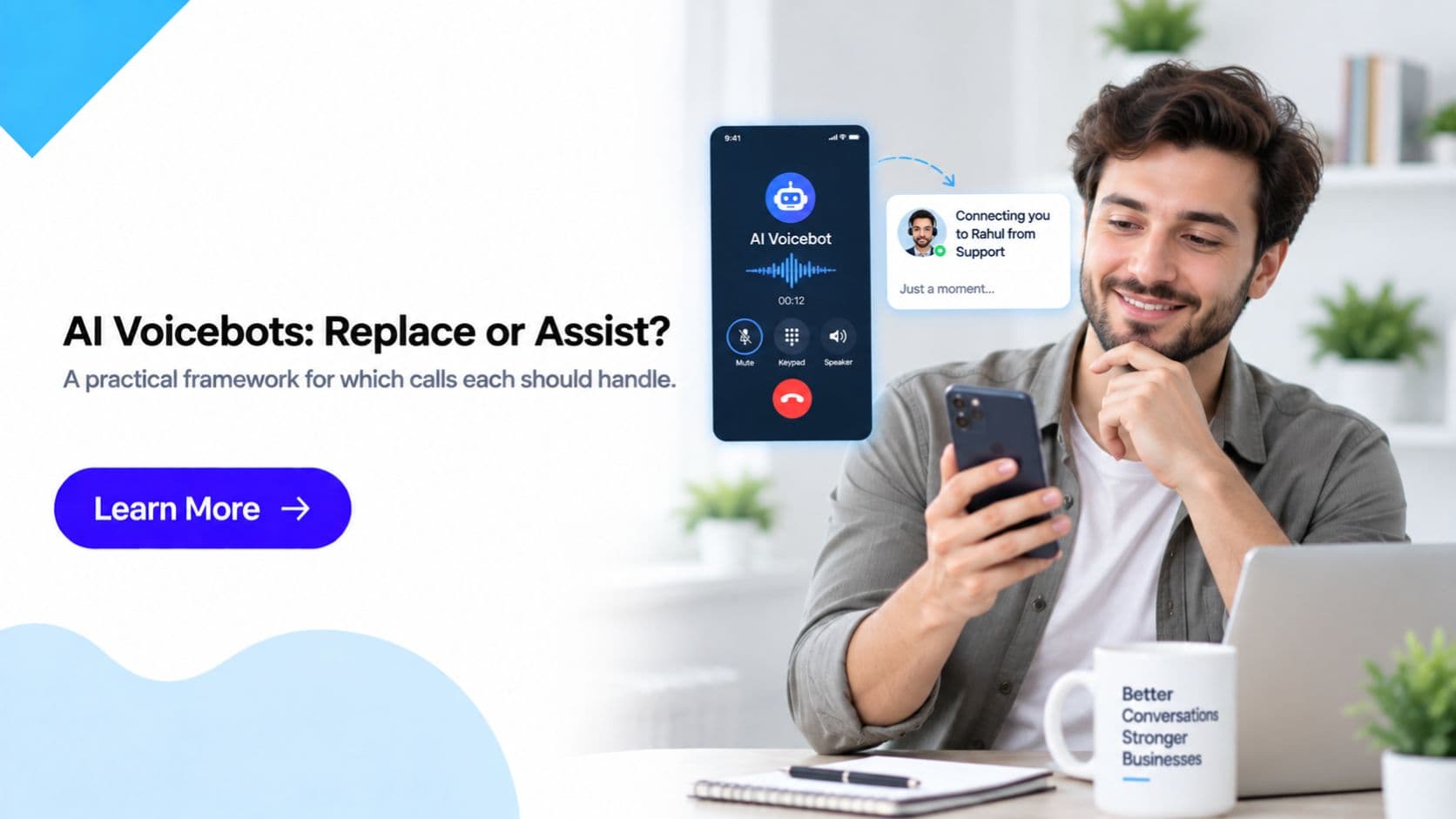
What a Good Voicebot-to-Human Handoff Looks Like
The quality of the handoff matters as much as the automate-or-not decision itself. A voicebot that recognizes its own limits but hands off poorly still produces a bad call experience.
- Preserve context. Everything the caller already said- their issue, any details provided, what the voicebot already tried- should carry forward to the human agent automatically.
- Never force a restart. The caller should not have to repeat their problem from the beginning once they reach a human- that's the fastest way to turn a reasonable automation attempt into a frustrating call.
- Honor explicit requests immediately. If a caller asks for a human agent at any point, that request should be honored without additional voicebot prompts standing in the way.
Signs You've Drawn the Line in the Wrong Place
The split between voicebot and human agent is rarely right on the first attempt- it's worth checking these signals a few weeks into any rollout:
- Escalation rate on a specific call type stays consistently high. If a call type routed to the voicebot escalates to a human most of the time anyway, that task type is not actually scriptable yet- it belongs with agents until the pattern is understood better.
- Callers start speaking over the voicebot or repeating "agent" or "human." This is usually a sign the voicebot is holding onto a call type it shouldn't, and the handoff trigger needs to fire earlier, not that the caller needs more patience.
- Agents report spending most of their day on the same handful of repetitive questions. That's a sign a call type currently sitting with human agents is actually a strong voicebot candidate and has been under-automated.
- Average handling time on voicebot-resolved calls creeps up over time. A voicebot whose average call is getting longer, not shorter, is likely being asked to do more than its current scope supports- a cue to either expand its training or narrow what it's allowed to handle.
Treat these as an ongoing tuning signal rather than a one-time decision. The right split shifts as call volume, caller expectations, and the voicebot's own configuration mature.
Frequently Asked Questions
Will AI voicebots fully replace human call-center agents? No, not universally. Whether a voicebot can replace a human on a given call depends on the task, not on the technology being AI-driven. High-volume, low-ambiguity calls- FAQ answers, order status, simple booking within fixed rules- are genuinely voicebot territory. Complex complaints, emotionally sensitive conversations, high-value negotiation, and certain regulated verification steps still need a human agent, and that is unlikely to change just because the voicebot gets better at speech understanding.
What kinds of calls should never go to a voicebot alone? Complex complaints or disputes that require judgment, emotionally sensitive conversations where a caller needs to feel heard rather than processed, high-value sales negotiation where a human's read on tone and hesitation matters, and certain regulated verification steps in banking or insurance where compliance teams expect a trained human on the line. These are consistent with the same nuance already established for IVR and chatbot automation across voice and chat channels- automation handles the predictable, humans handle the judgment calls.
What happens when a voicebot can't resolve a caller's request? A well-built voicebot should recognize when a request falls outside its scope and hand off to a human agent with the full conversation context- what the caller already said, what the voicebot already tried- carried forward. The caller should never have to repeat themselves or restart the conversation from scratch once they reach a human. A voicebot that keeps guessing or loops the caller through irrelevant prompts before escalating creates more frustration than no automation at all.
Does using a voicebot reduce headcount or just workload per agent? Usually the latter first. A voicebot absorbs the high-volume, repetitive calls that would otherwise occupy an agent's day, so agents handle fewer but higher-value calls- not zero calls. For most Indian businesses, the realistic near-term outcome is fewer repetitive calls reaching agents and shorter queues, not an empty call center. Headcount reduction, where it happens at all, tends to follow only after workload-per-agent has already dropped substantially and stayed there.
How do businesses decide which call types to automate first? Start with high-volume, low-ambiguity, scriptable queries- FAQ answering, order or appointment status checks, and simple booking within fixed rules are the common starting points. Avoid automating call types that require judgment calls, exception-handling, or emotional sensitivity until you have clear data on how often those cases actually occur in your call volume.
Does over-automating hurt customer experience for voice calls specifically? Yes- the same pattern shows up on WhatsApp chatbots, and arguably it is worse on voice. A caller on a live call has even less patience for a bot that can't help than a chat user does, because a phone call carries an expectation of immediate resolution and there's no way to scroll back or skim ahead. Routing a complex or emotionally charged call through a rigid voicebot script before eventually escalating anyway wastes the caller's time twice over- once on the bot, then again waiting for an agent.
Get Click Media builds AI voicebot automation designed to absorb the repetitive share of your call volume, alongside a lean IVR system for the simple, regulated cases that still need a fixed script- so the split between voicebot and human agent is a deliberate design decision, not a default.
Get an AI Voicebot- Natural-language calls · Clean human handoff · IVR System
Article topics
Frequently Asked Questions
Will AI voicebots fully replace human call-center agents?
No, not universally. Whether a voicebot can replace a human on a given call depends on the task, not on the technology being AI-driven. High-volume, low-ambiguity calls- FAQ answers, order status, simple booking within fixed rules- are genuinely voicebot territory. Complex complaints, emotionally sensitive conversations, high-value negotiation, and certain regulated verification steps still need a human agent, and that is unlikely to change just because the voicebot gets better at speech understanding.
What kinds of calls should never go to a voicebot alone?
Complex complaints or disputes that require judgment, emotionally sensitive conversations where a caller needs to feel heard rather than processed, high-value sales negotiation where a human's read on tone and hesitation matters, and certain regulated verification steps in banking or insurance where compliance teams expect a trained human on the line. These are consistent with the same nuance already established for IVR and chatbot automation across voice and chat channels- automation handles the predictable, humans handle the judgment calls.
What happens when a voicebot can't resolve a caller's request?
A well-built voicebot should recognize when a request falls outside its scope and hand off to a human agent with the full conversation context- what the caller already said, what the voicebot already tried- carried forward. The caller should never have to repeat themselves or restart the conversation from scratch once they reach a human. A voicebot that keeps guessing or loops the caller through irrelevant prompts before escalating creates more frustration than no automation at all.
Does using a voicebot reduce headcount or just workload per agent?
Usually the latter first. A voicebot absorbs the high-volume, repetitive calls that would otherwise occupy an agent's day, so agents handle fewer but higher-value calls- not zero calls. For most Indian businesses, the realistic near-term outcome is fewer repetitive calls reaching agents and shorter queues, not an empty call center. Headcount reduction, where it happens at all, tends to follow only after workload-per-agent has already dropped substantially and stayed there.
How do businesses decide which call types to automate first?
Start with high-volume, low-ambiguity, scriptable queries- FAQ answering, order or appointment status checks, and simple booking within fixed rules are the common starting points. Avoid automating call types that require judgment calls, exception-handling, or emotional sensitivity until you have clear data on how often those cases actually occur in your call volume.
Does over-automating hurt customer experience for voice calls specifically?
Yes- the same pattern shows up on WhatsApp chatbots, and arguably it is worse on voice. A caller on a live call has even less patience for a bot that can't help than a chat user does, because a phone call carries an expectation of immediate resolution and there's no way to scroll back or skim ahead. Routing a complex or emotionally charged call through a rigid voicebot script before eventually escalating anyway wastes the caller's time twice over- once on the bot, then again waiting for an agent.
About the author
Get Click Media creates practical resources for businesses using messaging, automation, analytics, and digital communication to improve customer engagement. This article was published on .