

In this article
Explore the key concepts, practical considerations, and frequently asked questions related to how political campaigns use ivr and missed call services in india.
Key takeaways
- Voice broadcast delivers one recorded message to an entire voter or supporter list at a scheduled time, without volunteers dialing each number by hand.
- Missed-call supporter registration costs the caller nothing since the call disconnects before it's answered, yet it logs the number for a follow-up.
- Campaigns can typically get a missed-call number, broadcast list, and basic IVR hotline live within days, though election-specific rules go beyond general TRAI telemarketing norms.
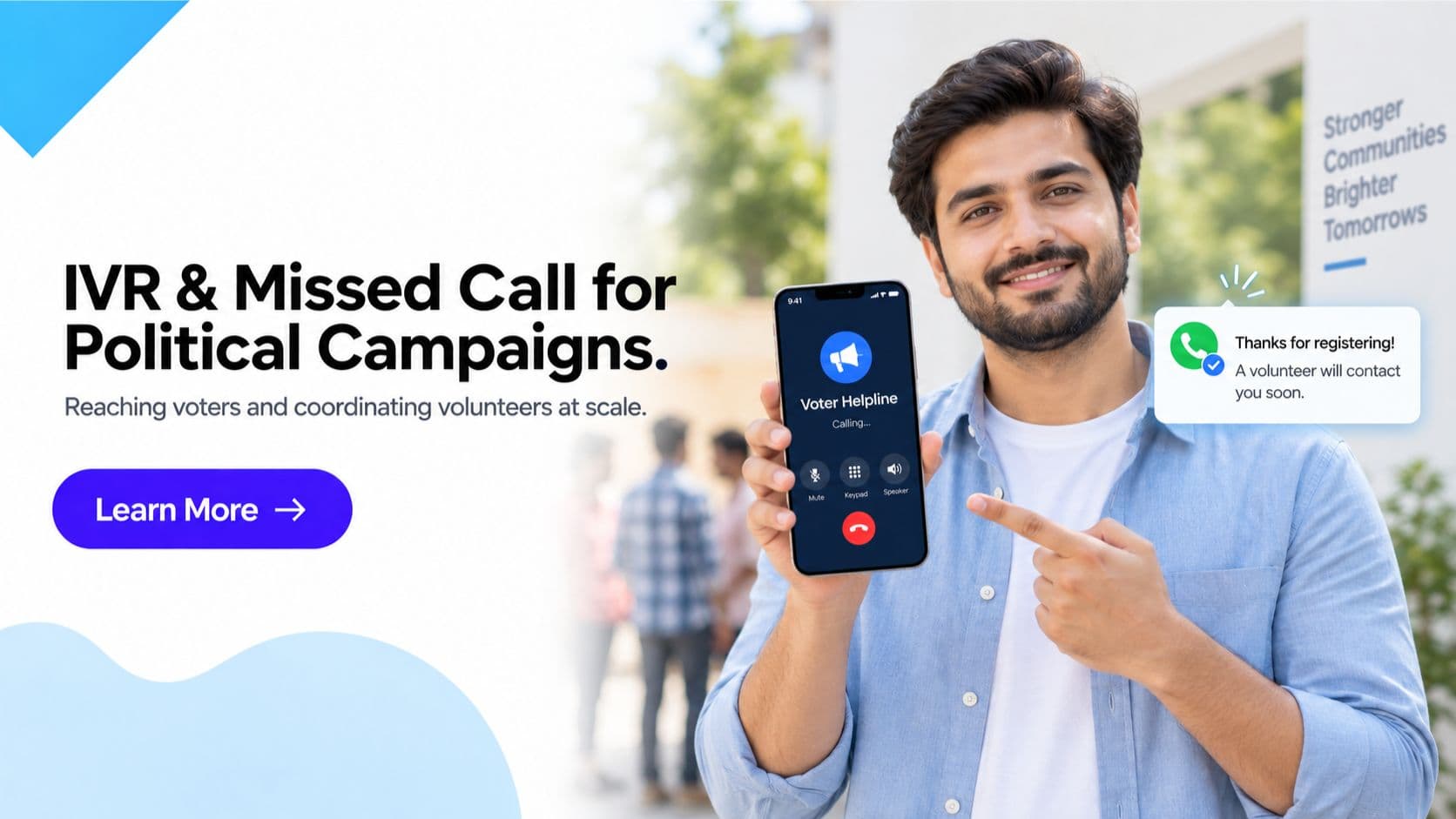
When an election is weeks away and a campaign needs to reach thousands of voters with an update, phone calls still do something a text or a social post can't- they work whether or not the person on the other end has a smartphone, a data plan, or the habit of checking an app. IVR and voice solutions for political campaigns give Indian campaign organizations a way to broadcast announcements, register supporter interest, and answer voter questions at a scale that live calling or door-to-door outreach alone can't match- and the voter doesn't have to do anything more than pick up the phone or give a missed call.
That's the appeal for a campaign operating under a tight timeline and a wide, mixed audience: a single message reaches a voter list of any size the moment it's scheduled, a supporter can register interest for free with one missed call, and a voter with a routine question gets an answer without waiting for a volunteer to be free. None of that depends on the voter owning a particular kind of phone or being comfortable with an app.
Set Up Voice & IVR Infrastructure for Your Campaign- Voter outreach voice broadcast · Missed-call supporter registration · IVR voter information hotlines. Get a Custom Quote · See Political Campaign Voice Solutions
Voter Outreach via Voice Broadcast
When a campaign has an announcement ready- an event, a rally, a schedule change, a candidate update- voice broadcast delivers a pre-recorded version of that message to a voter or supporter contact list at a scheduled time. The campaign records the message once, and every number on the list hears the same message, delivered consistently, without needing a volunteer to place each call individually.
This matters most when timing is tight. A campaign that needs to notify ten thousand supporters of a venue change by tomorrow morning can't rely on manual calling to get there in time. Voice broadcast turns that into a scheduling decision rather than a staffing problem- the message goes out to the whole list at the appointed hour, whether the list has a hundred numbers or a hundred thousand.
Missed-Call Supporter Registration
A campaign publishes a number and asks supporters to give it a missed call to register interest. Because the call is disconnected automatically before it's answered, it costs the supporter nothing- no airtime, no form, no app download. That missed call still logs the supporter's number on the campaign's side and can trigger an automatic follow-up SMS or a callback from a volunteer.
This is why missed-call registration tends to outperform a printed sign-up number alone: the barrier to act is as low as it gets. A voter who sees the number on a poster, hears it read out at a rally, or catches it at the end of a voice broadcast can register in seconds, without breaking their data plan or navigating a form. For a campaign trying to build a supporter or volunteer list quickly and cheaply, that's a meaningful difference in response volume.
Voter Information Hotline (IVR)
When a voter calls a published campaign information number, an IVR menu answers the questions that come up again and again- polling-day logistics, candidate background information- through recorded options the caller navigates themselves. A caller who needs more than the menu can offer is typically routed to a callback request rather than a live transfer.
The value here is consistency at volume. Every caller gets the same accurate answer to a routine question, at any hour, without a live volunteer needing to be available for every single call. That frees the campaign's actual people to spend their time on calls that genuinely need a human- while the hotline absorbs the repetitive, predictable ones automatically.
Volunteer & Worker Coordination
Campaigns run on a distributed base of volunteers and field workers who need to hear about shift assignments, meeting points, and last-minute changes fast. Voice broadcast or a targeted calling list notifies that base directly, instead of relying on a phone tree where one volunteer calls the next and a broken link in the chain means someone never hears the update.
For a field operation spread across multiple constituencies or polling booths, that speed compounds. A single scheduled broadcast reaches everyone on the coordination list at roughly the same moment, which matters when a change- a new meeting point, a shifted call time- needs to land before the old plan is already in motion.
Callback Follow-Up via Auto-Dialer
Missed-call registrations and hotline callback requests build up into a queue, and an auto-dialer works through that queue systematically, connecting each answered call to an available volunteer or agent. Instead of a stack of callback requests sitting untouched because no one got around to dialing them by hand, the queue gets worked through in order.
That systematic handling is what keeps a callback promise credible. A supporter who left a missed call expecting to hear back is far more likely to actually get that call- and get it sooner- when an auto-dialer is methodically clearing the queue than when it depends on a volunteer remembering to make time for it between other tasks.
Measuring Outreach with Call Analytics
A campaign running voice broadcast, missed-call registration, and an IVR hotline at the same time needs to know which channel is actually landing. A dashboard reporting on broadcast delivery, missed-call registration volume, and hotline call patterns gives the campaign team a single place to see that, instead of piecing it together from separate logs.
That visibility feeds directly back into strategy. If a particular broadcast produces a spike in missed-call registrations right after it goes out, that's a signal the message and the call-to-action worked together- worth repeating. If a hotline is fielding the same question over and over, that's a sign the menu needs an option added, or that the underlying information needs to go out more proactively.
Why Voice Still Works for Political Outreach in India
Voice channels reach voters that other channels quietly miss. A voter without a smartphone or a reliable data connection can still receive a phone call or place a missed call- the entire interaction happens over a basic voice line, with nothing to download and nothing to load.
It also crosses literacy levels in a way text-based outreach can't. A voice broadcast or an IVR menu is spoken, not written, so it reaches a voter regardless of reading ability- something a WhatsApp message or an SMS blast simply can't do on its own.
And a phone call still feels more direct than a broadcast text. A recorded message in a candidate's or campaign's own voice, delivered to a phone that rings, reads as more personal and immediate than a message sitting unread in a crowded inbox- which is part of why campaigns pair voice broadcast with a missed-call call-to-action rather than relying on either channel alone.
A Note on Consent and DND for Campaign Calling
Campaign calling runs over the same telecom infrastructure as any other outbound calling in India, so the same baseline good practice applies- call from a properly registered number, keep track of where a contact came from, and respect a number that has opted out of being called. Campaign communication also has its own regulatory considerations around election timing and content that sit outside general TRAI telemarketing rules, so this isn't a substitute for legal advice- campaigns should confirm the specifics that apply to their own outreach with TRAI's official guidance or their own legal counsel before scaling up calling.
Frequently Asked Questions
What is voice broadcast used for in a political campaign? Voice broadcast sends a pre-recorded message- an event announcement, a schedule change, a candidate update- to a voter or supporter contact list at a scheduled time. Instead of relying on volunteers to call each voter one by one, the campaign records the message once and delivers it to the entire list at once, giving every voter on that list the same consistent update at the same time.
How does missed-call supporter registration work, and why is it popular for campaigns? A campaign publishes a number and asks supporters to give it a missed call to register interest. The call is disconnected automatically before it's answered, so it's completely free for the supporter- no airtime, no data, no app to install, no form to fill. That missed call still logs the supporter's number on the campaign's end and can trigger an automatic follow-up SMS or a callback, which is why it's a popular low-friction way to build a supporter or volunteer list at scale.
What does a voter information hotline IVR typically answer? A voter information hotline handles the questions that come up repeatedly- polling-day logistics, candidate background information, and similar routine queries- through a recorded menu of options that a caller navigates themselves. Callers who need more than the menu can offer are typically routed to a callback queue rather than a live transfer, so the hotline still gets them to a person, just not on the first call.
How do campaigns coordinate volunteers with voice calling? When a campaign needs to reach its volunteer or field-worker base with a shift assignment, a meeting point, or a last-minute change, it can send that update as a voice broadcast or through a targeted calling list rather than a phone tree run by hand. Everyone on the list gets the update at roughly the same time, which is faster and more reliable across a large, distributed volunteer base than asking one volunteer to call the next.
What should campaigns keep in mind about consent and DND when calling voters? Campaign calling still runs over the same telecom network as any other outbound calling, so the same baseline good practice applies- use a properly registered number, keep a record of where a contact came from, and respect a number that has asked not to be called. This isn't legal advice, and campaign communication has its own regulatory considerations that go beyond general TRAI telemarketing rules- campaigns should confirm the specifics with TRAI's official guidance or their own legal counsel before running outreach at scale.
How quickly can a campaign get voice broadcast and IVR set up? Because voice broadcast, missed-call numbers, and IVR hotlines are established infrastructure rather than custom-built software, campaigns can typically get a missed-call number provisioned, a broadcast list loaded, and a basic hotline menu live within days, not weeks. The exact timeline depends on call volume and how many menu options or callback flows the hotline needs, but there's no lengthy development cycle standing between a campaign and its first broadcast.
Get Started
Voice broadcast, missed-call supporter registration, and IVR hotlines work best as one connected system rather than three separate tools- the broadcast creates the prompt, the missed-call number gives the listener a free way to act on it, and the hotline handles the questions that follow. Get Click Media's IVR and voice solutions for political campaigns build this outreach infrastructure end-to-end, on top of the same voice broadcast (OBD) platform used across retail, government, and service outreach in India.
Ready to reach voters at scale? Voter outreach voice broadcast · Missed-call supporter registration · Voter information IVR hotlines- live in days. Get a Custom Quote · Talk to Get Click Media
Article topics
Frequently Asked Questions
What is voice broadcast used for in a political campaign?
Voice broadcast sends a pre-recorded message- an event announcement, a schedule change, a candidate update- to a voter or supporter contact list at a scheduled time. Instead of relying on volunteers to call each voter one by one, the campaign records the message once and delivers it to the entire list at once, giving every voter on that list the same consistent update at the same time.
How does missed-call supporter registration work, and why is it popular for campaigns?
A campaign publishes a number and asks supporters to give it a missed call to register interest. The call is disconnected automatically before it's answered, so it's completely free for the supporter- no airtime, no data, no app to install, no form to fill. That missed call still logs the supporter's number on the campaign's end and can trigger an automatic follow-up SMS or a callback, which is why it's a popular low-friction way to build a supporter or volunteer list at scale.
What does a voter information hotline IVR typically answer?
A voter information hotline handles the questions that come up repeatedly- polling-day logistics, candidate background information, and similar routine queries- through a recorded menu of options that a caller navigates themselves. Callers who need more than the menu can offer are typically routed to a callback queue rather than a live transfer, so the hotline still gets them to a person, just not on the first call.
How do campaigns coordinate volunteers with voice calling?
When a campaign needs to reach its volunteer or field-worker base with a shift assignment, a meeting point, or a last-minute change, it can send that update as a voice broadcast or through a targeted calling list rather than a phone tree run by hand. Everyone on the list gets the update at roughly the same time, which is faster and more reliable across a large, distributed volunteer base than asking one volunteer to call the next.
What should campaigns keep in mind about consent and DND when calling voters?
Campaign calling still runs over the same telecom network as any other outbound calling, so the same baseline good practice applies- use a properly registered number, keep a record of where a contact came from, and respect a number that has asked not to be called. This isn't legal advice, and campaign communication has its own regulatory considerations that go beyond general TRAI telemarketing rules- campaigns should confirm the specifics with TRAI's official guidance or their own legal counsel before running outreach at scale.
How quickly can a campaign get voice broadcast and IVR set up?
Because voice broadcast, missed-call numbers, and IVR hotlines are established infrastructure rather than custom-built software, campaigns can typically get a missed-call number provisioned, a broadcast list loaded, and a basic hotline menu live within days, not weeks. The exact timeline depends on call volume and how many menu options or callback flows the hotline needs, but there's no lengthy development cycle standing between a campaign and its first broadcast.
About the author
Get Click Media creates practical resources for businesses using messaging, automation, analytics, and digital communication to improve customer engagement. This article was published on .