

In this article
Explore the key concepts, practical considerations, and frequently asked questions related to ivr vs live agent support: finding the right balance | gcm.
Key takeaways
- A blended model resolving 65% of calls via IVR cuts blended cost per resolved call from ₹124 to about ₹46, a 63% reduction.
- A healthy IVR-to-agent escalation rate sits around 25-40%; rates above 50% usually mean the menu is too generic or too long.
- Complex complaints, emotional calls, high-value negotiations, and ambiguous multi-issue queries should always route to a live agent, never IVR.
Every Indian call center runs on the same underlying tension: automation is cheap and scales infinitely, but a human voice is what actually resolves the calls that matter most. IVR (Interactive Voice Response) can answer the phone at 3 AM, route a caller through a menu, and handle a balance check without tying up a single agent- but ask it to defuse an angry customer or close a negotiated deal, and it falls apart immediately. Get Click Media builds IVR systems with multi-level call routing and a drag-and-drop flow builder specifically designed to route the right caller to the right place- self-service where it works, a live agent where it doesn't.
This is not a "which one wins" question. GCM's own IVR product exists to route callers toward live agents when self-service isn't enough, not to keep them trapped in a menu tree forever. The businesses getting this right in 2026 aren't the ones who automated everything or the ones who still route every call to a human- they're the ones who built a deliberate hybrid: IVR absorbing the high-volume repetitive load, and live agents reserved for the calls where a human genuinely changes the outcome.
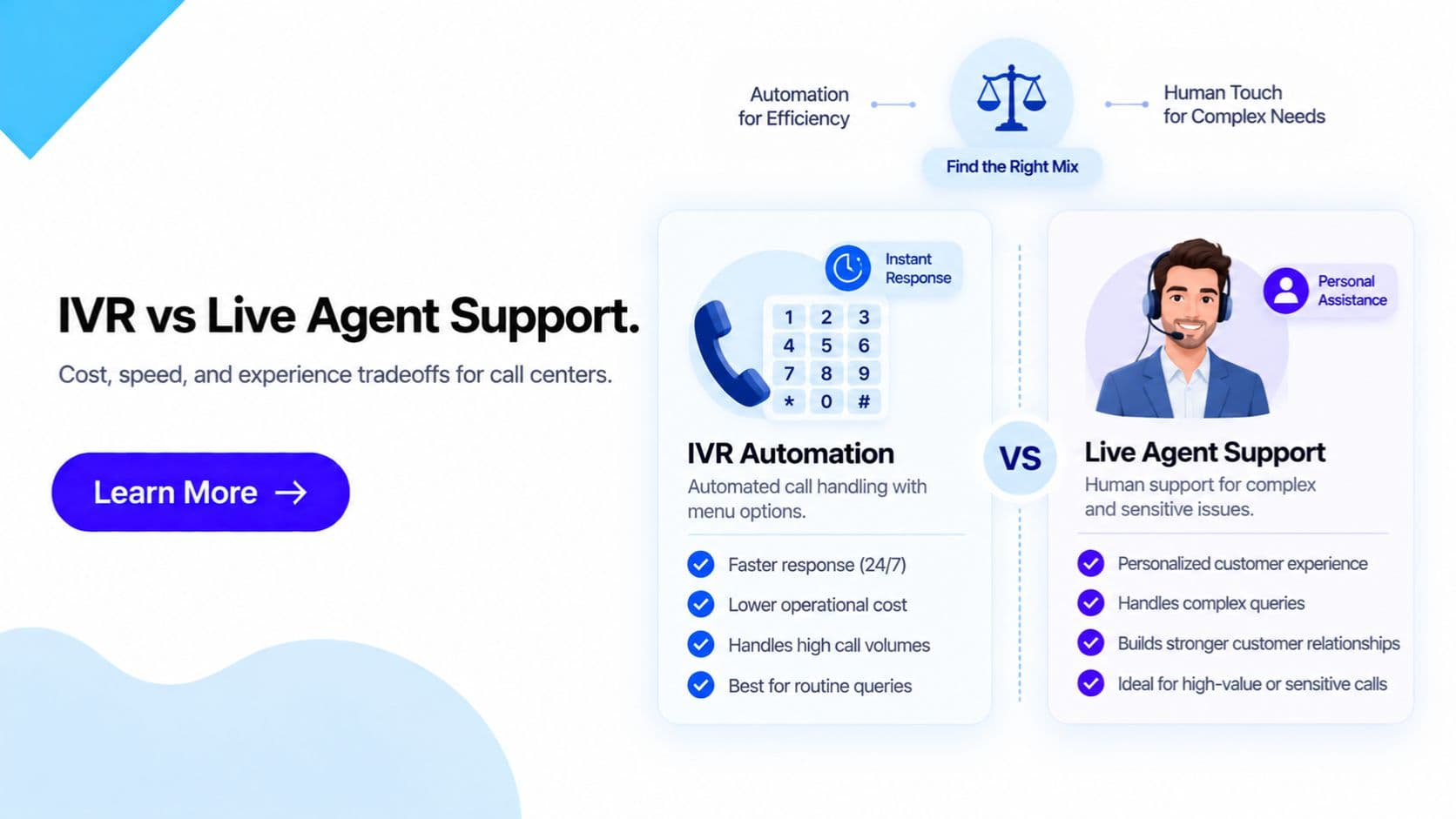
This page compares IVR automation against live agent support across cost, speed, consistency, and customer experience, and lays out a practical framework for deciding what belongs in self-service and what should always reach a person- so you can design an escalation flow that cuts cost without cutting corners on the calls that actually need empathy or judgment.
Quick answer: IVR wins decisively on cost per interaction, 24/7 availability, and consistency for simple, repetitive queries. Live agents win for complex complaints, emotionally sensitive conversations, high-value sales, and anything ambiguous enough that a menu tree can't cleanly categorize it. The right answer for almost every Indian call center is a blended model- IVR-first for routine volume, with a fast, context-aware escalation path to a live agent for everything else.
Get IVR System- Drag-and-drop flow builder · Multi-level call routing · Built to escalate cleanly
IVR vs Live Agent Support- 15-Point Comparison
| Dimension | IVR Automation | Live Agent Support |
|---|---|---|
| Cost per interaction | Low- fraction of an agent-handled call | High- ₹15-40+ per minute fully loaded |
| Availability | 24/7 at near-zero marginal cost | Shift-based- true round-the-clock coverage needs staffed shifts |
| Consistency | Identical experience every call, no variance | Varies by agent skill, mood, training, and fatigue |
| Handling complex/emotional queries | Poor- cannot read tone or improvise | Strong- empathy, judgment, real-time adaptation |
| Speed for simple queries | Fast- instant menu response, no hold time | Slower- queue wait plus agent lookup time |
| Scalability during call spikes | High- one system absorbs 10x volume with no added headcount | Low- near-linear cost, needs proportionally more agents |
| Personalization depth | Minimal- generic menu tree for all callers | Deep- agent can adapt to context and customer history |
| Escalation path | Needs a designed zero-out/fallback route | Is the escalation destination itself |
| Customer sentiment- routine issues | Generally fine if menu is short and fast | Feels like overkill or a wasted queue wait for simple asks |
| Customer sentiment- complex issues | Frequently a top complaint if forced through menu | Preferred- customers want a human for hard problems |
| Setup and maintenance cost | Moderate upfront (flow design), low ongoing | Low upfront, high ongoing (hiring, training, shift staffing) |
| Language/dialect handling | Fixed set of recorded/TTS languages per flow | Flexible- agent can adapt tone, language, and phrasing live |
| Compliance/recording requirements | Call recording and DPDP Act 2023 consent apply | Same- call recording and DPDP Act 2023 consent apply |
| Outbound telemarketing regulation | Falls under TRAI telemarketing rules for outbound IVR campaigns | Same TRAI rules apply for outbound live-agent calling |
| Ability to close a sale or negotiate | None- one-way or fixed-branch logic only | Strong- live back-and-forth, objection handling |
The Real Cost and Speed Comparison
Here is a worked example for a support line handling 40,000 calls a month, comparing an agent-only model against an IVR-first model with escalation for the harder cases:
| Metric | Agent-Only Support | IVR-First + Agent Escalation |
|---|---|---|
| Monthly call volume | 40,000 calls | 40,000 calls |
| Resolved by IVR self-service | 0 | 26,000 (65%) |
| Escalated to / handled by live agent | 40,000 (100%) | 14,000 (35%) |
| Average handling time- self-serve | Not applicable | 2.2 minutes |
| Average handling time- agent-handled | 5.5 minutes | 5.5 minutes |
| Agent cost per minute (fully loaded) | ₹22 | ₹22 |
| Total agent cost | ₹48,40,000 | ₹16,94,000 |
| Telephony/IVR platform cost per call | ₹3.20 | ₹3.20 |
| Total telephony/platform cost | ₹1,28,000 | ₹1,28,000 |
| Total monthly cost | ₹49,68,000 | ₹18,22,000 |
| Blended cost per resolved call | ₹124.20 | ₹45.55 |
| Average resolution time (blended) | 5.5 minutes | 3.4 minutes |
What this shows: Routing every one of the 40,000 monthly calls to a live agent costs nearly ₹49.7 lakh a month at a modest ₹22/minute blended agent cost. Letting IVR resolve the repetitive 65% and reserving agents for the 35% that genuinely need a human brings the blended cost per resolved call down from ₹124 to about ₹46- a reduction of roughly 63%- while also cutting the blended average resolution time because simple queries no longer sit in an agent queue behind harder calls.
Where Live Agents Are Necessary- 5 Scenarios
IVR cannot substitute for a human in these situations, no matter how well the flow is designed:
1. Complex or multi-part complaints
A complaint that spans a billing error, a missed delivery, and a request for compensation cannot be cleanly mapped to a single menu branch. IVR is built for single-intent routing; a caller with three overlapping issues needs an agent who can hold the whole context in their head and work through it as one conversation rather than three separate menu paths.
2. Emotionally sensitive conversations
A bereavement-related account closure, a customer describing a medical emergency, or someone who is audibly upset needs tone, patience, and real-time reassurance- none of which a recorded prompt or text-to-speech menu can provide. Forcing these calls through automated self-service before reaching a person almost always makes the interaction worse, not faster.
3. High-value sales or negotiation
Closing a loan, renewing a large insurance policy, or negotiating a B2B contract depends on live back-and-forth- reading hesitation, adjusting the offer, and handling objections as they come up. IVR can qualify or route these calls, but it cannot close them; that still requires a human on the line.
4. Ambiguous or multi-issue calls
When a caller isn't sure which menu option fits, or their issue genuinely spans two departments, forcing a decision at a menu prompt just produces a misrouted call that then needs to be transferred anyway- often after the caller has already sat through several menu levels. An agent (or a fast zero-out to one) resolves the ambiguity immediately instead of making the caller guess.
5. Regulatory verification needing human judgment
Some banking and insurance verification steps go beyond a scripted "press 1 to confirm"- they require an agent to assess a caller's responses, flag inconsistencies, or handle an edge case the compliance script didn't anticipate. Where judgment is part of the verification itself, a human has to be on the call, not just a recorded prompt tree.
Where IVR Should Handle It- 5 Scenarios
And here is where automation is clearly the better use of both the caller's time and the business's money:
1. Balance and status checks
Account balance, order status, or ticket status lookups are single-intent, data-driven queries with one correct answer- exactly what a self-service menu or automated lookup handles fastest, without a caller waiting in an agent queue for information a system can retrieve instantly.
2. Appointment confirmations and reminders
Confirming, rescheduling, or cancelling an appointment through a menu is faster for the caller than waiting for an agent to pull up a calendar, and it frees agent time entirely for calls that need a person's judgment.
3. High call-volume spikes
During a billing cycle, a product launch, or a service outage, call volume can spike well beyond normal staffing levels. IVR absorbs that spike at effectively the same marginal cost as a normal day, while an agent-only model would need to scale headcount up and back down- something no call center can do on short notice.
4. After-hours coverage
Outside business hours, IVR is often the only line available at all- confirming receipt of a request, capturing a callback request, or providing basic account information- rather than leaving callers with no response until agents are back on shift the next morning.
5. Simple payment and OTP flows
Payment confirmations, due-date reminders with a pay-now option, and OTP-based verification are transactional, low-ambiguity flows that a menu or voice OTP prompt resolves in seconds- routing these to a live agent would be a poor use of a paid minute for both the business and the caller.
Use-Case Recommendation Matrix
| Use case | Best channel | Why |
|---|---|---|
| Balance/order/ticket status check | IVR | Single-intent, data lookup, no judgment needed |
| Appointment confirmation/reschedule | IVR | Menu-driven, faster than waiting for an agent |
| Simple payment reminder + pay-now | IVR | Transactional, no back-and-forth required |
| OTP or identity verification (basic) | IVR | Scripted confirmation, no ambiguity |
| Complex, multi-part complaint | Live agent | Needs a single person holding full context |
| Emotionally sensitive conversation | Live agent | Requires empathy and real-time tone reading |
| High-value sales/negotiation | Live agent | Live persuasion and objection handling |
| Ambiguous or unclear-intent call | Live agent (fast zero-out) | Menu cannot cleanly categorize the request |
| Regulatory verification with edge cases | Live agent | Judgment-based assessment, not scripted confirmation |
| After-hours basic account query | IVR | Only available channel outside agent shift hours |
| Sudden call volume spike (launch/outage) | IVR-first with escalation | Absorbs spike without linear headcount cost |
| First-time caller, unclear need | IVR menu with fast escalation path | Routes simple cases fast, escalates the rest immediately |
Designing the Right IVR-to-Agent Escalation Flow
The businesses that get the most value out of a blended model spend as much design effort on the escalation path as on the self-service menu itself. A few practices matter more than the rest:
Keep menus short. A top-level menu with 3-4 options outperforms one with 8. Every extra option adds decision fatigue and increases the chance a caller picks wrong or gives up. If a flow genuinely needs more branches, nest them one level deeper under a clear top-level category rather than flattening everything into one long list.
Build a fast zero-out path. At any point in the flow, a caller should be able to reach a human quickly- not after exhausting every menu level. A visible "press 0 for an agent" option at each level, rather than buried only at the end, reduces frustration for the callers who already know self-service won't solve their problem.
Pass full context on handoff. When a call escalates, the agent should see what the caller pressed, what the IVR attempted, and why it escalated- so the caller never has to repeat themselves from scratch. This single change is often the biggest driver of satisfaction improvement in a hybrid model, independent of how good the menu itself is.
Design explicit fallback and timeout routes. Every menu level needs a defined path for an invalid key press, no input, or a caller looping through the same menu- routing to a general queue or agent, never a dead end. Get Click Media's IVR system flow builder makes these fallback paths a required part of every level rather than an afterthought.
Review escalation data regularly. Call analytics showing which menu options generate the highest escalation or drop-off rates is the concrete signal for where the menu needs simplifying- not guesswork. A menu option with a 70% escalation rate is effectively not doing its job as self-service and should either be redesigned or routed to an agent by default.
Frequently Asked Questions- IVR vs Live Agent Support
Can IVR fully replace live agents in a call center? No. A well-designed IVR can resolve a large share of repetitive, high-volume queries- balance checks, order status, appointment confirmations- without ever needing a human. But complex complaints, emotionally charged conversations, high-value sales negotiations, and ambiguous multi-issue calls all need a live agent's judgment and empathy. The realistic goal is not full replacement- it is letting IVR absorb the routine volume so agents spend their time only on calls that genuinely need a human.
What is a good IVR-to-agent escalation rate? There is no universal number, but for a well-tuned self-service IVR menu handling common transactional queries, an escalation rate in the 25-40% range is a reasonable benchmark- meaning 60-75% of calls resolve without a human. Escalation rates well above 50% usually signal that the menu is too generic, too long, or missing self-service options for queries customers actually call about.
How much does a live agent cost per minute in India compared to automated IVR handling? A fully loaded live agent in India- including salary, benefits, telephony, real estate, and supervision- typically costs roughly ₹15-40+ per minute depending on the city, skill level, and whether the process is outsourced or in-house. Automated IVR handling costs a small fraction of that per call, since it runs on telephony and platform infrastructure rather than headcount that scales linearly with volume.
What query types should always go to a human agent, not IVR? Complex or multi-part complaints, emotionally sensitive conversations such as bereavement-related account changes or visibly frustrated customers, high-value sales or negotiation calls, ambiguous queries that do not map cleanly to a menu option, and regulatory verification steps that require human judgment rather than a scripted confirmation should always route to a live agent.
How does a well-designed IVR reduce agent load without frustrating customers? By keeping menus short (ideally 3-4 top-level options), offering a fast zero-out path to a human at any point, handling only the genuinely repetitive queries in self-service, and passing full call context to the agent on escalation so the customer never has to repeat themselves. A frustrating IVR is usually one that is too long, too generic, or has no visible way to reach a person quickly.
What happens when IVR fails to route a call correctly? A properly designed flow includes a fallback and timeout path for every menu level- an invalid key press, no input, or a caller stuck looping through the same menu should route to a general queue or a live agent rather than dropping the call or trapping the caller. Reviewing drop-off and loop points in call analytics is how most misrouting issues get caught and fixed before they generate complaints at scale.
Get Started
The goal isn't choosing between IVR and live agents- it's building a flow where each one handles the calls it's actually good at. Get Click Media's IVR system gives you a drag-and-drop flow builder with multi-level routing and fallback paths built in, so routine queries resolve in self-service and everything else reaches an agent fast, with full context carried over. If you're also weighing automated channels against each other, see how IVR compares to a simpler automation layer in our IVR vs Missed Call Service breakdown.
Get IVR System- Drag-and-drop flow builder · Multi-level call routing · Built to escalate cleanly
Article topics
Frequently Asked Questions
Can IVR fully replace live agents in a call center?
No. A well-designed IVR can resolve a large share of repetitive, high-volume queries- balance checks, order status, appointment confirmations- without ever needing a human. But complex complaints, emotionally charged conversations, high-value sales negotiations, and ambiguous multi-issue calls all need a live agent's judgment and empathy. The realistic goal is not full replacement- it is letting IVR absorb the routine volume so agents spend their time only on calls that genuinely need a human.
What is a good IVR-to-agent escalation rate?
There is no universal number, but for a well-tuned self-service IVR menu handling common transactional queries, an escalation rate in the 25-40% range is a reasonable benchmark- meaning 60-75% of calls resolve without a human. Escalation rates well above 50% usually signal that the menu is too generic, too long, or missing self-service options for queries customers actually call about.
How much does a live agent cost per minute in India compared to automated IVR handling?
A fully loaded live agent in India- including salary, benefits, telephony, real estate, and supervision- typically costs roughly ₹15-40+ per minute depending on the city, skill level, and whether the process is outsourced or in-house. Automated IVR handling costs a small fraction of that per call, since it runs on telephony and platform infrastructure rather than headcount that scales linearly with volume.
What query types should always go to a human agent, not IVR?
Complex or multi-part complaints, emotionally sensitive conversations such as bereavement-related account changes or visibly frustrated customers, high-value sales or negotiation calls, ambiguous queries that do not map cleanly to a menu option, and regulatory verification steps that require human judgment rather than a scripted confirmation should always route to a live agent.
How does a well-designed IVR reduce agent load without frustrating customers?
By keeping menus short (ideally 3-4 top-level options), offering a fast zero-out path to a human at any point, handling only the genuinely repetitive queries in self-service, and passing full call context to the agent on escalation so the customer never has to repeat themselves. A frustrating IVR is usually one that is too long, too generic, or has no visible way to reach a person quickly.
What happens when IVR fails to route a call correctly?
A properly designed flow includes a fallback and timeout path for every menu level- an invalid key press, no input, or a caller stuck looping through the same menu should route to a general queue or a live agent rather than dropping the call or trapping the caller. Reviewing drop-off and loop points in call analytics is how most misrouting issues get caught and fixed before they generate complaints at scale.
About the author
Get Click Media creates practical resources for businesses using messaging, automation, analytics, and digital communication to improve customer engagement. This article was published on .