

In this article
Explore the key concepts, practical considerations, and frequently asked questions related to ivr for call centers: cutting wait times and agent load.
Key takeaways
- IVR cuts wait times two ways- routing callers to the right skill queue directly, and resolving simple queries like balance checks before a human is needed.
- Balance checks, order status, hours, and simple account lookups are the classic self-service candidates- structured answers with no judgment call required.
- Adding more menu levels backfires past a point- IVR path data consistently shows rising abandonment at deeper menu levels, so keep flows shallow.
Every call an IVR system resolves through self-service, or routes correctly to the right queue on the first attempt, is a call that never sits in a generic hold line and never consumes an agent's time on the wrong department. That is the entire mechanism behind IVR reducing call-center wait times and agent load- fewer calls reaching a human at all, and the calls that do reach a human getting there faster and in the right place. Call analytics and reporting is how a call center actually confirms this is happening, rather than assuming it.
Cut Call Center Wait Times with Get Click Media- Multi-level IVR routing · Self-service menus · Real-time call analytics. Request a Demo · Build Your IVR Flow
Where the Wait Time Actually Comes From
Hold time in a call center rarely comes from one cause- it stacks up from three separate sources, and each one responds to a different fix.
A generic hold queue. Without routing, every inbound call- sales, support, billing, a simple hours enquiry- lands in the same line, and a caller with a two-second question waits behind callers with genuinely complex issues.
Misrouted calls that get transferred. A caller who reaches the wrong queue and gets transferred effectively waits twice- once in the original queue, then again after being handed to the correct department, with no guarantee the second wait is any shorter.
Simple queries that never needed a human. A balance check, an order-status lookup, or a hours-and-location question consumes exactly the same agent time and queue slot as a complex issue, even though the caller only wanted one fact.
An IVR addresses the third source directly through self-service, and the first two through routing- covered below.
How IVR Self-Service Removes Load Before It Reaches an Agent
The most direct way an IVR reduces agent load is by never sending a call to an agent in the first place. A multi-level IVR flow can include a routing action that leads straight to a self-service lookup instead of a department queue- the caller enters an account number or order ID, and the system reads back the answer with no agent involved at any point.
The query types that fit this pattern well share one trait: a single, structured answer with no judgment call required.
- Balance checks- account balance, prepaid balance, outstanding amount.
- Order or delivery status- has it shipped, when will it arrive.
- Business hours and location- whether a branch is open, where the nearest one is.
- Simple account information- policy status, membership validity, appointment confirmation.
Every one of these calls that resolves in the IVR is a call that never enters an agent's queue, never adds to average handle time, and never competes with a more complex caller for the same agent's attention. This is the same logic that separates an auto-dialer from a pure voice broadcast on the outbound side- agent time is the scarce resource, and the goal is spending it only where a live conversation is actually needed.
How Smart Routing Cuts Wait Time for the Calls That Do Need an Agent
Not every call can be resolved by self-service, and for the ones that do need a human, the IVR's second job is getting them to the right agent on the first attempt.
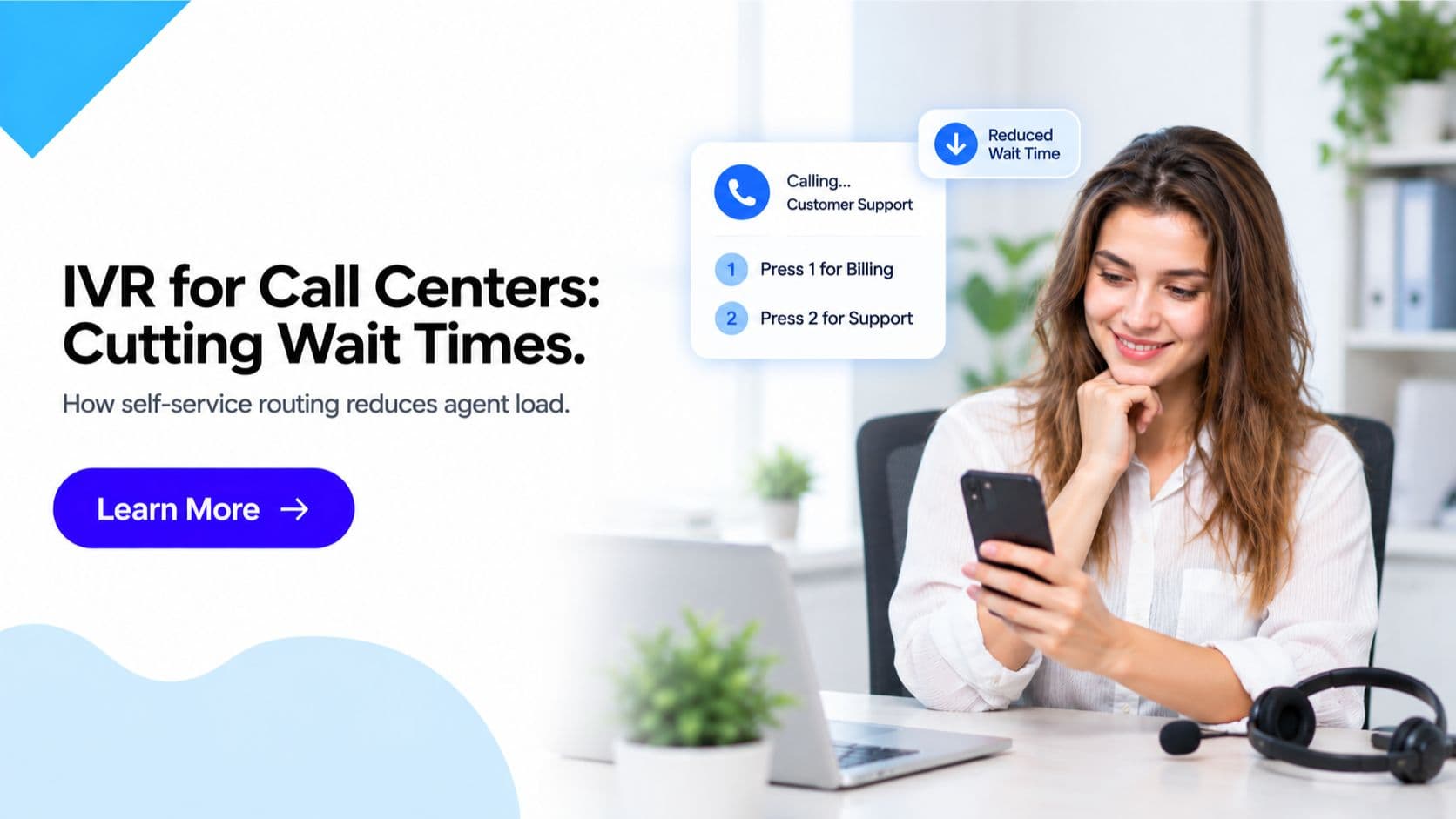
A menu built around "Press 1 for Sales, 2 for Support, 3 for Billing"- with Support optionally nesting into a sub-menu for "report a new issue" versus "check an existing ticket"- sends a caller directly to the skill queue that can actually help, instead of a generic line that then has to identify the right department and transfer the call. That transfer step is exactly the "waiting twice" pattern described above, and menu-based routing removes it by making the identification happen up front, through a key press, instead of by an agent after the caller has already waited once.
Routing only works if every path actually leads somewhere, which is why a fallback and timeout path matters just as much as the menu options themselves. If a caller presses an invalid key, presses nothing, or the line times out, a well-built flow routes them to a live agent queue or a callback option rather than leaving them stuck with no way forward. Without that fallback, a confused caller either hangs up and redials- adding a second call to the queue- or sits on a dead line, which is worse for wait times than no IVR at all.
Measuring the Impact
Assuming an IVR is reducing wait time and agent load is not the same as confirming it, and call analytics and reporting is where that confirmation actually happens.
IVR path performance shows which menu options callers choose and where they abandon the flow- if a self-service option is barely used, or a particular menu level shows a spike in drop-off, that's a specific, fixable problem rather than a vague sense that "the IVR could be better."
Average handle time and agent-level metrics- calls handled and average handle time per agent- show whether the calls reaching agents are actually the ones that needed a human, and whether routing is distributing them sensibly across the team.
Answer and drop-off rate shows what share of calls connect versus disconnect before reaching a resolution, which is the closest single number to "is the wait time problem getting better or worse."
Read together, real-time data flags a problem happening right now- a menu option suddenly spiking in abandonment- while historical trend reporting shows whether a redesigned flow actually moved the numbers over weeks, not just on the day it launched.
Common Mistake- Over-Building the Menu
The instinct to add more menu levels- one more sub-menu, one more routing branch to cover an edge case- feels like it should reduce agent load further, but past a certain point it does the opposite. Every additional level a caller has to sit through before reaching their destination adds time, and time is exactly what a caller waiting on hold has already run out of patience for. IVR path data consistently shows abandonment climbing at deeper menu levels, which means an over-built menu can drive callers to hang up and call back- adding a second call to the queue instead of removing load from it.
The goal is fewer, well-designed levels that get a caller to the right place fast, with a quick path to a live agent or callback built in for anyone the menu genuinely can't resolve- not a deeper tree that tries to account for every possible request.
Frequently Asked Questions
How does IVR actually reduce wait times in a call center? Two ways at once. First, it routes callers directly to the right department or skill queue based on a menu choice, instead of dropping everyone into one generic hold line where the caller who needed billing waits behind twenty callers who needed sales. Second, it resolves simple queries- balance checks, order status, hours- through self-service before a human is ever involved, so those calls never enter a queue at all.
What call types are best resolved by IVR self-service without an agent? Balance checks, order or delivery status, business hours and location, and simple account information are the classic examples- queries with a single, structured answer that a caller can retrieve by pressing a key or entering an account number, with no judgment call or conversation required. These are exactly the calls that clog a queue for no real reason when a human answers them one at a time.
How does a call center measure whether its IVR is actually helping? Through IVR path performance data- which menu options callers choose and where they abandon the flow- alongside average handle time, agent-level handle time per agent, and overall answer and drop-off rate. If abandonment is climbing at a specific menu level, or handle time isn't dropping despite adding a self-service option, that's the concrete signal something in the flow needs to change, rather than assuming the IVR is working because it exists.
What happens when a caller can't get what they need from the menu? A well-designed flow always includes a fallback or timeout path- if a caller presses an invalid key, presses nothing, or the line times out, they're routed to a live agent queue or a callback option rather than being left stuck in a dead end or forced to hang up and redial. A fallback path that dumps every unresolved call back to a generic queue defeats the purpose, so it should route to the queue most likely to actually help.
Does adding more IVR menu levels always reduce agent load? No- past a certain point it backfires. Every extra menu level a caller has to sit through before reaching their destination adds time and a chance to give up, and rising abandonment at deeper menu levels is a common finding in IVR path data. The goal is fewer, smarter menu levels that get a caller to the right place fast, not more levels stacked on top of each other.
How does IVR reporting help with staffing decisions? Real-time call volume and answer-rate data shows exactly when call volume is spiking against available agents, and historical trend reporting shows which days or hours predictably run heavier- so a call center can staff up ahead of a known peak instead of reacting after hold times have already climbed and callers have already started abandoning.
Get Started
Cutting call-center wait time isn't one feature- it's self-service removing calls that never needed an agent, smart routing getting the rest to the right queue on the first try, and analytics confirming both are actually working rather than just assumed. Get Click Media's IVR system provides the drag-and-drop flow builder behind the routing and fallback logic, call analytics and reporting is built into every voice account by default to track the impact, and IVR pricing in India covers what a flow like this costs to run at your call volume.
Cut Call Center Wait Times with Get Click Media- Multi-level IVR routing · Self-service menus · Real-time call analytics. Request a Demo · See IVR Pricing
Article topics
Frequently Asked Questions
How does IVR actually reduce wait times in a call center?
Two ways at once. First, it routes callers directly to the right department or skill queue based on a menu choice, instead of dropping everyone into one generic hold line where the caller who needed billing waits behind twenty callers who needed sales. Second, it resolves simple queries- balance checks, order status, hours- through self-service before a human is ever involved, so those calls never enter a queue at all.
What call types are best resolved by IVR self-service without an agent?
Balance checks, order or delivery status, business hours and location, and simple account information are the classic examples- queries with a single, structured answer that a caller can retrieve by pressing a key or entering an account number, with no judgment call or conversation required. These are exactly the calls that clog a queue for no real reason when a human answers them one at a time.
How does a call center measure whether its IVR is actually helping?
Through IVR path performance data- which menu options callers choose and where they abandon the flow- alongside average handle time, agent-level handle time per agent, and overall answer and drop-off rate. If abandonment is climbing at a specific menu level, or handle time isn't dropping despite adding a self-service option, that's the concrete signal something in the flow needs to change, rather than assuming the IVR is working because it exists.
What happens when a caller can't get what they need from the menu?
A well-designed flow always includes a fallback or timeout path- if a caller presses an invalid key, presses nothing, or the line times out, they're routed to a live agent queue or a callback option rather than being left stuck in a dead end or forced to hang up and redial. A fallback path that dumps every unresolved call back to a generic queue defeats the purpose, so it should route to the queue most likely to actually help.
Does adding more IVR menu levels always reduce agent load?
No- past a certain point it backfires. Every extra menu level a caller has to sit through before reaching their destination adds time and a chance to give up, and rising abandonment at deeper menu levels is a common finding in IVR path data. The goal is fewer, smarter menu levels that get a caller to the right place fast, not more levels stacked on top of each other.
How does IVR reporting help with staffing decisions?
Real-time call volume and answer-rate data shows exactly when call volume is spiking against available agents, and historical trend reporting shows which days or hours predictably run heavier- so a call center can staff up ahead of a known peak instead of reacting after hold times have already climbed and callers have already started abandoning.
About the author
Get Click Media creates practical resources for businesses using messaging, automation, analytics, and digital communication to improve customer engagement. This article was published on .