

In this article
Explore the key concepts, practical considerations, and frequently asked questions related to how missed call alert services work: a complete guide for indian businesses.
Key takeaways
- A missed call number disconnects automatically after one or two rings, before it ever connects- so the call stays free for the caller.
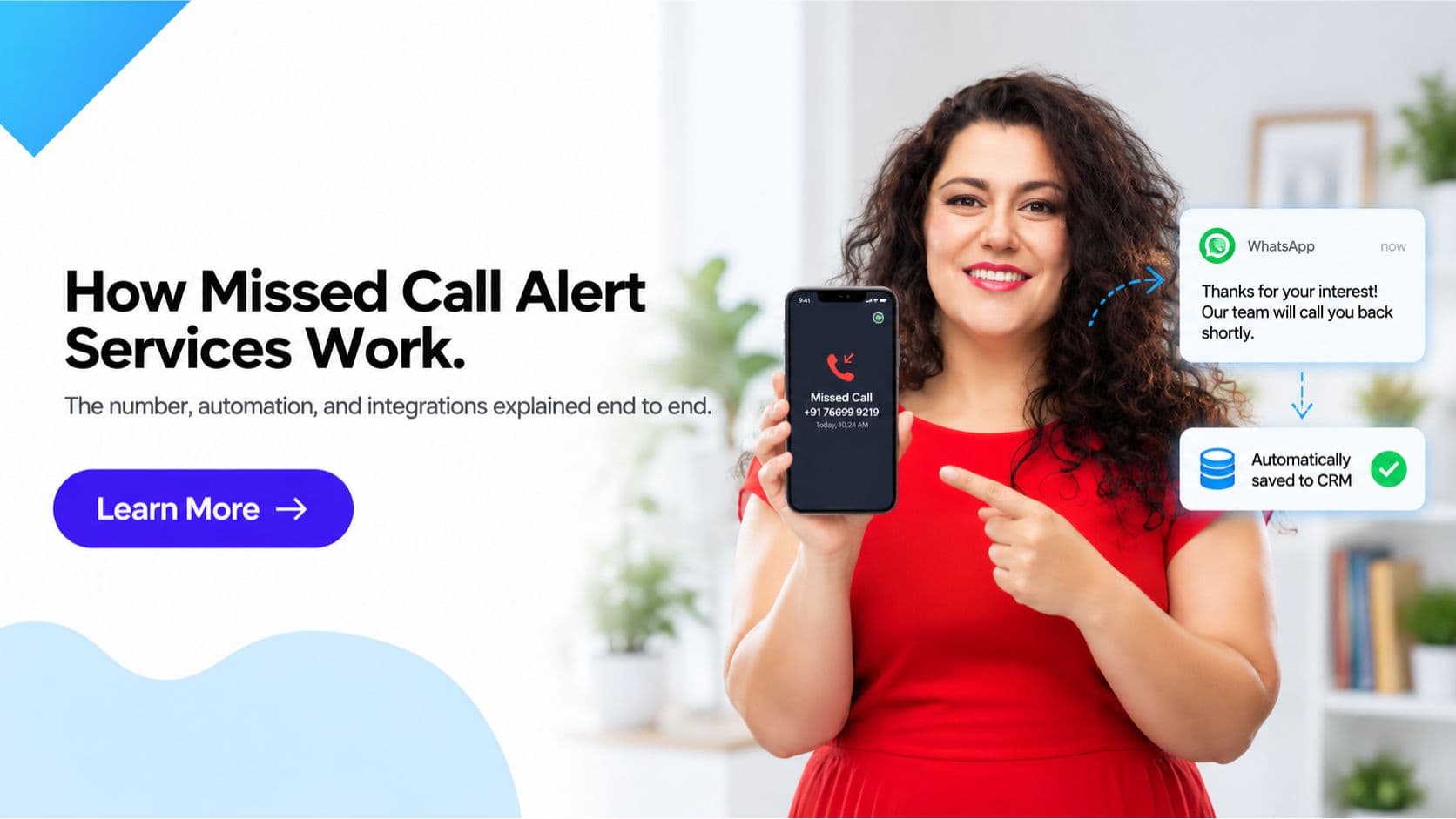
- The moment a call is logged, an auto-reply fires, a CRM lead record is created, and an optional callback trigger can alert a sales agent.
- Plans start at ₹1,499/month for up to 1,000 calls with SMS auto-reply, rising with volume, WhatsApp, CRM integration, or a toll-free number.
A missed call alert service looks simple from the outside- a number, a ring, a hang-up- but there's a specific technical flow behind every missed call alert service: how the number detects and disconnects the call, how the automated reply fires, and how the lead lands in your CRM. This guide walks through that flow end to end, so you know exactly what gets set up and in what order.
How a Missed Call Number Actually Works
A missed call number runs on a telephony platform configured to do the opposite of a normal business line- it's built to disconnect, not connect. When a caller dials the number, the platform detects the incoming ring signal immediately. Instead of routing the call to an agent, an IVR, or a voicemail box, it disconnects the call automatically after one or two rings- before the call ever actually connects or gets answered on either end.
This is the detail that makes the entire model work: because the call never connects, the caller is never billed for a connected call, and the business never incurs the per-minute or per-call telephony charge that an answered call would generate. The only thing that happens on the network is a ring and a disconnect. At the same moment the ring is detected, the platform logs the caller's number and the exact timestamp instantly- that log entry, not a conversation, is the entire signal the rest of the system acts on.
What Gets Set Up
| Component | What it is | Setup owner |
|---|---|---|
| Missed Call Number | A dedicated local or toll-free number configured to disconnect before connecting | GCM provisions and activates |
| Auto-Reply Engine (SMS/WhatsApp) | The automated message service that fires the instant a missed call is logged | GCM configures templates |
| CRM/Webhook Integration | The connection that pushes each missed call into your CRM as a lead record | GCM sets up- your team maps fields |
| Callback/Auto-Dialer Trigger | The optional task or dial-out that alerts a sales agent for human follow-up | GCM configures- business defines routing |
| Analytics Dashboard | Real-time log of every missed call, source, and triggered action | GCM provides access |
Step-by-Step Setup
1. Choose a Number Type- Normal or Toll-Free
Start by deciding whether a normal local number or a toll-free number fits the campaign. Both disconnect the same way technically, so the choice is about branding and reach rather than function- a normal number is cheaper and works well for regional or single-city campaigns, while a toll-free number carries a national, non-geographic feel that often reads as more established on hoardings and print ads.
Tip: If the number will appear across multiple states or in a national ad spot, a toll-free number is usually worth the small premium for the trust signal alone.
2. Provision and Activate the Number
Once the number type is decided, Get Click Media provisions the dedicated number on your account and connects it to the telephony platform that handles ring detection and auto-disconnect. This is a backend activation step- no wiring or hardware is needed on your end, and the number is typically live within a couple of business days.
Provisioning timelines can move faster for a normal number than a toll-free number, since toll-free allocation sometimes involves an extra approval step.
3. Configure the Auto-Reply- SMS or WhatsApp
This is where the missed call turns into value for the caller. You set the message template- an SMS, a WhatsApp reply, or both- that fires automatically the instant the missed call is logged. A good auto-reply includes a link, an offer detail, or a clear next step, since the caller already showed intent by dialing.
Keep the auto-reply short and action-oriented- a link or a one-line offer converts better than a long paragraph, since it's usually read on a phone right after the call.
4. Set Up CRM or Webhook Integration
Next, the missed call number is connected to your CRM through a webhook, so every missed call creates a lead record automatically with the caller's number and timestamp. This step removes manual data entry entirely- your sales team sees new leads appear in the CRM in real time as calls come in.
Map the missed call source field in your CRM early- it makes it far easier to track which ad, hoarding, or campaign generated each lead later.
5. Configure the Optional Callback-to-Agent Trigger
If the campaign needs a human follow-up rather than just an automated message, set up a callback trigger- either a task assigned to a specific agent or an automated dial-out that connects the caller to a sales agent shortly after the missed call. This step is optional and layers on top of the auto-reply and CRM logging rather than replacing them.
Route callback tasks by time of day or agent availability if your team works in shifts- an unrouted callback queue tends to get missed during busy hours.
6. Test and Go Live
Before publishing the number on any ad, hoarding, or campaign material, call it yourself and confirm the full chain works: the auto-reply SMS or WhatsApp arrives within moments, the lead entry appears correctly in the CRM, and the callback trigger (if configured) fires as expected. Only sign off once every configured action has been verified end to end.
Test from more than one carrier and network type where possible- ring and disconnect timing can vary slightly across telecom operators.
Common Use Cases
- Ad-campaign lead capture- "give a missed call to know more" printed on a hoarding, newspaper ad, or radio spot
- Retail and showroom callbacks- "give a missed call for a callback" displayed in-store or on packaging
- App download or opt-in triggers- a missed call confirms interest before a download link or opt-in SMS goes out
- Event or webinar registration- a missed call registers interest and triggers a confirmation message with joining details
Frequently Asked Questions
How does a missed call number technically detect and log a call? The number sits on a telephony platform that watches for the incoming ring signal and disconnects the call automatically after one or two rings- before it ever actually connects or gets answered. Because the call is never connected, it's free for the caller and doesn't incur the per-minute or per-call telephony charge that an answered call would. The platform logs the caller's number and the exact timestamp the instant the ring is detected, and that log entry is the trigger for everything that happens next.
What happens the instant someone gives a missed call? The moment the ring is detected and the call is disconnected, the system logs the caller's number and timestamp, then fires whatever automated actions are configured on that number- typically an SMS or WhatsApp auto-reply within moments, a lead entry created in your CRM, and, if configured, a callback task or automated dial-out to a sales agent. All of this happens without anyone on your side picking up a phone.
Is a toll-free or a normal number better for a missed call service? Either works technically, since the call is disconnected before it connects either way- the choice comes down to branding and cost. A normal local number is cheaper and fine for regional campaigns. A toll-free number carries a national, more established feel that tends to read as more trustworthy in print ads and hoardings, at a small premium over a normal number. See the missed call service pricing breakdown for exact numbers on both.
How fast does the auto-reply SMS or WhatsApp fire after a missed call? Typically within moments of the missed call being logged. The missed call event itself is the trigger- there's no manual step, no agent action, and no queue in between the call being detected and the automated message going out.
Does a missed call service integrate with an existing CRM? Yes- the missed call number is connected to your CRM through a webhook, so every missed call creates a lead record automatically with the caller's number and timestamp, ready for your sales team to work without manual data entry. This runs alongside any SMS/WhatsApp auto-reply and callback trigger configured on the same number.
What does a missed call alert service cost? Pricing is a flat monthly plan based on expected call volume, number type, and which automated actions you need- starting at ₹1,499/month for up to 1,000 calls with SMS auto-reply, rising as volume and integrations (WhatsApp, CRM webhook, toll-free number) are added. See the full missed call service pricing plans for the current tiers.
Get Started
Get Click Media provisions the number, configures the auto-reply, and wires up the CRM and callback triggers- so a missed call alert service is live in days, not weeks. Check the missed call service pricing page for the plan that matches your expected call volume.
Ready to turn missed calls into leads? Request a Demo to get your dedicated number provisioned and connected.
Article topics
Frequently Asked Questions
How does a missed call number technically detect and log a call?
The number sits on a telephony platform that watches for the incoming ring signal and disconnects the call automatically after one or two rings- before it ever actually connects or gets answered. Because the call is never connected, it's free for the caller and doesn't incur the per-minute or per-call telephony charge that an answered call would. The platform logs the caller's number and the exact timestamp the instant the ring is detected, and that log entry is the trigger for everything that happens next.
What happens the instant someone gives a missed call?
The moment the ring is detected and the call is disconnected, the system logs the caller's number and timestamp, then fires whatever automated actions are configured on that number- typically an SMS or WhatsApp auto-reply within moments, a lead entry created in your CRM, and, if configured, a callback task or automated dial-out to a sales agent. All of this happens without anyone on your side picking up a phone.
Is a toll-free or a normal number better for a missed call service?
Either works technically, since the call is disconnected before it connects either way- the choice comes down to branding and cost. A normal local number is cheaper and fine for regional campaigns. A toll-free number carries a national, more established feel that tends to read as more trustworthy in print ads and hoardings, at a small premium over a normal number. See the missed call service pricing breakdown for exact numbers on both.
How fast does the auto-reply SMS or WhatsApp fire after a missed call?
Typically within moments of the missed call being logged. The missed call event itself is the trigger- there's no manual step, no agent action, and no queue in between the call being detected and the automated message going out.
Does a missed call service integrate with an existing CRM?
Yes- the missed call number is connected to your CRM through a webhook, so every missed call creates a lead record automatically with the caller's number and timestamp, ready for your sales team to work without manual data entry. This runs alongside any SMS/WhatsApp auto-reply and callback trigger configured on the same number.
What does a missed call alert service cost?
Pricing is a flat monthly plan based on expected call volume, number type, and which automated actions you need- starting at ₹1,499/month for up to 1,000 calls with SMS auto-reply, rising as volume and integrations (WhatsApp, CRM webhook, toll-free number) are added. See the full missed call service pricing plans for the current tiers.
About the author
Get Click Media creates practical resources for businesses using messaging, automation, analytics, and digital communication to improve customer engagement. This article was published on .