

In this article
Explore the key concepts, practical considerations, and frequently asked questions related to how indian d2c brands use whatsapp to cut cart abandonment.
Key takeaways
- Indian e-commerce cart abandonment runs 65-80%, and WhatsApp's near-98% open rate outperforms email recovery sequences that typically see only 40-50% opens.
- The recommended sequence fires three staged reminders- within 15-60 minutes, around 24 hours, and 48-72 hours later- with a discount usually reserved for the second message.
- Cart recovery templates are generally billed as lower-cost Utility category by Meta, but adding a promotional discount can push them into the pricier Marketing category.
Indian e-commerce stores lose 65-80% of carts to abandonment- a customer adds items, starts checkout, and leaves before paying. Most of that loss is recoverable if the follow-up message actually reaches the customer and makes it effortless to finish the purchase. Email tries to do this, but abandoned-cart emails typically see only 40-50% open rates and often arrive after the customer has already moved on or bought elsewhere.
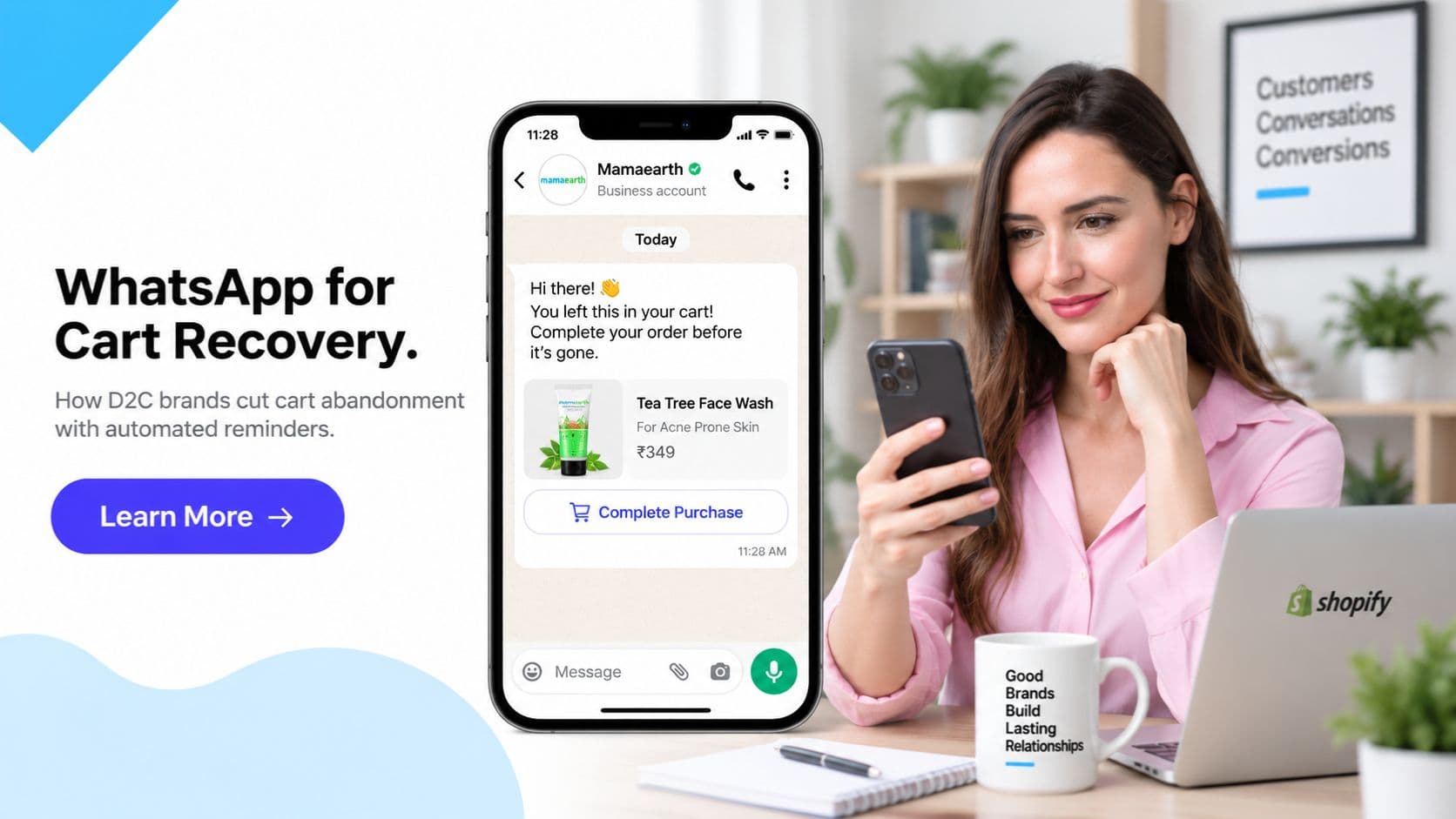
This is why WhatsApp has become the default recovery channel for Indian D2C brands specifically- not just e-commerce broadly. D2C brands run on tighter margins per order and rely more heavily on their own paid traffic, so a lost cart is a lost customer-acquisition spend, not just a lost sale. With close to a 98% open rate and a message format that can show the exact product left in the cart- image, name, price- alongside a direct "Complete Purchase" button, WhatsApp cart recovery converts a meaningfully higher share of abandoned carts than email-only recovery for the same traffic. The customer doesn't need to remember what they were buying or re-search your site; the product card and the button do the work.
In practice, many D2C brands running a WhatsApp recovery sequence alongside email see recovered-cart revenue land somewhere in the range of a few percentage points to low double digits of otherwise-lost cart value each month- the exact figure depends heavily on category, price point, and how fast the first reminder fires, but the direction is consistent: a plain, well-timed WhatsApp nudge recovers carts that would otherwise have gone to email's spam folder or nowhere at all.
Get Click Media builds and manages WhatsApp abandoned cart recovery for Indian e-commerce brands, with native Shopify and WooCommerce integrations that listen for cart and checkout events and trigger the recovery sequence automatically- no manual list-building, no CSV exports. The flow runs on WhatsApp Business API, so every reminder is sent from your verified business number with the same product data as your live store.
This guide covers how the recovery sequence is structured, how it compares to email, real use-case scenarios across Indian D2C categories, and the compliance basics- opt-in and template categorisation- that keep the flow running smoothly. Cart abandonment is a pre-order problem- for the related, later-stage issue of COD orders that get placed but then refused or returned (RTO), see our guide on WhatsApp COD-to-prepaid conversion.
Set Up WhatsApp Cart Recovery with Get Click Media- Official Meta BSP · Shopify/WooCommerce integration · Go live in 5 days. Recover Abandoned Carts · Request a Demo · See WhatsApp API Pricing
What Is WhatsApp Abandoned Cart Recovery?
WhatsApp abandoned cart recovery is an automated message sequence triggered when a customer adds products to their cart on your Shopify, WooCommerce, or custom e-commerce store, begins checkout, and then leaves without completing payment- typically detected within 15-60 minutes of inactivity at checkout.
Instead of a generic "you left something behind" text, the message is built as a product card- the exact item(s) the customer left in their cart, shown with image, name, and price- paired with a "Complete Purchase" button. Tapping the button deep-links the customer either to a pre-filled checkout page with their cart already loaded, or to a direct payment link, so they can finish paying in one or two taps rather than rebuilding the cart from scratch.
Because it runs on WhatsApp Business API, the same flow can branch based on the customer's response- if they reply with a question instead of paying, a WhatsApp chatbot can pick up the objection ("is this in stock?", "any discount available?", "how long is delivery?") and route it to a live agent if needed, rather than losing the customer to an unanswered question.
The Cart Recovery Sequence- Step by Step
- Cart and checkout event captured from your store. Your Shopify, WooCommerce, or custom store sends a webhook the moment a customer adds an item to cart, starts checkout, and then goes inactive without completing payment. Get Click Media's store integration listens for these events in real time- no polling delay.
- Customer identity and opt-in are confirmed. The system matches the cart to a customer phone number that has valid WhatsApp opt-in- captured at signup, during checkout, or through a prior WhatsApp interaction. Carts tied to numbers without consent are excluded from the flow.
- First nudge sent within 15-60 minutes. A product-card message goes out showing the exact item(s) left in the cart, with a "Complete Purchase" button linking to the pre-filled checkout or a payment link. This first message is a simple reminder- no discount, low-pressure.
- Second reminder sent around 24 hours later. If the cart is still unpaid, a second message follows, often with a small time-bound incentive- a percentage discount, free shipping, or a bundled offer- to convert customers who needed an extra reason to complete the purchase.
- Final reminder sent around 48-72 hours after abandonment. A last message closes the loop, sometimes flagging limited stock or the incentive's expiry. If there is still no response, the sequence ends automatically to avoid over-messaging the customer.
- Replies are routed to a chatbot or live agent. At any stage, if the customer replies with a question instead of tapping the button, WhatsApp chatbot logic handles common objections- stock, sizing, delivery time, payment options- and escalates to a human agent when the query needs one.
- Conversion is tracked back to the original cart. Once the customer completes payment, the order is matched back to the original abandoned cart event, so recovery rate, revenue recovered, and time-to-conversion are all measurable per campaign.
WhatsApp Cart Recovery vs Email Cart Recovery
| Factor | WhatsApp Cart Recovery | Email Cart Recovery |
|---|---|---|
| Typical open rate | ~98% | ~40-50% |
| Message format | Rich product card- image, name, price, button | Static HTML email, often rendered inconsistently |
| Deliverability risk | Low- delivered directly to the app | Higher- spam filters, promotions tab |
| Time to view | Usually within minutes | Often hours to days, if opened at all |
| Action to complete purchase | One-tap button, deep-links to checkout | Click through email, then navigate site |
| Two-way conversation | Yes- customer can reply with questions | No- reply-to inboxes are rarely monitored |
| Personalisation | Product-specific card per customer | Product image blocks, same for most customers |
| Mobile experience | Native, no rendering issues | Inconsistent across email clients |
| Cost per message | WhatsApp conversation charge applies | Near-zero per email |
| Setup complexity | Requires WhatsApp Business API + store webhook | Requires email service provider + store integration |
| Best for | High-intent, fast-moving recovery windows | Lower-cost, longer nurture sequences |
| Compliance requirement | Requires WhatsApp opt-in consent | Requires email marketing consent (CAN-SPAM/local law) |
The two are not mutually exclusive- many Get Click Media clients run WhatsApp as the primary, fast-response channel for the first 72 hours, with email continuing as a lower-cost backup channel for customers without WhatsApp opt-in.
WhatsApp Cart Recovery- 5 Use Cases for Indian E-commerce
1. Fashion & Apparel
A customer adds a kurta set to their cart, selects a size, and drops off at the payment step. The first WhatsApp nudge, sent 30 minutes later, shows the exact kurta set with size and price, plus a "Complete Purchase" button. Many fashion shoppers abandon simply because they got distracted mid-checkout, not because of price objection, so the plain reminder alone recovers a large share. Result: first-message recovery rate of 20-25% for fashion carts, without any discount offered.
2. Electronics & Gadgets
A customer adds a pair of wireless earbuds to their cart but drops off comparing prices across other sites. The 24-hour reminder includes a small discount code alongside the product card, nudging price-sensitive electronics shoppers who were still deciding. Result: second-message (discount) reminder recovers 2-3x more carts than the first plain reminder for electronics categories.
3. Grocery & Quick-Commerce
A customer builds a grocery cart but abandons at checkout, often due to a delivery slot issue or a forgotten payment method. Because grocery purchase intent decays fast, the first reminder goes out within 15-20 minutes- the tightest window in the recovery sequence- showing the cart items and a one-tap re-checkout link. Result: grocery cart recovery messages sent within 20 minutes recover significantly more than reminders sent after an hour, since intent drops sharply for perishable/urgent orders.
4. Beauty & Personal Care
A customer adds a skincare bundle to their cart and leaves without paying, often after checking reviews or ingredient lists elsewhere. The recovery message reinforces the specific products with their images, and the chatbot handles common follow-up questions- "is this suitable for oily skin?", "is this original?"- directly in the WhatsApp thread. Result: carts where the customer replies to the chatbot's product Q&A convert at a notably higher rate than carts that receive no reply at all.
5. Furniture & High-Ticket Items
A customer adds a sofa or a large appliance to their cart- a considered, higher-value purchase where checkout abandonment is common because the customer wants to think it over or discuss with family. The recovery sequence stretches slightly longer, with the final reminder at 72 hours reinforcing warranty, delivery timeline, and EMI options rather than pushing urgency. Result: high-ticket cart recovery messages that mention EMI/installment options in the final reminder recover a materially higher share than reminders that only repeat the price.
Frequently Asked Questions- WhatsApp Abandoned Cart Recovery
What is WhatsApp abandoned cart recovery and how does it work? WhatsApp abandoned cart recovery is an automated message sent to a customer who added products to their cart on your Shopify, WooCommerce, or custom e-commerce store but left without completing payment. The message is triggered by a webhook from your store, shows the exact product(s) left behind- image, name, price- as a product card, and includes a "Complete Purchase" button that deep-links to a pre-filled checkout or payment link. The customer completes the order in one tap without re-searching for the product.
How much can WhatsApp cart recovery messages improve conversion vs email? Indian e-commerce cart abandonment commonly runs 65-80%. Email cart-recovery sequences typically see 40-50% open rates, and many abandoned-cart emails land in spam or go unopened for days. WhatsApp's open rate runs close to 98%, and because the message shows a rich product card with a direct action button, recovery rates on WhatsApp are typically meaningfully higher than email-only recovery flows for the same abandoned-cart volume.
Does WhatsApp abandoned cart recovery work with Shopify and WooCommerce? Yes. Get Click Media's Shopify and WooCommerce integrations listen for cart and checkout events- add to cart, checkout started, checkout abandoned- and automatically trigger the WhatsApp recovery sequence with the correct product data pulled directly from your store. No manual tagging or CSV exports are required; the integration reads live cart data from your store's webhook events.
What is the ideal timing for cart recovery messages on WhatsApp? A staged sequence works best: a first nudge around 15-60 minutes after the customer goes inactive at checkout, a second reminder around 24 hours later- often with a small time-bound incentive- and a final reminder around 48-72 hours after abandonment. Sending too early can feel intrusive before the customer has genuinely abandoned the cart, and waiting too long lets purchase intent fade.
Are WhatsApp cart recovery messages Utility or Marketing templates? This depends on the message content and context. A straightforward reminder referencing an existing cart the customer created themselves is generally treated as a Utility-category template by Meta, which carries lower conversation charges. If the message includes a promotional discount or incentive, it may need to be categorised as Marketing. Get Click Media reviews each recovery message and submits the correct template category to avoid rejections or billing surprises.
Can I offer a discount in the cart recovery message? Yes, and it is a common tactic on the second reminder rather than the first- a small, time-bound discount or free-shipping offer tied to completing the purchase within a set window. Leading with a full-price reminder first often recovers price-insensitive customers without discounting, reserving the incentive for customers who need an extra push.
Do I need customer opt-in to send cart recovery messages on WhatsApp? Yes. WhatsApp requires businesses to have valid opt-in consent before messaging a customer, including for cart recovery. In practice, this consent is typically captured when the customer first messages your WhatsApp number, opts in during checkout, or interacts with a WhatsApp-based ad or chat widget on your store. Get Click Media's integration ensures only opted-in numbers receive recovery messages, keeping the number compliant with Meta's policies.
What happens if the customer doesn't respond to any of the reminders? If the customer doesn't act after the full sequence- typically three messages over 48-72 hours- the flow stops automatically to avoid over-messaging. Some businesses route non-responders into a longer-term WhatsApp broadcast list for future offers, with appropriate opt-in, rather than continuing to message about the same specific cart. Get Click Media's chatbot can also route any customer reply- a question about size, shipping, or payment- into a live conversation instead of ending the flow.
Does WhatsApp cart recovery also help with RTO on COD orders, or is that a separate problem? They're related but distinct. Cart recovery brings back customers who left before placing any order at all. A separate, later-stage problem for Indian D2C brands is COD orders that get placed but then refused or returned at the doorstep- RTO. WhatsApp helps with both, but the mechanics differ: cart recovery uses product-card reminders, while COD-to-prepaid conversion uses order confirmation and payment nudges after the order is already placed. See our dedicated guide on WhatsApp COD-to-prepaid conversion for the RTO-specific approach.
Get Started
Cart abandonment is one of the most fixable leaks for Indian D2C brands- the customer already showed intent, they just need a fast, frictionless nudge to finish. WhatsApp's open rate and product-card format make it the highest-converting recovery channel available today, and pairing it with a WhatsApp chatbot means every reply gets handled instead of ignored. Combined with WhatsApp Business API and direct e-commerce store integration, cart recovery runs automatically in the background of every sale you're at risk of losing. Once carts are under control, many D2C brands turn to the next leak in the funnel- COD orders that don't survive delivery- covered in WhatsApp COD-to-prepaid conversion.
Set Up WhatsApp Cart Recovery with Get Click Media- Official Meta BSP · Shopify/WooCommerce integration · Go live in 5 days. Recover Abandoned Carts · Request a Demo · See WhatsApp API Pricing
Article topics
Frequently Asked Questions
What is WhatsApp abandoned cart recovery and how does it work?
WhatsApp abandoned cart recovery is an automated message sent to a customer who added products to their cart on your Shopify, WooCommerce, or custom e-commerce store but left without completing payment. The message is triggered by a webhook from your store, shows the exact product(s) left behind- image, name, price- as a product card, and includes a 'Complete Purchase' button that deep-links to a pre-filled checkout or payment link. The customer completes the order in one tap without re-searching for the product.
How much can WhatsApp cart recovery messages improve conversion vs email?
Indian e-commerce cart abandonment commonly runs 65-80%. Email cart-recovery sequences typically see 40-50% open rates, and many abandoned-cart emails land in spam or go unopened for days. WhatsApp's open rate runs close to 98%, and because the message shows a rich product card with a direct action button, recovery rates on WhatsApp are typically meaningfully higher than email-only recovery flows for the same abandoned-cart volume.
Does WhatsApp abandoned cart recovery work with Shopify and WooCommerce?
Yes. Get Click Media's Shopify and WooCommerce integrations listen for cart and checkout events- add to cart, checkout started, checkout abandoned- and automatically trigger the WhatsApp recovery sequence with the correct product data pulled directly from your store. No manual tagging or CSV exports are required; the integration reads live cart data from your store's webhook events.
What is the ideal timing for cart recovery messages on WhatsApp?
A staged sequence works best: a first nudge around 15-60 minutes after the customer goes inactive at checkout, a second reminder around 24 hours later- often with a small time-bound incentive- and a final reminder around 48-72 hours after abandonment. Sending too early can feel intrusive before the customer has genuinely abandoned the cart, and waiting too long lets purchase intent fade.
Are WhatsApp cart recovery messages Utility or Marketing templates?
This depends on the message content and context. A straightforward reminder referencing an existing cart the customer created themselves is generally treated as a Utility-category template by Meta, which carries lower conversation charges. If the message includes a promotional discount or incentive, it may need to be categorised as Marketing. Get Click Media reviews each recovery message and submits the correct template category to avoid rejections or billing surprises.
Can I offer a discount in the cart recovery message?
Yes, and it is a common tactic on the second reminder rather than the first- a small, time-bound discount or free-shipping offer tied to completing the purchase within a set window. Leading with a full-price reminder first often recovers price-insensitive customers without discounting, reserving the incentive for customers who need an extra push.
Do I need customer opt-in to send cart recovery messages on WhatsApp?
Yes. WhatsApp requires businesses to have valid opt-in consent before messaging a customer, including for cart recovery. In practice, this consent is typically captured when the customer first messages your WhatsApp number, opts in during checkout, or interacts with a WhatsApp-based ad or chat widget on your store. Get Click Media's integration ensures only opted-in numbers receive recovery messages, keeping the number compliant with Meta's policies.
What happens if the customer doesn't respond to any of the reminders?
If the customer doesn't act after the full sequence- typically three messages over 48-72 hours- the flow stops automatically to avoid over-messaging. Some businesses route non-responders into a longer-term WhatsApp broadcast list for future offers, with appropriate opt-in, rather than continuing to message about the same specific cart. Get Click Media's chatbot can also route any customer reply- a question about size, shipping, or payment- into a live conversation instead of ending the flow.
Does WhatsApp cart recovery also help with RTO on COD orders, or is that a separate problem?
They're related but distinct. Cart recovery brings back customers who left before placing any order at all. A separate, later-stage problem for Indian D2C brands is COD orders that get placed but then refused or returned at the doorstep- RTO. WhatsApp helps with both, but the mechanics differ: cart recovery uses product-card reminders, while COD-to-prepaid conversion uses order confirmation and payment nudges after the order is already placed. See our dedicated guide on [WhatsApp COD-to-prepaid conversion](/whatsapp-cod-to-prepaid-conversion) for the RTO-specific approach.
About the author
Get Click Media creates practical resources for businesses using messaging, automation, analytics, and digital communication to improve customer engagement. This article was published on and was last reviewed on .