

In this article
Explore the key concepts, practical considerations, and frequently asked questions related to whatsapp payment reminders.
Key takeaways
- Templates use a 'Pay Now' button that deep-links to Razorpay, PayU, or CCAvenue checkout, or opens a pre-filled UPI intent link.
- A typical cadence runs a pre-due reminder at T-3 days, a due-date nudge, then overdue follow-ups at day 1, 7, and 15.
- Reminders are submitted as Utility-category templates rather than Marketing, since they relate to an existing account obligation and cost less.
Collections calling is one of the most expensive, most avoided parts of running a lending book, an insurance renewal desk, or a subscription business in India. Every overdue account means an agent has to dial, wait, explain the amount due, read out account details over an unreliable phone line, and then hope the customer doesn't hang up before agreeing to pay. Multiply that by thousands of accounts every billing cycle and the cost- in agent hours, call center capacity, and customer irritation- adds up fast.
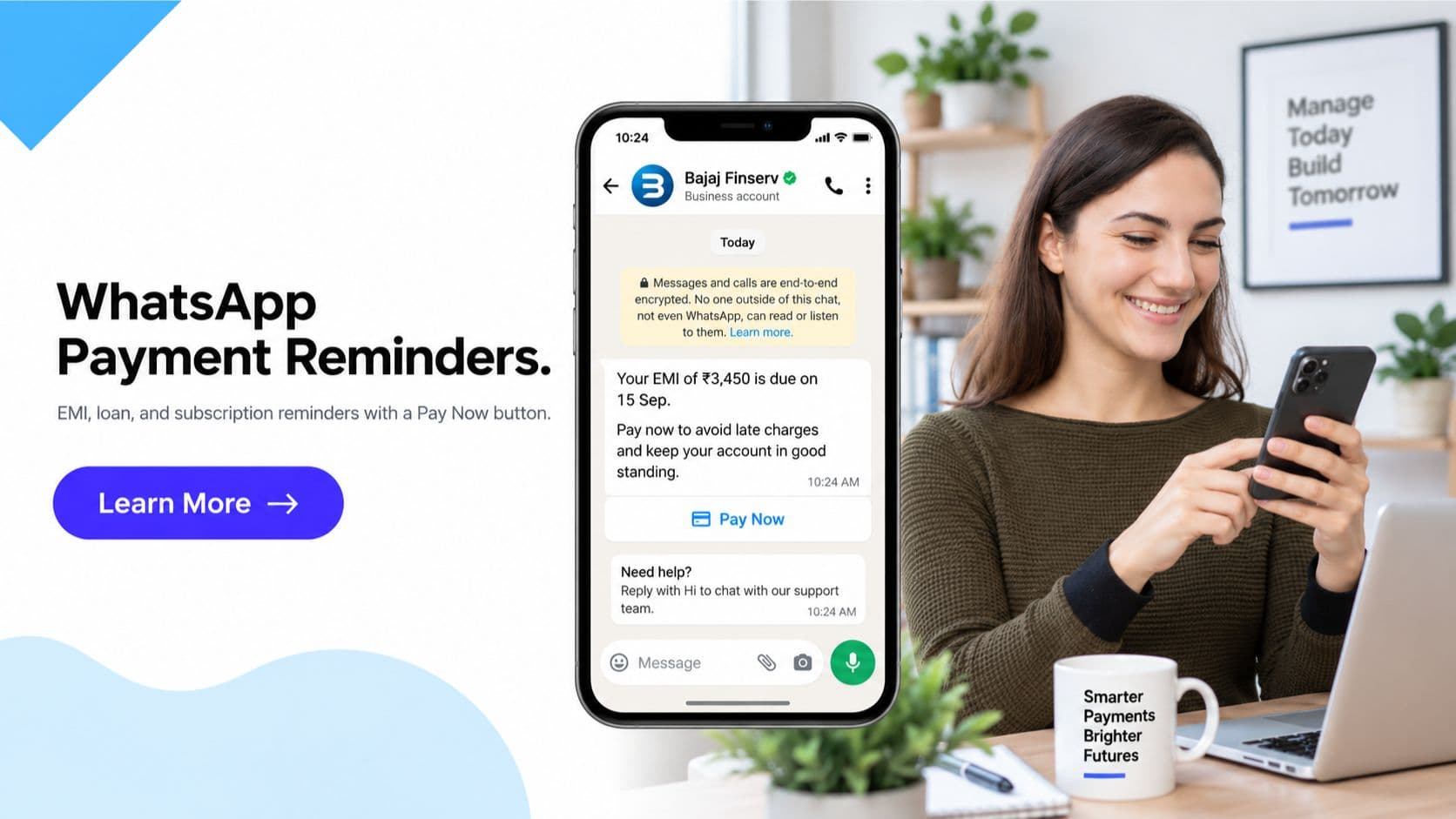
WhatsApp payment reminders replace a large share of that calling with a single automated message. A WhatsApp Business API template tells the customer exactly what they owe, when it's due, and gives them a "Pay Now" button that opens a payment gateway checkout or a UPI intent link immediately- no call, no waiting on hold, no reading out a sixteen-digit loan account number to a stranger.
For NBFCs, insurers, and SaaS businesses already running EMI, premium, or subscription cycles, the friction isn't awareness- customers usually know a payment is coming- it's the last mile of actually completing the payment. A phone call demands the customer stop what they're doing, listen, and often switch to a banking app mid-conversation to pay. A WhatsApp reminder puts the payment link directly inside the same message the customer already opened to check the amount.
Get Click Media builds and manages this entire flow: the Utility-category template, the scheduling logic for pre-due, due-date, and overdue stages, and the payment gateway integration that turns a tap into a completed transaction. This post covers how the reminder sequence works, how it compares to voice-based collections, and where Indian businesses are already using it.
Set Up WhatsApp Payment Reminders with Get Click Media- Official Meta BSP · Pay Now button + gateway integration · Go live in 5 days. Set Up Payment Reminders · Request a Demo · See WhatsApp API Pricing
What Are WhatsApp Payment Reminders?
WhatsApp payment reminders are automated, pre-approved WhatsApp Business API template messages sent to customers ahead of, on, or after a payment due date. Each template carries the account holder's name, the exact amount due, the due date, a short reference to the obligation- an EMI number, a policy number, an invoice ID- and a "Pay Now" call-to-action button.
The button is a URL-type button configured to deep-link into a payment gateway's hosted checkout page (Razorpay, PayU, or CCAvenue) or open a UPI intent link that pre-fills the payee, amount, and reference note in the customer's UPI app. Because the amount and reference are generated per-customer at send time, every recipient gets a personalised, ready-to-pay link rather than a generic "please pay your dues" message.
These templates are almost always submitted and approved under Meta's Utility category, since they relate to an existing account obligation rather than a promotional offer. Utility templates carry lower conversation charges than Marketing templates and are less likely to be blocked by recipients, since customers generally welcome a clear notice about their own account rather than treating it as spam.
The Payment Reminder Sequence- Step by Step
- Pre-due reminder (T-3 days). Sent roughly three days before the due date, giving the customer time to arrange funds. The message states the amount, the due date, and includes the Pay Now button so early payers can clear it immediately without waiting for the deadline.
- Due-date reminder. Sent on the day payment is due, restating the amount and adding a light urgency cue- "due today." This is usually the highest-converting stage, since the customer is actively reminded on the exact day rather than needing to remember a date from days earlier.
- Overdue follow-up, day 1. If payment hasn't been received, a follow-up template goes out the day after the due date, referencing the missed date and, where applicable, disclosing any late fee that has started to accrue.
- Overdue follow-up, day 7. A second overdue reminder at the one-week mark, often with firmer language while still staying within RBI's Fair Practices Code requirements for respectful, non-harassing communication.
- Overdue follow-up, day 15. A final automated WhatsApp attempt before the account is routed to a live collections call or agent-assisted recovery workflow. By this stage, most businesses log the WhatsApp delivery and read status as part of the compliance trail before escalating.
- Payment confirmation. Once the customer pays via the Pay Now link, a confirmation template closes the loop immediately, stopping the reminder sequence for that cycle and giving the customer a receipt in the same chat thread.
Each stage can be paused automatically the moment a payment is detected through the gateway webhook, so customers who pay on day 2 don't keep receiving day-7 and day-15 reminders for a cleared invoice.
WhatsApp Payment Reminders vs Collections Calling
| Factor | WhatsApp Payment Reminders | Collections Calling |
|---|---|---|
| Cost per contact | Low, fixed Utility conversation fee | Higher- requires agent time per call |
| Scale | Thousands of customers reminded simultaneously | Limited by agent headcount and call capacity |
| Time to pay | One tap from message to gateway checkout | Customer must switch apps mid-call to pay |
| Accuracy of amount | Exact amount and due date shown in text | Read out verbally, prone to mishearing |
| Dispute reduction | Reference to last payment shown upfront | Customer must be told or asked to check |
| Compliance trail | Delivery and read receipts logged automatically | Requires manual call logging and recording |
| Customer experience | Non-intrusive, read at customer's convenience | Can feel intrusive, especially at odd hours |
| RBI Fair Practices fit | Text-based, easy to keep respectful and factual | Higher risk of tone or frequency complaints |
| Reach on poor networks | Delivers over low-bandwidth data connections | Voice calls can drop on weak signal |
| Escalation path | Can auto-escalate to a call after N reminders | Already the escalation point |
| Agent effort required | None for standard reminders | Full agent time for every dial |
| Suitable channel category | Utility template, low per-message cost | N/A- variable telecom/call center cost |
| Automation potential | Fully automated end to end | Requires human dialing and follow-up |
The realistic model for most Indian collections operations isn't "WhatsApp instead of calling"- it's WhatsApp first, with calling reserved for accounts that don't respond after the full reminder sequence. That keeps expensive agent time focused only on the customers who genuinely need a conversation.
WhatsApp Payment Reminders- 5 Use Cases for Indian Businesses
1. NBFC and Lender EMI Reminders
An NBFC or lending business running thousands of active loan accounts sends a pre-due EMI reminder three days before each instalment date, followed by a due-date reminder and an overdue sequence if the EMI isn't paid. The Pay Now button links straight to the loan servicing gateway, pre-filled with the loan account number and EMI amount. Result: a meaningful share of EMI reminders convert to same-day payment without a single collections call being placed.
2. Insurance Premium Renewal
An insurer sends a premium due reminder ahead of the policy renewal date, stating the policy number, sum insured, and premium amount, with a Pay Now link to the renewal payment page. Because many lapses happen simply from customers forgetting the date rather than refusing to pay, an early WhatsApp nudge captures renewals that would otherwise lapse and require a full re-underwriting call. Result: fewer policies lapse for non-payment when a pre-due WhatsApp reminder is in place, cutting reinstatement calls significantly.
3. SaaS and Subscription Billing
A SaaS business on a monthly or annual billing cycle sends a WhatsApp reminder ahead of the renewal charge, especially useful for customers on manual payment plans rather than saved-card auto-debit. The message states the plan, amount, and renewal date, with a Pay Now button linked to the billing gateway. Result: manual-renewal customers pay on time far more often when reminded on WhatsApp instead of only by email.
4. Gym and Fitness Membership Renewal
A gym or fitness studio sends a membership renewal reminder a few days before the monthly or quarterly due date, including the membership tier and amount, with a Pay Now link to the studio's payment page. Front-desk staff no longer need to chase members verbally at the counter or over calls when a due date passes. Result: front-desk collection effort per member drops sharply once WhatsApp reminders handle the first two stages of follow-up.
5. Utility and Rent Reminders
A housing society, landlord, or local utility provider sends a maintenance, rent, or bill reminder ahead of the due date with the exact amount and a Pay Now button linked to the collection gateway or UPI intent. Residents pay directly from the chat instead of visiting an office or making a bank transfer with manually copied account details. Result: on-time collection rates improve measurably once residents can pay in one tap instead of needing to visit the society office.
Frequently Asked Questions- WhatsApp Payment Reminders
What are WhatsApp payment reminders and how do they work? WhatsApp payment reminders are automated Utility-category template messages sent via WhatsApp Business API that notify a customer of an amount due- EMI, loan instalment, insurance premium, subscription fee, or rent- and include a "Pay Now" button. Tapping the button deep-links the customer straight to a payment gateway checkout or opens a UPI intent link, so they can pay without leaving the chat or calling anyone.
Which payment gateways can the "Pay Now" button link to? The button can link to any hosted checkout page from gateways like Razorpay, PayU, or CCAvenue, or trigger a UPI intent link that opens the customer's UPI app directly with the amount and payee pre-filled. Get Click Media integrates the gateway of your choice into the template so the correct amount, due date, and reference ID are passed through automatically.
Are WhatsApp payment reminders compliant with RBI's lending and digital lending guidelines? Yes, when built correctly. RBI's Fair Practices Code and Digital Lending Guidelines require lenders to communicate with borrowers respectfully, avoid harassment, and stick to permitted hours. A clearly worded WhatsApp reminder stating the exact amount, due date, and a payment option fits this requirement better than repeated collection calls. Get Click Media's templates are reviewed against these guidelines before submission to Meta.
Should payment reminders be sent as Utility or Marketing templates? Payment reminders are typically approved and sent as Utility-category templates, since they relate to an existing account obligation rather than promotional content. Utility templates also carry lower per-conversation charges than Marketing templates and have higher deliverability, since customers are less likely to block a transactional notification about their own account.
What is a typical WhatsApp payment reminder cadence? Most Indian lenders, insurers, and subscription businesses use a four-stage cadence: a pre-due reminder around 3 days before the due date, a due-date reminder on the day itself, and an overdue follow-up sequence at 1, 7, and 15 days past due. Each stage can use a different tone and, for overdue stages, may include a small late-fee disclosure.
Can WhatsApp payment reminders reduce "I already paid" disputes? Yes. Because each reminder template shows the exact amount due, the due date, and a reference to the last recorded payment, customers can immediately see whether the reminder is accurate before they respond or call in. This transparency cuts down on disputed or duplicate follow-ups compared to a generic phone call that doesn't reference specific account data.
Is WhatsApp payment reminder cheaper than collections calling? Per-contact cost is significantly lower. A collections call requires an agent's time regardless of outcome, while a WhatsApp Utility template costs a small, fixed conversation fee and can be sent to thousands of customers simultaneously. A meaningful share of recipients pay directly from the reminder, reducing the volume of accounts that need an agent call at all.
Which industries in India use WhatsApp payment reminders? The most common users are NBFCs and lenders for EMI collection, insurers for premium renewal, SaaS and subscription businesses for recurring billing, gyms and fitness studios for membership renewal, and landlords, housing societies, or utility providers for rent and bill reminders. Get Click Media builds industry-specific templates for each of these use cases.
Get Started
WhatsApp payment reminders turn a routine, expensive part of collections- calling every customer to read out an amount- into a single automated message with a one-tap payment link. For a deeper comparison of channel effectiveness, see WhatsApp vs Voice Calls. Businesses running EMI or loan books can pair this with a full NBFC and lending WhatsApp API setup, while insurers can start with WhatsApp API for insurance.
Set Up WhatsApp Payment Reminders with Get Click Media- Official Meta BSP · Pay Now button + gateway integration · Go live in 5 days. Set Up Payment Reminders · Request a Demo · See WhatsApp API Pricing
Article topics
Frequently Asked Questions
What are WhatsApp payment reminders and how do they work?
WhatsApp payment reminders are automated Utility-category template messages sent via WhatsApp Business API that notify a customer of an amount due- EMI, loan instalment, insurance premium, subscription fee, or rent- and include a 'Pay Now' button. Tapping the button deep-links the customer straight to a payment gateway checkout or opens a UPI intent link, so they can pay without leaving the chat or calling anyone.
Which payment gateways can the 'Pay Now' button link to?
The button can link to any hosted checkout page from gateways like Razorpay, PayU, or CCAvenue, or trigger a UPI intent link that opens the customer's UPI app directly with the amount and payee pre-filled. Get Click Media integrates the gateway of your choice into the template so the correct amount, due date, and reference ID are passed through automatically.
Are WhatsApp payment reminders compliant with RBI's lending and digital lending guidelines?
Yes, when built correctly. RBI's Fair Practices Code and Digital Lending Guidelines require lenders to communicate with borrowers respectfully, avoid harassment, and stick to permitted hours. A clearly worded WhatsApp reminder stating the exact amount, due date, and a payment option fits this requirement better than repeated collection calls. Get Click Media's templates are reviewed against these guidelines before submission to Meta.
Should payment reminders be sent as Utility or Marketing templates?
Payment reminders are typically approved and sent as Utility-category templates, since they relate to an existing account obligation rather than promotional content. Utility templates also carry lower per-conversation charges than Marketing templates and have higher deliverability, since customers are less likely to block a transactional notification about their own account.
What is a typical WhatsApp payment reminder cadence?
Most Indian lenders, insurers, and subscription businesses use a four-stage cadence: a pre-due reminder around 3 days before the due date, a due-date reminder on the day itself, and an overdue follow-up sequence at 1, 7, and 15 days past due. Each stage can use a different tone and, for overdue stages, may include a small late-fee disclosure.
Can WhatsApp payment reminders reduce 'I already paid' disputes?
Yes. Because each reminder template shows the exact amount due, the due date, and a reference to the last recorded payment, customers can immediately see whether the reminder is accurate before they respond or call in. This transparency cuts down on disputed or duplicate follow-ups compared to a generic phone call that doesn't reference specific account data.
Is WhatsApp payment reminder cheaper than collections calling?
Per-contact cost is significantly lower. A collections call requires an agent's time regardless of outcome, while a WhatsApp Utility template costs a small, fixed conversation fee and can be sent to thousands of customers simultaneously. A meaningful share of recipients pay directly from the reminder, reducing the volume of accounts that need an agent call at all.
Which industries in India use WhatsApp payment reminders?
The most common users are NBFCs and lenders for EMI collection, insurers for premium renewal, SaaS and subscription businesses for recurring billing, gyms and fitness studios for membership renewal, and landlords, housing societies, or utility providers for rent and bill reminders. Get Click Media builds industry-specific templates for each of these use cases.
About the author
Get Click Media creates practical resources for businesses using messaging, automation, analytics, and digital communication to improve customer engagement. This article was published on .