

IVR & Voice Solutions for Banking EMI Reminders, Fraud Alerts & Self-Service
Handle EMI reminders, fraud alerts, and balance inquiries over the phone with automated voice calling and IVR. Get Click Media connects voice and IVR to your core banking or loan management system- improving on-time EMI payments and cutting fraud-alert response time to under a minute.
Same platform as your SMS, WhatsApp & RCS channels · 10,000+ Indian businesses
75-85%
On-time EMI payment rate with voice reminders
<1 min
Typical fraud alert call response time
24/7
IVR self-service for balance & card queries
10,000+
Indian businesses on Get Click Media
Trusted by 10,000+ businesses across India




















IVR and voice calling for banking businesses automate EMI due reminders, fraud and unusual-transaction alerts, and self-service IVR menus for balance inquiries, mini-statements, and card blocking. Get Click Media integrates voice and IVR with core banking and loan systems in India- so every reminder and alert triggers automatically and every call is logged for dispute resolution and compliance.
Banking communication carries a trust premium a text message alone can't always meet- a fraud alert or a card-block request is more reassuring, and often faster to act on, as a phone call than as an SMS the customer might not open in time. Voice and IVR fill exactly that gap alongside a bank's existing SMS and WhatsApp channels.
Why Banks and NBFCs in India Need IVR & Voice
Banks and NBFCs handle a steady stream of time-critical, high-stakes customer moments- an EMI coming due, a suspicious transaction, a lost card- where a phone call carries more urgency and reassurance than a text message, and where self-service over IVR can resolve a routine query without adding to a call-center queue.
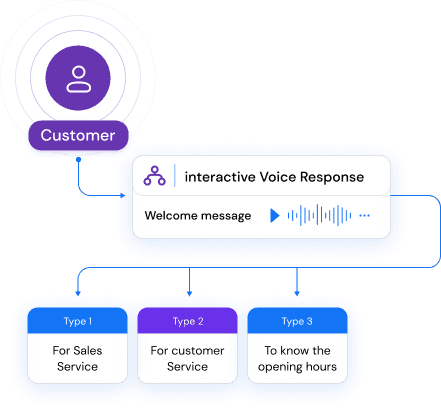
Voice broadcast covers the outbound side- EMI reminders and fraud alerts sent to thousands of customers automatically- while inbound IVR covers self-service for balance checks, card blocking, loan status, and complaint registration, all without requiring an agent to be available around the clock.
💡 Key insight: Banks and NBFCs running a multi-touch EMI reminder call sequence (7 days, 2 days, due date) typically see a meaningfully higher on-time payment rate than a single-reminder workflow, because each call reaches a different segment of customers based on when they usually act.
IVR & Voice Use Cases for Banking- 6 Automations
EMI Due Reminder Call
Trigger: EMI due date approaching in the loan management system. Pre-recorded voice broadcast call with due amount and date, sent at 7 days, 2 days, and on the due date. Result: Fewer missed payments and less manual collections follow-up before the due date.
Fraud & Unusual Transaction Alert Call
Trigger: Fraud management system flags an unusual or high-value transaction. Immediate outbound call describing the flagged transaction with an option to confirm or dispute it. Result: Faster customer response window, reducing potential fraud exposure.
Balance & Mini-Statement IVR Menu
Trigger: Customer dials the bank's IVR self-service number. Multi-level IVR authenticates the caller and reads out account balance or recent transactions. Result: Round-the-clock self-service without adding to the call-center queue.
Card-Block Emergency IVR
Trigger: Customer reports a lost or stolen card. Dedicated IVR flow verifies identity and blocks the card immediately, with a confirmation read back on the call. Result: Cards blocked in real time instead of waiting for the next available agent.
Loan Status Inquiry IVR
Trigger: Customer calls to check loan application or disbursement status. IVR looks up the application by loan reference number and reads out the current stage. Result: Fewer status-check calls escalated to the loan processing team.
Complaint Registration via IVR
Trigger: Customer calls to raise a service or transaction complaint. IVR captures the complaint category and details, generates a ticket number, and reads it back to the caller. Result: Every complaint logged with a reference number, even outside call-center hours.
Real results from Indian banking businesses
| Metric | Before Voice/IVR | After Voice/IVR | Source |
|---|---|---|---|
| On-time EMI payment rate | ~60-65% | ~75-85% (with voice reminder calls) | GCM banking client data |
| Fraud alert response time | Minutes to hours (manual outreach) | Under a minute (automated trigger) | GCM fraud-alert integration data |
| Balance/mini-statement calls resolved by IVR | 0% self-service | ~55-70% resolved without an agent | GCM banking client data |
| Card-block request handling time | 5-10 minutes (agent queue) | Under 1 minute (emergency IVR) | GCM banking client data |
On-time EMI payment rate
- Before Voice/IVR
- ~60-65%
- After Voice/IVR
- ~75-85% (with voice reminder calls)
- Source
- GCM banking client data
Fraud alert response time
- Before Voice/IVR
- Minutes to hours (manual outreach)
- After Voice/IVR
- Under a minute (automated trigger)
- Source
- GCM fraud-alert integration data
Balance/mini-statement calls resolved by IVR
- Before Voice/IVR
- 0% self-service
- After Voice/IVR
- ~55-70% resolved without an agent
- Source
- GCM banking client data
Card-block request handling time
- Before Voice/IVR
- 5-10 minutes (agent queue)
- After Voice/IVR
- Under 1 minute (emergency IVR)
- Source
- GCM banking client data
Get Click Media's IVR & Voice Capabilities for Banking
Core banking & loan system integration
Real-time triggers from core banking and loan management systems for EMI reminders, fraud alerts, and status calls
Multi-level IVR menu builder
Drag-and-drop IVR flow design for balance inquiries, card blocking, loan status, and complaint registration
Call recording & audit trail
Every IVR and agent-assisted call recorded and logged for dispute resolution and compliance review
Voice broadcast for reminders & alerts
Pre-recorded outbound calls at scale for EMI reminders, fraud alerts, and payment confirmations
India-hosted infrastructure
Call infrastructure and recordings hosted in India, built for regulated financial communication
Call analytics dashboard
Track call volume, IVR path drop-offs, and outcome data for every banking call flow from one dashboard

One message could
change your business.
Big or small, we power communication for all- talk to us today.
Voice & IVR for Banking
IVR and voice calling automate time-critical, high-trust banking communication that text alone can't fully cover- EMI due reminders sent as voice broadcast calls, fraud and unusual-transaction alert calls, and self-service IVR menus for balance inquiries, mini-statements, card blocking, and loan status. This lets a bank or NBFC reach customers on any phone, without an app or data connection, and resolve routine queries without a live agent on every call.
Yes- voice broadcast can trigger a pre-recorded EMI reminder call at set intervals before a due date, typically 7 days, 2 days, and on the due date itself, pulling the amount and due date directly from the loan management system. Customers who don't answer can be retried automatically or routed to an SMS fallback so the reminder still lands.
When a fraud management system is integrated with the voice platform, an unusual-transaction alert call can be triggered within seconds of the flag firing, giving the customer time to respond or call back before further transactions go through. Delivery speed depends on how the fraud system is wired to the calling infrastructure, which is why direct API integration matters more than a manual outbound process.
Every IVR interaction and agent-assisted call can be recorded and logged with a timestamp, caller number, and outcome, giving the bank a searchable audit trail for dispute resolution, quality review, and regulatory compliance requests. Recordings are retrievable from a single dashboard instead of scattered carrier-side systems.
Yes- an emergency IVR menu option lets a customer block a card immediately by entering account or card details and confirming through a PIN or OTP step, without waiting in an agent queue. The block request can be actioned in real time against the core banking system and confirmed to the customer on the same call.
Pricing depends on call volume, number type (toll-free, virtual, or local), and which features are needed- IVR menu depth, call recording, or voice broadcast volume. Get Click Media provides a custom quote based on your expected call volume rather than a flat rate- contact us for a quote specific to your bank or NBFC.
Related Voice & IVR resources
Ready to bring voice into your banking communication stack?
Get Click Media provides IVR and voice calling for banks and NBFCs in India, integrated with core banking systems for EMI reminders, fraud alerts, and self-service.