
In this article
Explore the key concepts, practical considerations, and frequently asked questions related to best rcs messaging platforms compared (2026).
Key takeaways
- Evaluate RCS platforms against seven criteria: carrier connectivity, verification support, SMS fallback, API quality, analytics, pricing transparency, and India compliance.
- Aggregator-routed providers often rely on cached or delayed capability data, which causes silent message failures and misfired SMS fallback.
- Run a pilot of a few hundred to a few thousand messages before signing a contract- a sales deck can't surface the gaps a real send does.
If you have already decided that RCS messaging belongs in your customer communication mix, the next decision is harder than it looks- which platform should actually send those messages.
Unlike bulk SMS, where most providers offer roughly the same thing at roughly the same price, RCS platforms differ meaningfully in carrier connectivity, verification support, fallback handling, and reporting depth. Picking the wrong one can mean weeks of delay getting your brand verified, campaigns that silently fail on unsupported devices, or a bill that looks nothing like what the sales call promised.
This guide gives you a practical framework for comparing RCS messaging platforms in India, the specific questions to ask before you sign anything, and the criteria that actually separate a good provider from a mediocre one.
Quick answer: The best RCS messaging platforms for Indian businesses combine direct carrier connectivity with Jio, Airtel, and Vi, managed Google brand verification, automatic SMS fallback for unsupported devices, transparent pricing, and India-specific compliance knowledge. Evaluate providers against these criteria with a real pilot campaign before committing- not just a sales deck.
Why the RCS Platform You Choose Actually Matters
RCS is not a commodity channel the way plain-text SMS has become. Sending RCS well requires the provider to manage carrier relationships, hold a verified Google Business Messages agent, detect device capability in real time, and gracefully fall back when a recipient cannot receive rich messages.
Get any one of these wrong and the customer experience breaks in ways that are easy to miss until a campaign underperforms. A poorly connected provider might deliver messages slowly or drop them silently on certain networks. A provider with no fallback logic might simply fail to reach every non-RCS device on your list, with no visibility into how much of your audience that actually is.
Because RCS is still maturing as a channel in India, the gap between providers is currently wider than it is for SMS or WhatsApp Business messaging. That gap is exactly why a structured comparison is worth the time.
The RCS Platform Comparison Framework
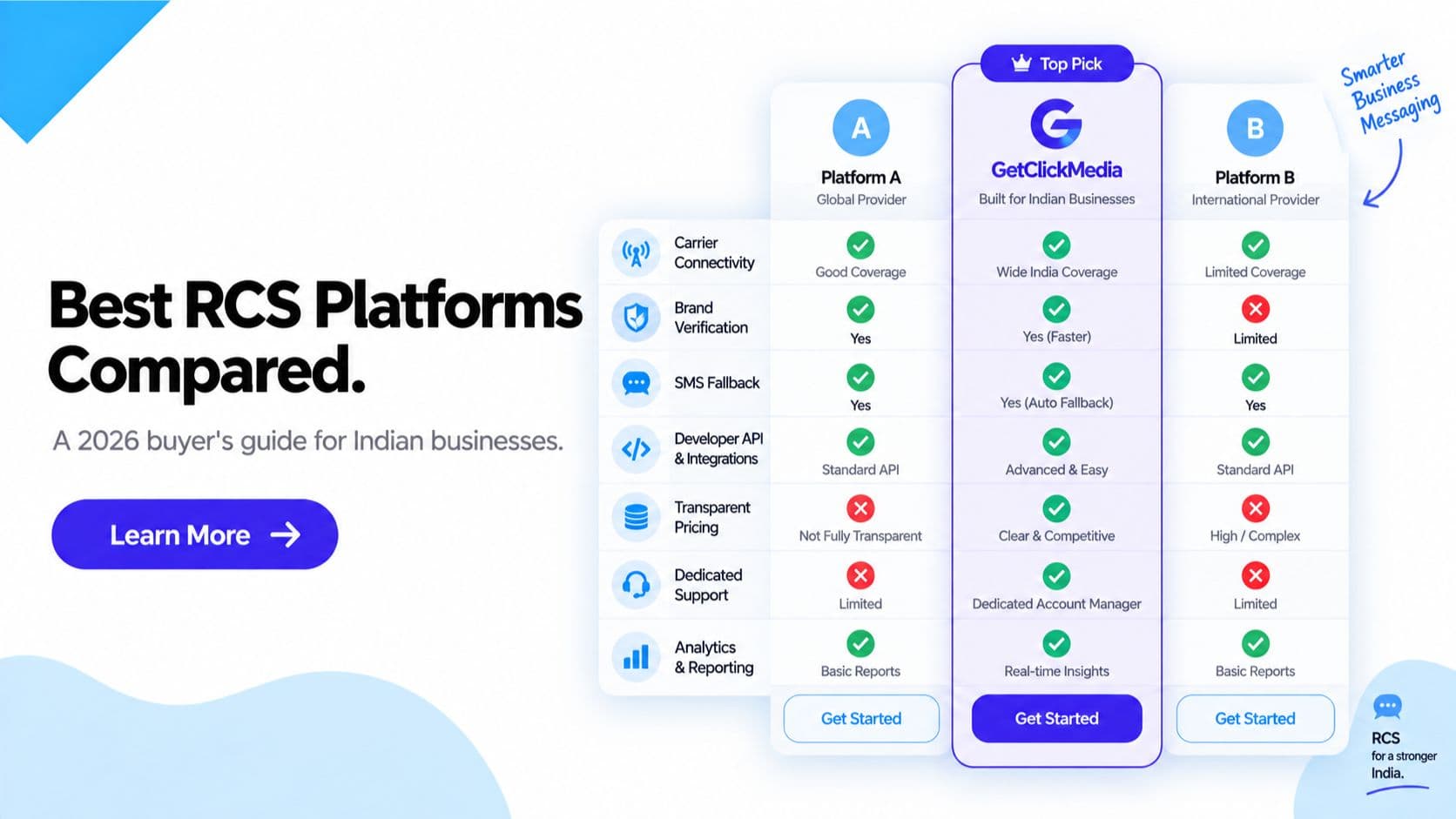
Use these seven criteria to evaluate any RCS messaging platform you are considering. Each one maps to a real operational risk if the provider falls short.
1. Carrier Connectivity
Ask whether the platform connects directly to Jio, Airtel, and Vi, or routes through a third-party aggregator layer. Direct connectivity generally means lower latency, more accurate real-time capability detection, and clearer accountability when something goes wrong. If a provider cannot clearly explain its carrier relationships, treat that as a warning sign. For more on what carrier support actually looks like in India, see our guide to RCS coverage across Indian networks.
2. Brand Verification Support
Every business sending RCS needs to complete Google's brand verification process- confirming your business identity, logo, and sender name before you can send verified messages. Some platforms hand you a checklist and leave you to navigate it alone. Others manage the entire process, including document preparation and back-and-forth with Google, as part of onboarding. Our RCS verified sender guide walks through what this process actually involves, so you can judge how much of it a given provider is truly handling for you.
3. Automatic SMS Fallback
Not every recipient's device supports RCS. A platform without automatic fallback logic will either fail silently on unsupported devices or force you to manually segment your list before every send- both of which defeat the purpose of a unified messaging platform. Look for a provider that checks device capability in real time and routes to SMS automatically within the same campaign, as covered in our RCS vs SMS comparison.
4. API and Webhook Quality
If you plan to trigger RCS messages from your own systems- order confirmations, delivery updates, account alerts- the quality of the provider's API matters as much as the channel itself. Look for clear documentation, sandbox testing environments, delivery and read-receipt webhooks, and reasonable rate limits. A weak or poorly documented API turns a simple integration into a multi-week engineering project. Our RCS API integration guide outlines what a well-built integration should look like.
5. Analytics and Reporting Depth
RCS's biggest advantage over SMS is the data it generates- delivery status, read receipts, and button-level interaction tracking. A platform that only reports delivery counts is throwing away most of that value. Look for dashboards that break down opens, clicks by specific button, fallback rates, and campaign-level conversion, ideally in near real time.
6. Pricing Transparency
Some providers publish clear per-message rates for RCS single messages and conversational sessions. Others require a sales call for even a rough estimate, and quietly bundle in setup fees, minimum commitments, or per-session charges that are hard to compare across vendors. Insist on a written rate card before evaluating any platform seriously. Our RCS messaging cost guide explains the typical pricing structures you should expect to see.
7. India-Specific Compliance Knowledge
RCS Business Messaging is currently not classified as commercial SMS under TRAI's DND and DLT regulations, which is a meaningful operational advantage- but this is general guidance, not legal advice, and the regulatory position can evolve. A platform with genuine India experience should be able to explain clearly how RCS compliance differs from SMS compliance under TRAI's rules and from the DLT registration process you may already be familiar with. If a provider cannot answer basic questions about Indian regulation, treat that as a sign they are not truly built for this market.
RCS Platform Comparison Checklist
Use this table as a working checklist when you evaluate shortlisted providers. Score each row for every platform you consider.
| Criterion | What to Ask | Why It Matters |
|---|---|---|
| Carrier connectivity | Direct integration with Jio, Airtel, Vi, or aggregator routed? | Affects delivery speed and reliability |
| Brand verification | Does the provider manage Google verification end-to-end? | Determines onboarding speed and effort |
| SMS fallback | Is fallback automatic and built into a single campaign flow? | Prevents silent loss of reach on unsupported devices |
| API quality | Sandbox access, clear docs, delivery and read webhooks? | Determines integration cost and speed |
| Analytics | Button-level click tracking, real-time dashboards? | Determines how well you can optimise campaigns |
| Pricing | Published rate card, no hidden session fees? | Determines true cost per conversion |
| India compliance | Clear guidance on TRAI, DND, and DLT distinctions | Reduces regulatory risk and confusion |
| Support | India business hours, dedicated onboarding contact? | Affects time to resolution on delivery issues |
Why Direct Carrier Integration Matters More Than It Seems
It is tempting to treat carrier connectivity as a background technical detail that does not affect day-to-day campaign performance. In practice, it affects almost everything.
Platforms with direct integration into Jio, Airtel, and Vi can detect RCS capability for a given number in real time, with high accuracy, before a message is even sent. This is what makes automatic SMS fallback reliable- the platform genuinely knows whether the recipient's device can receive RCS, rather than guessing based on stale data.
Aggregator-routed platforms, by contrast, often rely on capability data that is cached, delayed, or provided by a third party several steps removed from the carrier itself. The practical result is messages that fail silently, fallback logic that misfires, and delivery reports that do not match what customers actually experienced.
Direct carrier connectivity also tends to correlate with faster support resolution. When a Get Click Media customer reports a delivery issue, our team can trace the message through the direct carrier relationship rather than opening a ticket with an intermediary and waiting for a response.
Why India-Specific Compliance Support Is a Real Differentiator
Many global RCS platforms are built primarily for US and European markets, where the regulatory landscape around commercial messaging is entirely different from India's TRAI-governed environment.
An India-first provider understands, for example, that RCS Business Messaging currently sits outside the DND and DLT rules that apply to promotional SMS, and can explain what that means operationally- while being clear that this is general guidance and businesses should stay aware of how the regulatory position may change. A global-first provider may not be able to answer that question with any confidence at all, leaving your compliance team to figure it out independently.
This matters even more for regulated industries- banking, insurance, fintech, and healthcare- where compliance missteps carry real financial and reputational risk. A provider with genuine India experience should be a source of clarity here, not another variable you have to manage yourself.
Running a Pilot Before You Commit
Whatever platform you shortlist, do not sign a long-term contract based on a sales deck alone. Run a small pilot campaign- a few hundred to a few thousand messages- and evaluate:
- Actual delivery speed and success rate across Jio, Airtel, and Vi
- Whether SMS fallback triggered correctly for non-RCS devices
- The accuracy and depth of the analytics dashboard
- How responsive support was when you asked a technical question
- Whether the final invoice matched the quoted rate card
A pilot surfaces the gaps that a demo call cannot. Any credible RCS provider should be comfortable supporting a short pilot before you commit to volume.
How Get Click Media Fits This Framework
Get Click Media was built specifically for the Indian messaging market, with direct carrier integrations into Jio, Airtel, and Vi rather than aggregator-routed connectivity. Our onboarding team manages Google brand verification on your behalf, and every RCS campaign includes automatic SMS fallback from a single dashboard- so your entire audience receives a message, RCS-capable or not.
Our platform provides button-level click tracking, real-time delivery and read-receipt reporting, and a published, transparent rate structure rather than a black-box quote. Combined with support built around Indian business hours and genuine familiarity with TRAI, DND, and DLT rules, it is a platform designed to hold up against every criterion in this checklist- not just the ones that are easy to market.
That said, the right platform for your business depends on your specific volume, integration requirements, and existing messaging stack. Use the framework above to evaluate any provider you are considering, Get Click Media included.
Get Click Media is one of India's leading RCS messaging service providers, with direct carrier integrations with Jio, Airtel, and Vi. Our unified platform handles RCS and bulk SMS from a single dashboard- with real-time capability detection, intelligent fallback, brand verification, and campaign analytics built in. Request a demo to run your own pilot campaign.
Article topics
Frequently Asked Questions
What is the best RCS messaging platform for Indian businesses?
The best RCS messaging platform for Indian businesses is the one that combines direct carrier connectivity with Jio, Airtel, and Vi, handles Google brand verification on your behalf, provides automatic SMS fallback, and offers transparent per-message pricing. Get Click Media meets all four criteria through a single dashboard built specifically for the Indian market, but the right choice ultimately depends on your volume, integration needs, and existing messaging stack.
How do I compare different RCS messaging providers?
Compare RCS messaging providers across seven areas- carrier connectivity, brand verification support, SMS fallback capability, API and webhook quality, analytics depth, pricing transparency, and India-specific compliance knowledge. Request a sandbox account or demo from each shortlisted provider and test actual message delivery, fallback behaviour, and reporting before committing to a contract.
Do all RCS providers connect directly to Jio, Airtel, and Vi?
No. Some RCS providers route messages through intermediary aggregators rather than connecting directly to Indian carriers, which can add latency, reduce delivery visibility, and increase cost per message. Direct carrier integration with Jio, Airtel, and Vi generally means faster delivery, more reliable capability detection, and better support when delivery issues need to be diagnosed.
Is RCS brand verification the same across every platform?
The underlying verification process is set by Google and is broadly the same regardless of provider, but the amount of hands-on support you get varies significantly. Some platforms leave you to complete Google's brand verification paperwork alone, while others, including Get Click Media, manage the entire verification process on your behalf as part of onboarding.
What should I check before signing a contract with an RCS platform?
Before signing, check the provider's actual carrier connectivity in India, whether SMS fallback is automatic or requires manual setup, whether pricing is published or hidden behind a sales call, what analytics and reporting are included by default, and whether support is available in Indian business hours. Ask for a short pilot campaign before committing to a long-term contract.
Is RCS more expensive than SMS across most platforms?
Pricing varies by provider, but RCS is generally priced comparably to SMS on a per-message basis in India, with some platforms charging a premium for rich card sessions. Because RCS typically produces a much higher click-through rate, the cost per conversion is usually lower even when the per-message price is similar to or slightly above SMS. See our detailed breakdown in the RCS messaging cost guide.
Can I switch RCS platforms without losing my Google brand verification?
Brand verification is tied to your business identity with Google, not to a specific platform, so in principle it can be carried over. In practice, switching providers usually involves some re-verification or re-linking work, so it is worth choosing a platform you expect to stay with, rather than treating verification as fully portable across vendors.
Does the RCS platform I choose need to support SMS as well?
Yes, in almost all cases. Not every customer's device supports RCS, so a platform that automatically falls back to SMS when RCS is unavailable ensures your entire audience still receives the message. Choosing a platform that only sends RCS, with no SMS fallback, risks silently losing a meaningful share of your audience on every campaign.
About the author
Get Click Media creates practical resources for businesses using messaging, automation, analytics, and digital communication to improve customer engagement. This article was published on .