
In this article
Explore the key concepts, practical considerations, and frequently asked questions related to how rcs improves customer engagement: a data-backed guide.
Key takeaways
- RCS click-through rates run 15-35%, several times higher than bulk SMS's 1-5%, per the article's engagement comparison table.
- Verified sender badges counter the alphanumeric SMS spoofing that has made many Indian customers distrust unfamiliar text messages.
- Read receipts let marketers treat a customer who opened but didn't tap differently from one who never opened the message at all.
If your team is already sending bulk SMS or WhatsApp campaigns and wondering why open rates look strong on paper but conversions stay flat, the issue is often not reach- it is engagement. Customers see the message, but nothing about it earns a tap.
This is the specific problem RCS messaging is built to solve. It is not simply a prettier version of SMS- it changes the mechanics of how a customer notices, trusts, and acts on a business message. Understanding those mechanics is what separates businesses that use RCS as a marginal upgrade from businesses that use it to meaningfully shift engagement numbers.
This guide breaks down exactly why RCS drives higher engagement than SMS and email, walks through the use cases where that lift matters most across the customer lifecycle, and explains how to actually measure the difference in your own campaigns.
Quick answer: RCS improves customer engagement by combining verified sender branding, rich visual media, and interactive buttons into a single trusted message that customers can act on without leaving their messaging app. This typically produces click-through rates several times higher than SMS and meaningfully higher than email, and the built-in read receipts let businesses run smarter, more targeted follow-up campaigns.
Why RCS Engagement Is Fundamentally Different From SMS
Engagement is not just about whether a customer opens a message- it is about whether they trust it, understand it, and act on it. RCS improves all three, while SMS was never designed to do any of them particularly well.
Verified Branding Builds Trust Before the Message Is Even Read
Every RCS message from a business carries a verified sender name, logo, and checkmark, similar to verification badges on social platforms. Customers see this before they read a single word of the message, and it immediately signals that the message is genuinely from the brand it claims to be from.
This matters enormously in India, where SMS phishing using spoofed alphanumeric sender IDs is common enough that many customers have learned a healthy scepticism toward unfamiliar text messages. Our RCS verified sender guide covers exactly how this verification process works. The practical effect on engagement is straightforward- a verified message earns attention that an anonymous six-character SMS header cannot.
Rich Media Increases Attention and Comprehension
A message that shows a customer exactly what they are being offered- a product photo, a boarding pass, a delivery map- requires far less mental effort to process than a paragraph of text describing the same thing. RCS supports high-resolution images, carousels of multiple products, and video thumbnails directly inside the message.
This is a meaningful shift from SMS's plain-text-only format, where any visual context has to live behind an external link the customer must choose to click. Every additional step between a message and understanding its offer reduces the number of customers who follow through.
Interactive Buttons Reduce Friction to Near Zero
RCS messages can carry up to three built-in action buttons- Open URL, Call Now, View Location, and Quick Reply. A customer deciding whether to act on an offer does not need to copy a link, dial a number from memory, or type a response. They tap once, inside the message thread, and the action happens.
This single design choice is responsible for a large share of the click-through rate gap between RCS and SMS. Removing friction from the moment of decision consistently increases the share of people who follow through on that decision, and RCS is built around removing that friction at every step.
Read Receipts Enable Smarter, Targeted Follow-Ups
RCS gives businesses delivery confirmation, read receipts, and button-level interaction data- visibility that SMS simply does not offer. This turns engagement from a guess into a measurable signal you can act on.
A customer who opened a message but did not tap the button is meaningfully different from a customer who never opened it at all, and they deserve different follow-up treatment. RCS is the first mass messaging channel in India, alongside WhatsApp Business, to make that distinction visible and actionable at scale.
RCS Engagement Use Cases Across the Customer Lifecycle
Engagement is not a single event- it happens continuously across the relationship a customer has with a business. RCS strengthens engagement at nearly every stage of that lifecycle.
Onboarding
New customers form their first impression of a business fast, and a plain welcome SMS rarely does much to shape it. An RCS onboarding message can walk a new customer through account setup with a rich card sequence- a welcome image, a short explainer, and a button to complete their profile- all inside a single verified, branded message thread.
Cart Recovery
Cart abandonment messages are one of the clearest places where rich media changes outcomes. A cart recovery RCS message can show the actual product image the customer left behind, alongside a Buy Now button that returns them directly to checkout. Compare that to an SMS reminder with a generic link, and the difference in how compelling the message feels is significant- which shows up directly in recovered-cart rates.
Loyalty and Rewards
Loyalty program updates- points balances, tier upgrades, redeemable offers- benefit enormously from visual presentation. An RCS carousel can show a customer's current tier, their available rewards, and a redeem button in one glanceable message, rather than a wall of text explaining the same information.
Customer Support
Quick-reply buttons make RCS well suited to lightweight support interactions- confirming a delivery time, rescheduling an appointment, or answering a simple yes/no question- without requiring a full conversational back-and-forth. This reduces resolution time and keeps low-effort support requests from clogging call centre queues.
Re-Engagement and Win-Back
Lapsed customers are often the hardest audience to move with a plain-text message, because they have already tuned out the brand's SMS traffic. A verified, visually distinct RCS win-back offer stands out from that pattern precisely because it looks and feels different from the messages the customer has learned to ignore- and because it carries the same trust signal every other RCS message from that brand does.
Comparing Engagement: RCS vs SMS vs Email
| Metric | RCS | Bulk SMS | |
|---|---|---|---|
| Average open rate | 70–80% | 95%+ (habitual, not always meaningful) | 15–25% |
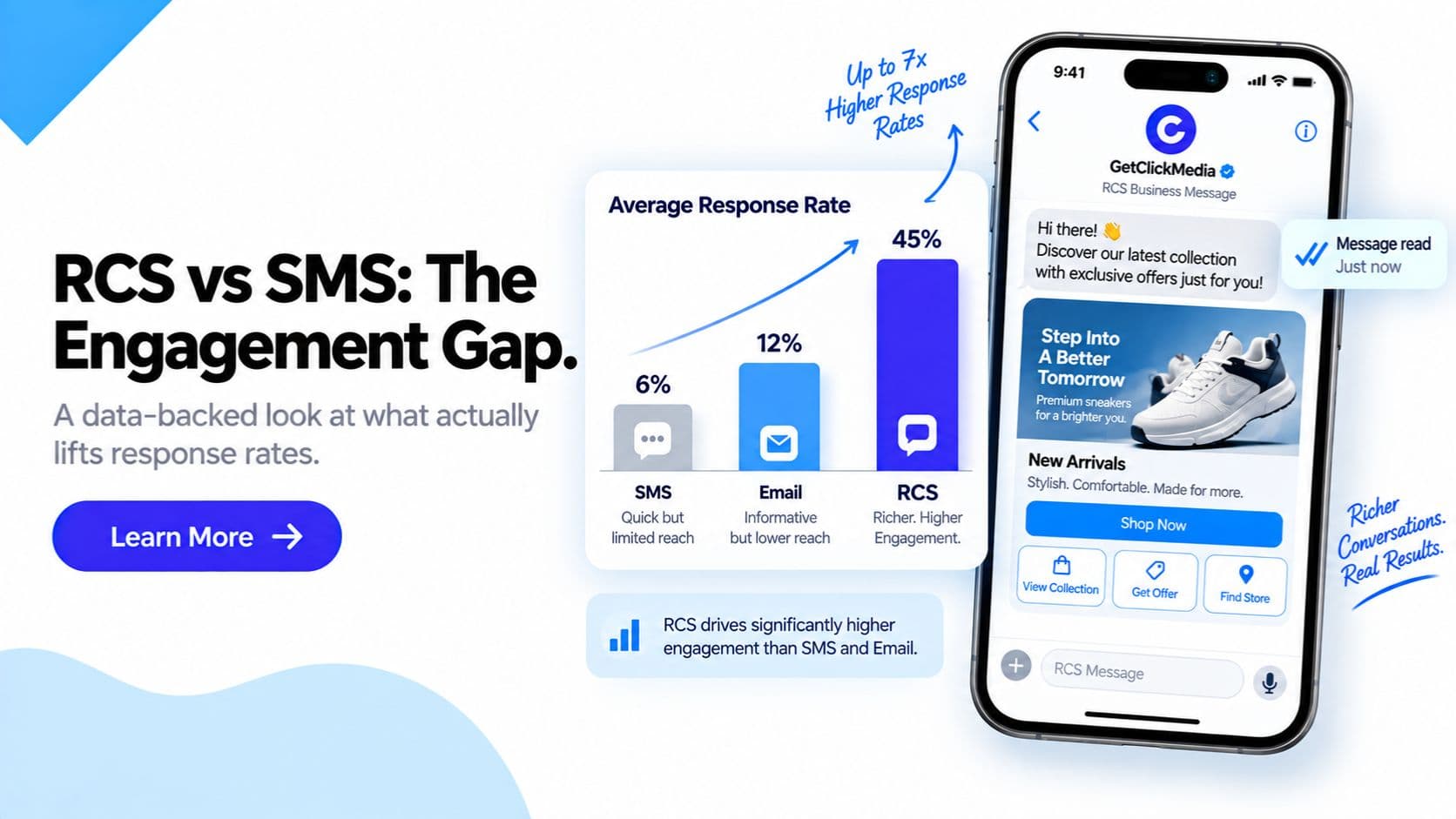
| Average click-through rate | 15–35% | 1–5% | 2–5% |
| Sender trust signal | Verified badge, logo | None (alphanumeric header) | Domain-dependent |
| Rich media support | Full (images, carousels, video) | None | Full |
| Built-in interactive buttons | Yes | No | Limited (email clients vary) |
| Read receipts | Yes | No | Limited (open pixel, unreliable) |
| Typical time to open | Minutes | Minutes | Hours to days |
The email open rate figure is a useful reference point precisely because it shows what happens when a channel competes for attention in a crowded, infrequently checked inbox. RCS lives inside the same messaging app customers already check dozens of times a day, which is a large part of why its engagement numbers behave more like a messaging channel than a broadcast channel. For a full breakdown of the RCS-versus-SMS engagement gap specifically, see our RCS vs SMS comparison.
How to Measure RCS Engagement Lift in Your Own Campaigns
Numbers from industry benchmarks are a useful starting point, but the only comparison that really matters is the one against your own historical performance. A reliable way to measure lift is to run a controlled comparison.
- Select an audience segment large enough to produce statistically meaningful results
- Split it into an RCS-first group (with automatic SMS fallback) and an SMS-only control group
- Send the same core offer, adapted to each channel's format
- Track delivery rate, read rate, button-level click-through rate, and downstream conversion for both groups
- Also track the fallback rate within the RCS group, since it tells you what share of results came from the SMS fallback layer rather than true RCS delivery
- Compare cost per conversion between the two groups, not just raw click-through rate
This kind of test, run once per quarter as your audience's device mix shifts, gives you a defensible, India-specific view of your own engagement lift rather than relying on generic industry averages.
Building out a full strategy around these mechanics- rather than running one-off tests- is the subject of our companion guide on building an RCS marketing strategy that converts.
Common Mistakes That Suppress RCS Engagement
Even with the right infrastructure in place, a few recurring mistakes quietly cap the engagement gains businesses see from RCS.
Treating RCS as SMS with an image attached. Copy written for a 160-character SMS rarely translates well into a rich card. The most common fix is to rewrite the message around the visual- letting the image and headline carry the offer, with body text supporting rather than repeating it.
Overloading messages with buttons or options. RCS supports up to three action buttons, but more choice does not mean more engagement. A single, obvious call-to-action generally outperforms a message asking the customer to choose between three competing actions.
Ignoring the fallback experience. Businesses sometimes invest heavily in RCS creative and treat the SMS fallback version as an afterthought, written in a rush. Since a meaningful share of any campaign's audience will still receive the SMS version, it deserves its own clear, well-written copy rather than a stripped-down leftover.
Not acting on read receipt data. Collecting read and click data without building follow-up logic around it wastes the channel's biggest advantage over SMS. Even a simple rule- resend a modified offer to customers who opened but did not click within 48 hours- captures value that would otherwise be left on the table.
Sending at the same frequency as SMS. Because RCS messages carry more visual weight and feel more like a direct communication from the brand, sending them as frequently as low-cost SMS blasts can fatigue an audience faster than expected. Cadence deserves its own consideration, which we cover in detail in our guide to building an RCS marketing strategy.
Getting Started
Engagement gains from RCS are real, but they depend on execution- verified branding done correctly, creative that actually uses rich media well, and a fallback strategy that does not leave part of your audience behind. Getting the underlying infrastructure right is what makes the rest of this possible.
Get Click Media is one of India's leading RCS messaging service providers, with direct carrier integrations with Jio, Airtel, and Vi. Our unified platform handles RCS and bulk SMS from a single dashboard- with real-time capability detection, intelligent fallback, brand verification, and campaign analytics built in. Request a demo to see the engagement lift on your own audience.
Article topics
Frequently Asked Questions
How does RCS improve customer engagement compared to SMS?
RCS improves customer engagement by combining verified branding, rich media, and interactive buttons in a single message, which increases attention, trust, and the likelihood of a customer taking action. Where SMS relies on plain text and external links, RCS lets customers view a product image, read details, and tap a button to act- all without leaving their messaging app, which typically produces a click-through rate several times higher than SMS.
What makes RCS more engaging than plain text SMS?
RCS is more engaging than plain text SMS because it removes the friction that normally sits between a message and an action. Verified sender branding builds immediate trust, rich cards and carousels convey information visually instead of through dense text, and built-in buttons let customers respond, buy, or ask a question with a single tap instead of copying a link or dialling a number.
Can RCS engagement data be used to improve marketing campaigns?
Yes. RCS provides delivery, read, and button-level interaction data that SMS cannot offer, which lets marketers see exactly what customers opened and what they tapped. This data can be used to trigger follow-up messages based on specific behaviour, identify which creative variations perform best, and continuously refine send times and content for future campaigns.
Does RCS work well for customer support and not just marketing?
Yes, RCS is used effectively across the full customer lifecycle, not just marketing campaigns. Businesses use RCS for onboarding walkthroughs, delivery and order updates, support conversations with quick-reply buttons, loyalty program updates, and win-back campaigns for lapsed customers- because the same rich, interactive format that improves marketing engagement also reduces friction in support and service interactions.
How much higher is RCS engagement compared to email marketing?
RCS messages are typically opened within minutes on a mobile device the customer already has in hand, producing engagement patterns closer to messaging apps than to email inboxes, which customers check less frequently and where messages compete with far more clutter. While exact figures vary by industry, RCS click-through rates in the 15 to 35 percent range are common, compared to email click-through rates that are usually in the low single digits.
What metrics should I track to measure RCS engagement lift?
Track delivery rate, read rate, button-level click-through rate, and downstream conversion rate, then compare each against the equivalent SMS or email campaign sent to a comparable audience segment. Tracking fallback rate is also important, since it tells you what share of your audience received the SMS version instead of RCS, which affects how you interpret blended campaign results.
Do read receipts in RCS actually help with follow-up campaigns?
Yes. Read receipts let you distinguish between customers who never saw a message and customers who saw it but did not act, which are two very different groups that deserve different follow-up strategies. A customer who opened a cart recovery message but did not click can be sent a different, more targeted follow-up than one who never opened it at all.
Is RCS engagement consistent across all industries in India?
RCS tends to produce the strongest engagement lift in industries where visual context and a clear call-to-action drive decisions, such as e-commerce, travel, banking, and real estate. Industries with simpler, purely informational messages, such as basic delivery notifications, still benefit from higher trust and readability, though the relative engagement lift over SMS may be smaller.
About the author
Get Click Media creates practical resources for businesses using messaging, automation, analytics, and digital communication to improve customer engagement. This article was published on .