
In this article
Explore the key concepts, practical considerations, and frequently asked questions related to apple rcs support: what ios 18 means for business messaging in india.
Key takeaways
- Apple added native RCS support starting with iOS 18, letting iPhones receive rich, verified business messages instead of falling back to plain SMS.
- RCS on iPhone is a separate protocol from iMessage- it carries no Memoji, iMessage effects, or iMessage App Store integrations.
- iPhones on iOS 17 or earlier still can't receive RCS, so real-time capability detection and automatic SMS fallback remain essential for Indian campaigns.
For years, RCS in India was effectively an Android story. If your customer had an iPhone, your RCS messaging campaign quietly fell back to plain SMS, no matter how good your rich card design was. That changed with Apple's rollout of native RCS support in iOS 18. For Indian businesses with a meaningful iPhone customer base, it is one of the more consequential shifts in the messaging landscape in recent years.
This article explains what Apple's RCS support actually does, how it changes the addressable audience for Indian businesses, and where its limitations are. It also covers how this should factor into your decision between RCS, SMS, and WhatsApp for iPhone-heavy audiences.
Quick answer: Apple added native RCS support starting with iOS 18. iPhones running iOS 18 or later can now send and receive rich, verified business messages instead of falling back to plain SMS. For Indian businesses, this significantly expands the addressable RCS audience beyond Android, though reach still depends on how quickly iPhone users update their software. RCS on iPhone also remains a separate protocol from Apple's proprietary iMessage.
What Apple's RCS Support Actually Changed
Before iOS 18, Apple's Messages app used two protocols: iMessage for communication between Apple devices, and SMS/MMS for everything else, including messages to and from Android phones and businesses. This meant every RCS Business Messaging campaign sent to an iPhone number was automatically downgraded to plain SMS, regardless of how the campaign was designed.
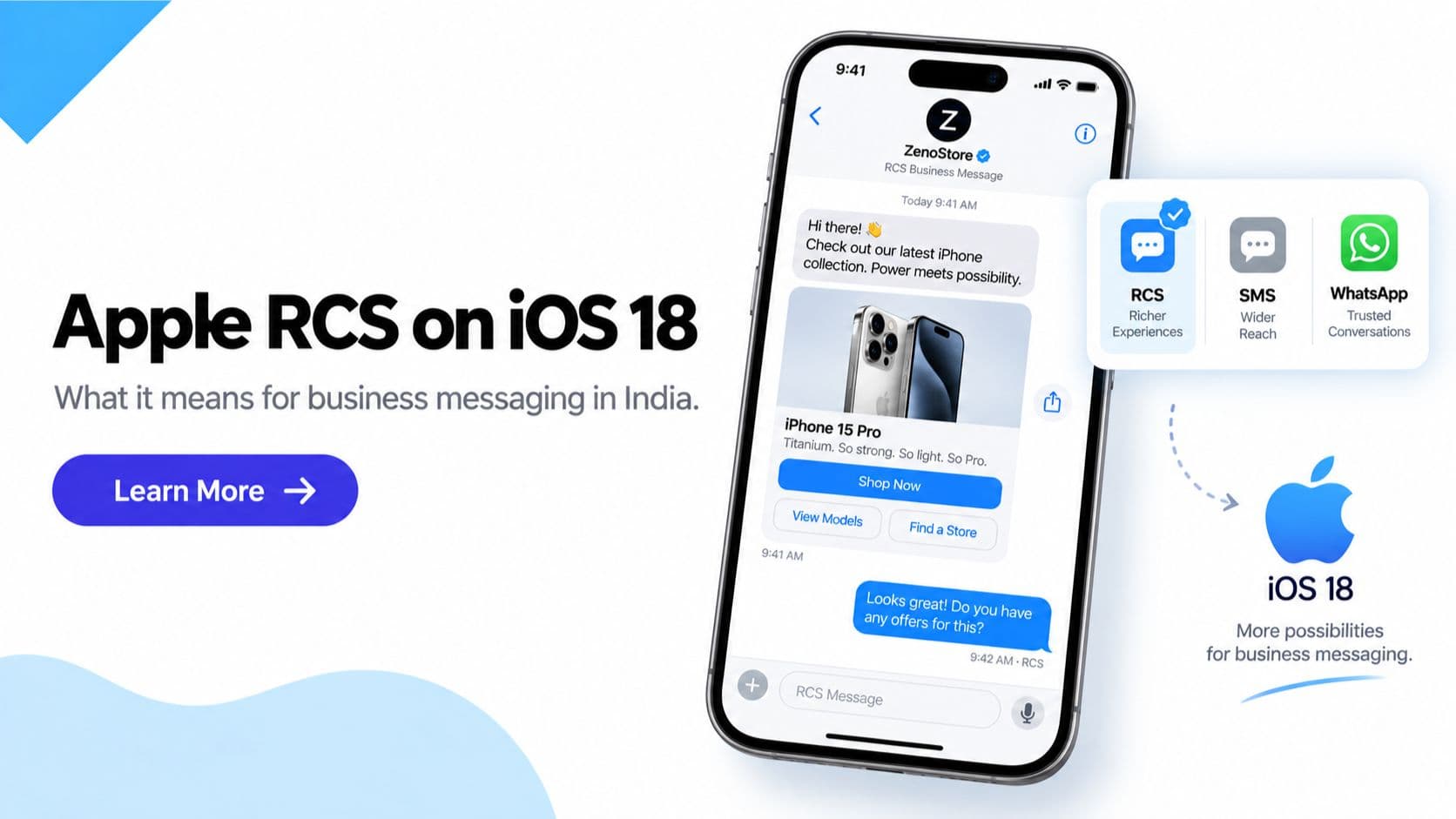
With iOS 18, Apple added RCS as a third protocol, used specifically for non-iMessage conversations that previously would have used SMS or MMS. In practice, this means an iPhone on iOS 18 or later can now receive a verified business's rich card- complete with images, buttons, and branded sender identity. It works the same way an Android phone running Google Messages does.
Why Apple made this change
Apple's move followed years of pressure from carriers, regulators, and competitors. They pushed back against the limitations of SMS/MMS as the fallback protocol for cross-platform messaging. RCS, as a GSMA-standardised protocol, offered a path to richer cross-platform messaging without requiring Apple to open up iMessage itself. The result is a meaningful upgrade to the messaging experience between iPhone users and the rest of the ecosystem, including verified businesses.
The Green Bubble Context, Translated to Business Messaging
Most Indian consumers are at least passively aware of Apple's "blue bubble, green bubble" distinction. Messages between iPhones appear in blue (iMessage), while messages involving a non-Apple device appear in green (SMS/MMS). This distinction became a well-known signal of a degraded messaging experience when a conversation happened over green bubbles: no read receipts, no typing indicators, and poor media quality.
RCS on iPhone changes this dynamic for business messaging specifically. A verified business sending an RCS message to an iPhone on iOS 18 no longer sends a plain, low-quality green-bubble SMS. It sends a rich, branded card with the same verified sender badge, images, and interactive buttons that Android users have had access to. In effect, Apple's RCS rollout closes much of the "green bubble" experience gap specifically for business-to-consumer messaging. The blue-vs-green distinction still applies to peer-to-peer texting between iPhone and Android users, but it no longer applies to verified business messages.
For businesses, the practical takeaway is this: the historical assumption that "RCS campaigns don't really reach iPhone users" is no longer accurate for customers on iOS 18 and later. That share of the iPhone base will only grow over time.
What This Means for Indian Businesses Right Now
A meaningfully larger addressable audience
India has one of the largest and fastest-growing iPhone user bases globally, concentrated in urban markets and higher-spending customer segments. This is exactly the audience many retail, travel, fintech, and D2C brands most want to reach with visual, high-conversion campaigns. Before iOS 18 support, this entire segment was effectively an SMS-only audience for RCS campaigns. Now, as iPhone users update their devices, that segment becomes reachable with the same rich experience Android users already receive.
Reach still depends on iOS version adoption
Apple's RCS support requires iOS 18 or later. iPhones running iOS 17 or earlier do not support RCS and will continue to receive SMS fallback. Businesses should not assume 100% of their iPhone audience is immediately RCS-capable. Adoption of new iOS versions in India, as elsewhere, happens gradually as users update their devices, often over many months. This is exactly why real-time device capability detection and automatic SMS fallback matters as much for iPhone reach as it always has for Android reach. The Get Click Media platform handles this automatically.
Carrier infrastructure still plays a role
Apple's RCS implementation works over standard carrier RCS infrastructure alongside Google's RCS Business Messaging platform for verified sender delivery. In India, that means delivery to iPhone users still depends on Jio, Airtel, and Vi's RCS network support, the same carriers already central to RCS delivery on Android. Apple's rollout does not bypass carrier infrastructure. It adds iPhone as a supported endpoint on top of it.
Limitations of Apple's RCS Implementation
Apple's RCS support is a genuine upgrade, but it comes with real limitations businesses should understand before assuming iPhone and Android RCS experiences are identical.
RCS on iPhone is not iMessage
This is worth stating plainly: RCS and iMessage remain separate protocols. iMessage-exclusive features- Memoji, iMessage effects, Apple-specific stickers, and end-to-end encrypted messaging between Apple devices- are not part of the RCS experience on iPhone. RCS on iPhone functions as a standard rich-messaging protocol, not an extension of iMessage.
No iMessage App Store integration
Businesses familiar with Apple's iMessage App Store know it as the ecosystem of extensions, stickers, and mini-apps that run inside iMessage conversations between Apple devices. Apple's RCS implementation does not provide any equivalent integration path. There is no way to build an "RCS-based iMessage app" the way developers build iMessage extensions. RCS on iPhone is a messaging protocol for rich, verified business communication, not a platform for building interactive iMessage-native apps.
Feature parity with Android RCS is not guaranteed
Apple has historically implemented cross-platform protocols with its own specific technical choices, and RCS is no exception. While the core experience- rich cards, buttons, verified sender identity- is broadly consistent with Android, businesses should expect some differences. Rendering, supported card formats, and feature rollout timing can vary between Apple's implementation and Google's Android-native Messages app. Testing campaigns across both platforms before a major launch remains good practice, something covered in more depth in our RCS business messaging features guide.
Adoption curve, not instant universal reach
As with any new platform capability, actual reach follows the pace of iOS version adoption among your specific customer base, not the date Apple shipped the feature. Businesses with significantly older iPhone-owning customer segments should expect a longer runway. RCS reach on iPhone will take longer to approach the levels seen on Android's more RCS-mature Google Messages base.
RCS vs SMS vs WhatsApp for iPhone-Heavy Audiences in India
With Apple's RCS support now in the picture, the channel decision for iPhone-heavy audiences looks meaningfully different than it did a year or two ago.
| Consideration | RCS (iOS 18+) | SMS | WhatsApp Business API |
|---|---|---|---|
| Works on older iOS versions | No- requires iOS 18+ | Yes, universal | Requires app + opt-in |
| Rich media and buttons | Yes | No | Yes |
| Verified sender identity | Yes | No | Yes (green tick program) |
| Requires customer opt-in | Best practice, not always mandated | Governed by DND/DLT for promos | Yes, explicit opt-in required |
| Best for | Visual campaigns to updated iPhone + Android users | Universal reach, OTPs | Deep two-way conversational support |
Practical guidance
For businesses with a large iPhone customer segment in India, the sensible strategy is no longer "skip RCS for iPhone users." It is to run RCS as the primary experience for iOS 18+ and RCS-capable Android devices. SMS should handle the fallback for older iOS versions and non-RCS devices. WhatsApp Business API works best for use cases that benefit specifically from deep two-way conversational support where the customer has already opted in. Get Click Media's platform detects device and OS capability in real time and routes each message accordingly. Businesses do not need to manually segment their iPhone and Android audiences to take advantage of Apple's expanded RCS support.
What Businesses Should Do Now
- Do not assume your iPhone audience is unreachable via RCS anymore. Reassess campaign targeting assumptions built before iOS 18.
- Rely on real-time capability detection rather than static device lists, since iOS version adoption changes continuously.
- Keep SMS fallback active for the portion of your iPhone base still on iOS 17 or earlier.
- Test rich card rendering on both Android and iPhone before major campaign launches, given Apple's independent implementation choices.
- Track engagement by platform where possible, to understand how quickly your specific iPhone audience is adopting RCS-capable iOS versions.
For a broader view of how this fits into the channel's overall trajectory in India, see our piece on the future of RCS, and for the underlying compliance picture, see our RCS compliance guide.
Why This Matters More in India Than in Many Other Markets
India's messaging landscape has always been shaped by device diversity- a wide spread of Android price tiers alongside a fast-growing, brand-loyal iPhone segment. Businesses in retail, travel, BFSI, and D2C categories have historically had to design two very different messaging experiences: a rich one for Android and a plain-text fallback for iPhone. Apple's RCS support narrows that gap without requiring businesses to build or maintain separate creative for each platform. The same RCS API integration that powers your Android campaigns now extends further into your iPhone audience as iOS 18 adoption climbs. For marketing and CRM teams, that simplification is arguably as valuable as the reach expansion itself. It reduces the operational overhead of running platform-specific campaigns.
Get Click Media is one of India's leading RCS messaging service providers, with real-time device capability detection across Android and iOS. We also offer direct carrier integrations with Jio, Airtel, and Vi, and automatic SMS fallback built into every campaign. As Apple's RCS support expands reach on iPhone, our platform ensures your campaigns reach every customer with the richest experience their device supports. Request a demo to see it in action.
Article topics
Frequently Asked Questions
Does Apple support RCS on iPhone?
Yes. Apple introduced native RCS support starting with iOS 18. This lets iPhones send and receive Rich Communication Services messages, including from verified businesses, instead of falling back to plain SMS for all non-iMessage conversations as earlier iOS versions did.
Do I need iOS 18 for RCS to work on my iPhone?
Yes, RCS support on iPhone requires iOS 18 or later. iPhones running iOS 17 or earlier will not receive RCS messages and will instead receive the automatic SMS fallback version of any RCS campaign, provided the sending platform supports fallback.
How does Apple's RCS support change business messaging in India?
Apple's RCS support meaningfully expands the addressable RCS audience for Indian businesses beyond the previously Android-only Google Messages ecosystem. Because India has a large and growing iPhone user base, particularly among urban and higher-spending customers, businesses can now reach more of their customer list with rich, verified RCS messages. This replaces plain SMS fallback for a meaningful share of iPhone users.
Is RCS on iPhone the same as iMessage?
No. iMessage remains Apple's proprietary messaging protocol used exclusively between Apple devices, shown with blue message bubbles. RCS on iPhone is a separate, carrier- and Google-connected protocol used for messaging with non-iMessage contacts and businesses. It does not integrate with or replace iMessage-exclusive features such as Apple-specific stickers or effects.
Can businesses build iMessage apps using RCS on iPhone?
No. Apple's RCS implementation on iPhone does not provide a way to build iMessage App Store style extensions or integrations. RCS on iPhone works as a standard rich-messaging protocol for verified business communication, similar in spirit to how it works on Android. But it is not connected to Apple's iMessage App Store ecosystem.
Should Indian businesses with iPhone-heavy audiences use RCS, SMS, or WhatsApp?
For iPhone-heavy audiences in India, RCS is now a viable primary channel for businesses on iOS 18 and later. It delivers rich cards and verified sender identity similar to what Android users have had access to. SMS remains the necessary fallback for iPhone users still on older iOS versions, and WhatsApp remains strong for two-way conversational support where the customer has already opted in. Most businesses get the best results running all three from a unified platform with automatic fallback.
What percentage of iPhone users in India can receive RCS messages?
The exact percentage depends on how quickly iPhone users in India update to iOS 18 and later, which varies by device age and user update habits. Any specific figure should be treated as an estimate that changes over time. Businesses should expect this share to grow through 2026 and beyond as more users update their devices. They should rely on their messaging platform's real-time capability detection rather than a fixed assumption.
Does Apple's RCS support work with Jio, Airtel, and Vi in India?
Apple's iOS 18 RCS support is designed to work over standard RCS carrier infrastructure, which Jio, Airtel, and Vi have been expanding in India. It works alongside Google's RCS Business Messaging platform, which handles verified sender delivery. As with Android, actual delivery depends on the specific device, iOS version, and network combination. This is why real-time capability detection and automatic SMS fallback remain important for campaign reliability.
About the author
Get Click Media creates practical resources for businesses using messaging, automation, analytics, and digital communication to improve customer engagement. This article was published on .