
In this article
Explore the key concepts, practical considerations, and frequently asked questions related to the future of rcs: what's next for rich communication services.
Key takeaways
- Apple's iOS 18 RCS rollout expands the addressable audience beyond Android-only Google Messages, closing the 'green bubble' gap for business messaging.
- RCS is on track to become the default channel for branded communication, with SMS remaining a permanent fallback for feature phones and 2G areas.
- Jio, Airtel, and Vi continue expanding RCS infrastructure, and emerging in-message checkout and agentic shopping flows point toward RCS becoming a transactional channel.
Every messaging channel eventually reaches a point where the question shifts from "should we adopt this" to "where is this going." For RCS messaging in India, that shift is happening right now. Businesses that were cautiously testing RCS a year or two ago are now running it as a core channel, and the bigger question for 2026 and beyond is what the channel becomes next.
This article looks ahead- at Apple's expanding RCS support, the rise of AI-powered conversational messaging, RCS's path toward becoming the default over plain SMS for branded communication, the channel's growth trajectory in India, where regulation might head, and the commerce features likely to define the next few years. If you are deciding how much to invest in RCS today, understanding where the channel is heading matters as much as understanding where it stands right now.
Quick answer: RCS is on a trajectory to become the default rich-messaging channel for branded business communication over the next few years, driven by Apple's iOS 18 adoption, AI-powered conversational experiences, expanding carrier support across Jio, Airtel, and Vi in India, and richer in-message commerce features. SMS will remain a permanent fallback for reach, but for engagement-driven business communication, RCS is increasingly the primary channel businesses should build around.
Apple's RCS Support: The Biggest Structural Shift
For years, the single biggest limitation on RCS's global reach was that it simply did not work on iPhones. Apple's Messages app relied on iMessage for rich features between Apple devices and fell back to plain SMS for everything else, including messages to and from Android devices. That changed with iOS 18, when Apple introduced native RCS support.
Why this matters for Indian businesses
India has a large and growing iPhone user base, particularly in urban, higher-spending demographics- exactly the segment many businesses most want to reach with rich, visual campaigns. Before iOS 18, RCS campaigns in India effectively reached only Android users on Google Messages, meaning any customer list with a meaningful share of iPhone users saw a large portion silently fall back to plain SMS.
With Apple's rollout, that gap is closing. As iPhone users in India update to iOS 18 and later versions, the addressable audience for RCS campaigns keeps expanding, and businesses that previously treated RCS as an "Android supplement" can increasingly treat it as a primary channel across their full customer base.
The pace of adoption still matters
Apple's support does not mean instant, universal reach- adoption depends on how quickly users update their software and how Apple's specific RCS implementation evolves over time. Realistically, expect the iPhone share of RCS-reachable devices in India to climb steadily rather than jump overnight, which is why running RCS with automatic SMS fallback remains the sensible approach through this transition period, as covered in our RCS vs SMS comparison.
AI-Powered Conversational RCS
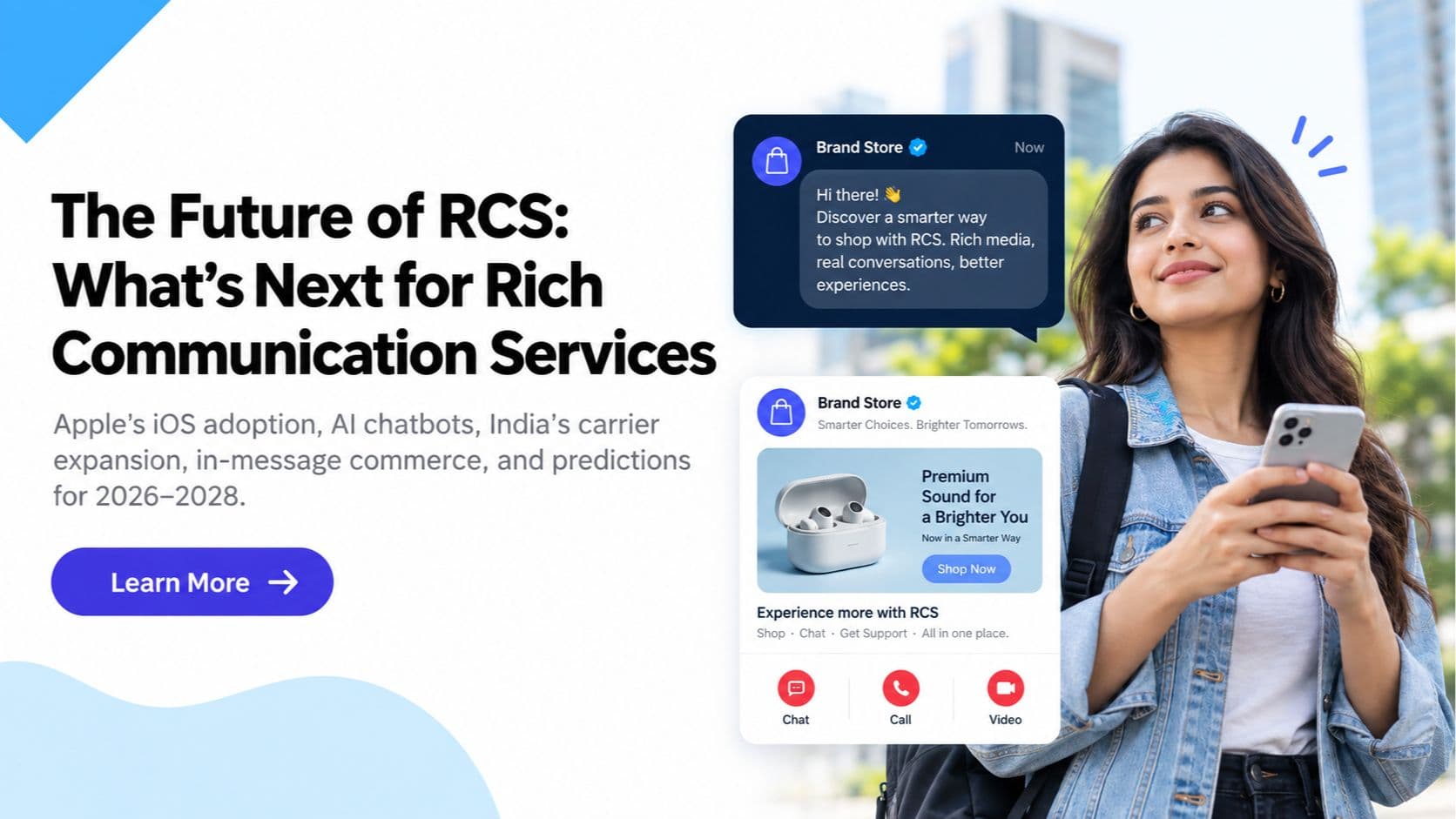
If rich media was the first wave of RCS's advantage over SMS, AI-driven conversation is shaping up to be the second. RCS's native support for quick-reply buttons, rich cards, and structured interactive elements makes it a natural fit for AI-powered chatbot experiences delivered directly inside a customer's default messaging app.
What this looks like in practice
Instead of directing a customer to a separate app or website to interact with a support bot, an AI-powered RCS conversation can happen entirely within Google Messages. A customer taps a quick-reply button, the AI system interprets intent, and the business responds with another rich card- product recommendations, order status, a booking confirmation, or an escalation to a human agent when needed.
This matters because it collapses the friction that has historically limited chatbot adoption: no app download, no separate login, no context switch. The conversation happens where the customer already is. Businesses exploring this today typically start with structured flows- order tracking, appointment booking, FAQ deflection- and expand toward more open-ended AI assistance as confidence grows. Our overview of RCS business messaging features covers the interactive building blocks that make these flows possible.
Where this is heading
Expect the line between "RCS campaign" and "AI assistant" to blur over the next few years. Rather than sending a single promotional card, businesses will increasingly launch a conversation that adapts based on customer responses, powered by AI models interpreting free-text replies alongside structured button taps.
RCS Becoming the Default Over SMS for Branded Communication
For much of its history, RCS has been described as an enhancement layer sitting on top of SMS. That framing is shifting. As device support widens (through both Android's Google Messages dominance and Apple's iOS 18 rollout) and as more carriers activate RCS at the network level, the more accurate framing for 2026 onward is that RCS is becoming the default channel for branded messaging, with SMS as the fallback- not the other way around.
Why the shift is happening
- Trust: Verified sender identity gives customers confidence that a message is genuinely from the brand it claims to be from, addressing the phishing and spoofing problems that have eroded trust in plain SMS.
- Engagement: Rich cards, images, and interactive buttons consistently outperform plain text on click-through and conversion, as detailed in our RCS vs SMS performance data.
- Economics: As RCS device reach approaches SMS-level coverage for smartphone-owning customers, the cost-per-conversion advantage of RCS becomes harder to ignore for marketing-led use cases.
- Regulatory breathing room: RCS currently sits outside the DND and DLT restrictions that constrain promotional SMS timing and targeting in India, a distinction covered in more depth in our RCS compliance guide.
What stays true for SMS
None of this means SMS disappears. Feature phones, 2G-only areas, and OTP delivery still depend on SMS's universal reach, and that will not change simply because RCS device support grows. The realistic future is a layered system: RCS first, SMS as an automatic, invisible fallback- which is exactly how the Get Click Media platform already routes messages today.
RCS Growth in India: Jio, Airtel, and Vi
India's three major private carriers have each been expanding their RCS infrastructure, and this carrier-level investment is one of the clearest signals for where the channel is heading domestically.
| Carrier | RCS Direction |
|---|---|
| Jio | Continued expansion of RCS-capable network infrastructure and growing Google Messages default usage across its large Android subscriber base |
| Airtel | Ongoing RCS carrier support alongside its broader push into rich business messaging partnerships |
| Vi | Expanding RCS network capability as part of its broader digital services push |
As Google Messages continues to ship as the default messaging app on a growing share of Android phones sold in India, and as these carriers deepen RCS network support, the practical reach of RCS campaigns for Indian businesses should keep climbing through 2026 and into 2027-2028. For a current snapshot of device and network reach, see our RCS coverage in India guide.
Richer Commerce Features: In-Message Checkout and Agentic Shopping
One of the more significant frontiers for RCS is commerce functionality happening natively inside the message thread, rather than requiring a jump to an external website or app.
What is emerging
- In-message checkout: Product carousels with buy buttons that move a customer closer to completing a purchase without leaving the conversation, reducing the drop-off that happens every time a customer is redirected elsewhere.
- Agentic shopping flows: Early forms of AI-assisted shopping assistants operating within RCS conversations- helping customers compare options, apply preferences, and move toward checkout through a guided, conversational flow rather than a static link.
- Order and delivery updates as structured cards: Real-time status updates delivered as interactive cards rather than plain text, with buttons for rescheduling, tracking, or support.
For India's fast-growing e-commerce and D2C sectors, these features point toward RCS becoming a genuine transactional channel- not just a marketing touchpoint- over the next few years. Businesses already using RCS API integration for campaign delivery are well positioned to adopt these commerce features as they mature, since the underlying integration work is largely the same.
Predictions for 2026-2028
A few reasonable, non-guaranteed expectations for how the channel develops over the next few years:
- iPhone RCS reach in India climbs steadily as iOS 18 and later adoption grows, narrowing the historical Android-only gap.
- AI-driven conversational RCS becomes mainstream for customer support and guided sales flows, moving beyond simple one-way promotional cards.
- RCS overtakes SMS as the primary channel for branded marketing communication among smartphone-owning, urban Indian audiences, while SMS remains essential for universal reach and OTPs.
- Carrier investment deepens as Jio, Airtel, and Vi continue building out RCS infrastructure alongside their broader 5G and digital services strategies.
- Commerce features mature from experimental to standard, with in-message checkout becoming a normal expectation for retail and e-commerce campaigns.
- Regulatory attention increases somewhat as RCS commercial volume grows, though the pace and shape of any change remains uncertain- see our RCS compliance guide for the current state of play.
Getting Ready for Where RCS Is Heading
Businesses do not need to wait for every feature discussed here to fully mature before starting an RCS program. The channel already delivers strong engagement today, and early adopters gain two lasting advantages: an established verified sender identity that customers already trust, and internal campaign experience that competitors starting later will need time to build.
The practical path is to start with the fundamentals- verified sending, rich cards, SMS fallback- and layer in AI-driven conversation and commerce features as they become available on your platform. Our guide to RCS API integration covers the technical groundwork, and our RCS messaging cost guide helps with budgeting for a program that will likely grow in scope over the next few years.
Get Click Media is one of India's leading RCS messaging service providers, with direct carrier integrations with Jio, Airtel, and Vi and continuous platform investment as the RCS ecosystem evolves. From verified sender setup to AI-ready conversational flows, our team helps businesses build RCS programs designed for where the channel is heading, not just where it stands today. Request a demo to get started.
Article topics
Frequently Asked Questions
What is the future of RCS messaging?
The future of RCS points toward it becoming the default rich-messaging layer for branded communication, replacing plain SMS as the primary business-to-consumer channel wherever the device and network support it. Expect deeper AI-powered conversational experiences, wider Apple device support following iOS 18, expanded in-message commerce, and continued growth in markets like India where Jio, Airtel, and Vi are actively expanding RCS coverage.
Will RCS eventually replace SMS completely?
RCS is unlikely to fully replace SMS in the near term because SMS still reaches devices and networks RCS cannot- including 2G feature phones and areas with unreliable data connectivity. The more realistic trajectory is that RCS becomes the default experience for capable devices while SMS remains a permanent fallback layer, similar to how the two channels already work together today.
How is Apple's RCS support changing the future of the channel?
Apple began supporting RCS in iOS 18, which meaningfully expands the addressable audience for RCS Business Messaging beyond the previously Android-only ecosystem. Over 2026 to 2028, as more iPhone users update to supported iOS versions, businesses can expect the effective reach of RCS campaigns in India to keep climbing, making it an increasingly viable primary channel rather than an Android-only supplement.
Will AI chatbots become a standard part of RCS messaging?
Yes, AI-powered conversational experiences are one of the clearest emerging trends in RCS. Businesses are increasingly using RCS's native support for buttons, quick replies, and rich cards to power AI-driven support and sales conversations directly inside the customer's messaging app, without requiring a separate app download the way some chatbot platforms do.
Is RCS growing in India?
Yes, RCS adoption in India is growing steadily as Jio, Airtel, and Vi continue to expand network-level RCS support and as Google Messages becomes the default messaging app on a growing share of Android devices sold in the country. Combined with Apple's iOS 18 RCS rollout, India's addressable RCS audience is expected to keep expanding through 2026 and beyond.
What new features can businesses expect from RCS in the next few years?
Expect richer in-message commerce features such as native checkout and payment flows, more sophisticated AI-driven conversational flows, deeper CRM and analytics integrations, and continued expansion of interactive card and carousel formats. Some of these capabilities are already available in early form; others are expected to mature over the 2026 to 2028 period as Google, carriers, and businesses invest further in the channel.
Could RCS become subject to stricter regulation as it grows?
It is plausible that regulators could apply more structured rules to RCS Business Messaging as its commercial volume grows, similar to how SMS and other channels have attracted regulatory frameworks over time. This is general observation, not a legal prediction, and businesses should treat today's lighter regulatory position as the current state rather than a permanent guarantee- see our RCS compliance guide for more detail.
Should businesses invest in RCS now or wait for the channel to mature further?
Most businesses benefit from starting an RCS program now rather than waiting, because early adopters build verified sender trust and campaign experience ahead of competitors, and the platform already delivers strong engagement even as new features continue to roll out. Waiting for the channel to fully mature means ceding an early-mover advantage in customer engagement to competitors who start today.
About the author
Get Click Media creates practical resources for businesses using messaging, automation, analytics, and digital communication to improve customer engagement. This article was published on .