
RCS Account Alerts & Service Notifications
Login alerts, KYC updates, password changes, maintenance and downtime notices, and renewal reminders- all as verified, structured RCS messages.
Security, compliance, and service alerts- one verified format
Trusted by 10,000+ businesses across India



















Security Alerts That Look Like the Threats They Warn About
A login alert or password-change notice sent from an unmarked number looks uncomfortably similar to the phishing texts it's trying to protect against. Customers who've learned to distrust unknown senders may ignore a genuine security alert- exactly the message that most needs to be noticed.
The same trust problem applies to service updates- a maintenance notice or downtime alert from a generic sender ID is easy to dismiss as spam, even when it's useful information the customer actually wants.
Verified Identity, Applied to Every Alert Type
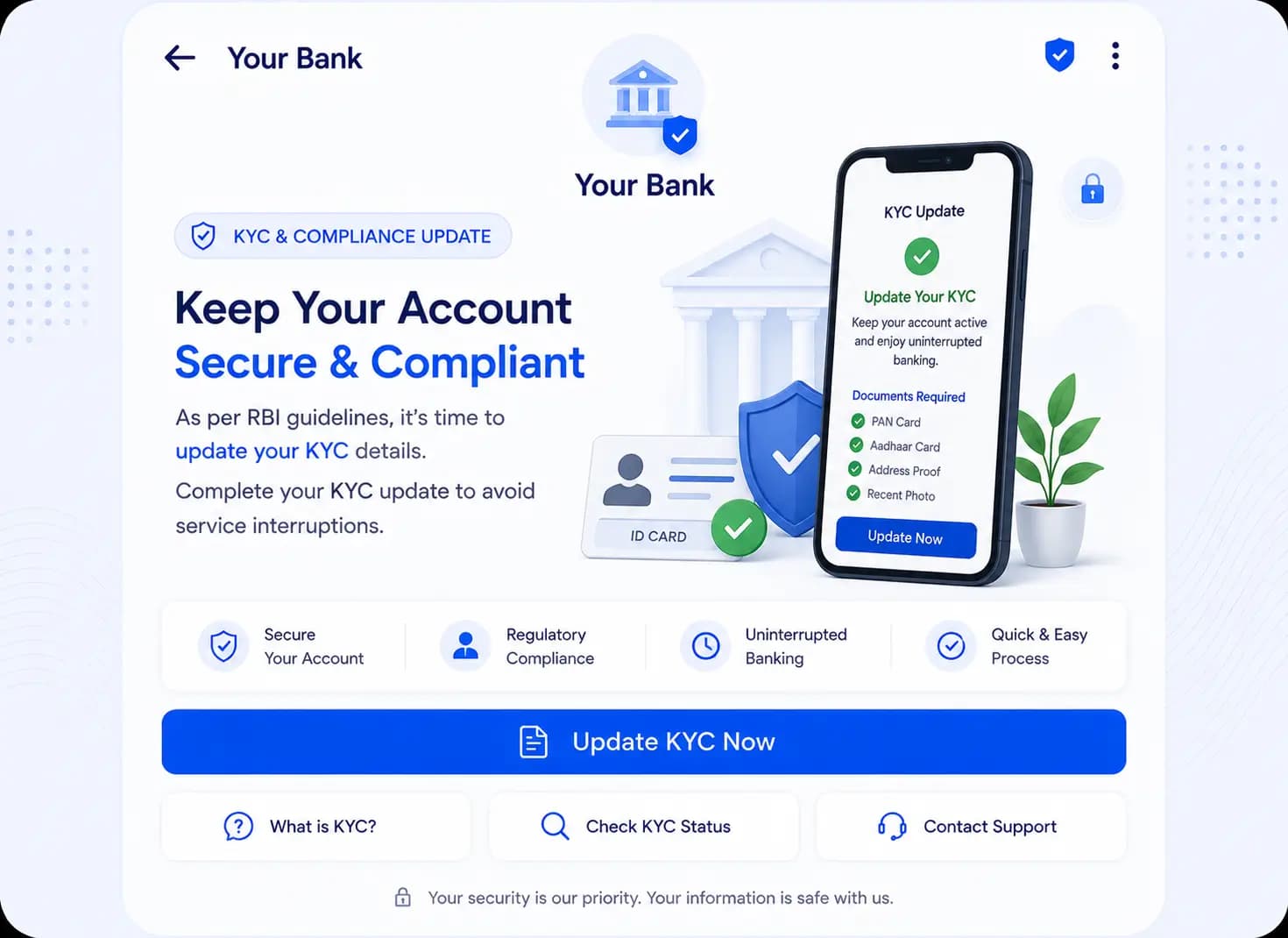
The same verified sender identity that protects OTP and payment messages applies here too- a login alert or KYC reminder carries your logo and verified badge, so it reads as genuinely from you. Where a response makes sense, a suggested-reply chip like 'This wasn't me' lets the customer act immediately instead of calling support.
From Event to Resolved Alert
The same workflow applies whether the trigger is a security event, a compliance deadline, or a scheduled maintenance window.
1. An account or service event fires
A login, a profile change, a scheduled maintenance window, or a renewal date approaching triggers the alert.
2. A verified alert sends immediately
The message carries your verified logo and business name, so it reads as legitimate rather than a possible phishing attempt.
3. A suggested action lets the customer respond
'This wasn't me', 'Update now', or 'Renew' chips let the customer act on the alert directly, where relevant.
4. Status stays visible until resolved
For multi-step processes like KYC updates, follow-up messages keep the customer informed until the action is complete.
Alert Types This Covers
Each alert type uses the same verified format, so customers learn to recognise and trust a message from you regardless of which event triggered it.
Login alerts
A notification when an account is accessed from a new device or location, with a 'This wasn't me' option.
Profile updates
Confirmation when account details- email, phone, address- are changed, so the customer notices any unauthorised edit.
KYC notifications
Reminders to complete or renew KYC documentation, with a direct link to the update flow.
Password changes
An alert confirming a password reset or change, adding a layer of visibility against unauthorised account access.
Maintenance alerts
Advance notice of scheduled maintenance that may affect service availability.
Downtime notifications
Real-time alerts when a service is unexpectedly unavailable, with an estimated resolution time if known.
Renewal reminders
Advance notice before a subscription, membership, or service plan is due to renew.
Scheduled service updates
Notification of planned changes to a service- new features, policy updates, or scheduled upgrades.
What Changes for Trust and Compliance
These benefits compound for businesses sending a high volume of security and compliance alerts, where trust in the sender directly affects how fast customers act.
Higher trust in security alerts
A verified sender makes login and password alerts harder to mistake for phishing- and more likely to be acted on when they matter.
Faster response to real issues
A visible, branded downtime or maintenance alert reduces the volume of 'is your service down' support queries.
Higher KYC and profile completion
A clear reminder with a direct action link improves completion rates versus a plain-text compliance notice.
One consistent alert format
Security, compliance, and service alerts all use the same verified, structured message format, rather than a mix of ad hoc formats.
A Notice vs a Trustworthy Alert
| Aspect | Plain SMS | RCS |
|---|---|---|
| Trust signal | Generic sender ID- easy to mistake for phishing. | Verified business name and logo on every account alert. |
| Response action | None- SMS can't offer a tappable response. | Suggested-reply chips like 'This wasn't me' or 'Renew now'. |
| Status follow-up | Typically a single message, no follow-up. | Can send follow-up updates until a multi-step process (like KYC) completes. |
| Format | Plain text only. | Rich card with clear structure- what happened, what to do next. |
Connecting Your Account & Service Systems
Login, profile, KYC, and service-monitoring events trigger RCS alerts through Get Click Media's RCS API, so security and service notifications go out the moment the underlying event happens, not on a delay.
What Account & Service Alerts Cost
Alerts are priced per message, the same as other transactional RCS sends. See our RCS Pricing India page for current rates on high-volume transactional messaging.
Verified Alerts for Security-Sensitive Messaging
All four capabilities run on the same verified RCS infrastructure used for OTPs and payment reminders, so there's no separate system to maintain.
Brand verification handled for you
Every account and service alert benefits from the same verified identity set up during onboarding.
Real-time, event-triggered sending
Alerts fire the moment the underlying event happens- no batch delay for time-sensitive notices.
Multi-step process support
Follow-up messages keep customers informed through processes like KYC renewal until they're complete.
One system for security and service alerts
Both alert categories run through the same verified infrastructure- no separate tools to manage.


Largest CPaaS partner for Account & Service Alerts
Get Click Media enables brands to send verified login, KYC, and service-status alerts customers can trust with RCS.

One message could
change your business.
Big or small, we power communication for all- talk to us today.
RCS Account & Service Notification FAQs
Both are transactional, account-level alerts (security/profile vs. service/maintenance) with heavy content overlap- combining avoids two thin, near-duplicate pages while still targeting both keyword sets via dedicated sections.
Yes- a suggested-reply chip like 'This wasn't me' can trigger an immediate security flow, such as forcing a password reset or alerting your fraud team.
A rich card explains what's needed and includes a direct link to your KYC update flow, with optional follow-up reminders until the update is confirmed complete.
Yes- an unexpected outage can trigger an immediate alert through our RCS API, with a follow-up message once service is restored.
Yes- this page covers account and service-status alerts (login, KYC, maintenance, renewals); our RCS Payment Reminders page covers due-date and billing-specific alerts tied to a payment action.
Yes- login, profile, KYC, and service-status events from your systems trigger RCS notifications through our RCS API, so alerts go out automatically as they happen.
Account and service alerts fall back to plain SMS automatically, so time-sensitive notifications like security alerts still reach every customer.
Explore RCS for Other Industries
Ready to send account alerts customers can actually trust?
Get Click Media connects your account and service systems to verified RCS notifications.