
RCS vs Push & Mobile App Notifications: Key Differences Businesses Need to Know
App-triggered push notifications only reach customers who have your app installed and have granted permission. RCS reaches any RCS-capable Android device- no install, no separate opt-in. See exactly where each channel earns its place.
Trusted by 10,000+ businesses across India
Trusted by 10,000+ businesses across India


















RCS vs Push Notifications: The Short Version
Push notifications only reach a customer if two conditions are met: they installed your specific app, and they granted notification permission at the OS level- a permission a large share of users decline, and app retention in India drops sharply after the first 30 days. RCS reaches any RCS-capable Android device with no app install and no separate permission prompt, since it lives inside Google Messages, already pre-installed on the phone, with a Google-verified sender badge on every message.
Choose RCS to reach customers who don't have your app, rarely open it, or never granted notification permission, and to avoid the ongoing cost of maintaining a native app just to send notifications. Keep push notifications as a low-cost companion channel for a popular, frequently opened app where users have already granted permission. Most businesses run push for engaged app users and RCS for everyone else, since RCS also carries automatic SMS fallback as a delivery floor.
RCS Business Messaging, in One Paragraph
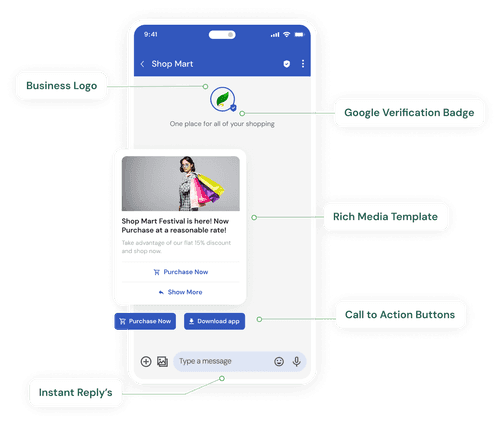
RCS (Rich Communication Services) is the modern successor to SMS, built directly into Google Messages on Android. It delivers verified-brand messages with images, carousels, suggested replies, and tappable action buttons- inside the customer's default messaging app, with no separate download or permission grant required. As part of a broader customer engagement platform, Get Click Media delivers RCS with automatic SMS fallback, so reach never depends on whether a customer has downloaded anything at all.
App Push Notifications, Explained
Push notifications are alerts triggered by a business's own native mobile app, delivered through Apple Push Notification service (APNs) or Firebase Cloud Messaging (FCM). They only reach a customer if two conditions are both met: the customer has installed that specific app, and has granted it notification permission at the OS level. Without either one, the channel simply doesn't exist for that customer- there's no fallback path the way there is with conversational messaging channels like RCS.
RCS vs Push Notifications, Feature by Feature
| Feature | RCS | Push / App Notifications |
|---|---|---|
| Rich Images | ✅ | ✅ (if implemented) |
| Carousels | ✅ | Depends (custom-built only) |
| CTA Buttons | ✅ | ✅ (deep links) |
| Verified Brand | ✅ | N/A (already inside your own app) |
| Read Receipts | ✅ | Limited (open tracking only, if instrumented) |
| Analytics | ✅ | ✅ (if instrumented via app analytics SDK) |
| API Integration | ✅ | ✅ (FCM/APNs) |
| Customer Experience | High | High, but only for users with the app installed |
| Requires app install | ❌ | ✅ |
| Requires OS notification permission | ❌ | ✅ |
Rich Content: Where Push Notifications Actually Compete
To be fair to push notifications, modern implementations via APNs and FCM do support images and rich media- so app notification vs RCS messaging isn't really a richness contest once both are properly built. The honest gap isn't what the notification can show. It's who can receive it in the first place.
| Aspect | Push Notifications | RCS |
|---|---|---|
| Image & rich media support | Supported through APNs/FCM rich notifications, but it takes custom implementation and ongoing OS-version maintenance. | Rich cards, images, and carousels are built into the RCS spec- no per-OS-version SDK work required. |
| Interactive buttons | Deep-link buttons are possible, but each action needs in-app handling to work correctly. | Suggested replies and CTA buttons work natively inside Google Messages, no extra build. |
| Where the real gap actually is | Media richness is genuinely comparable once built- the real limiting factor isn't what the notification can show. | Same rich formatting, but delivered without requiring the customer to have an app installed at all. |
What RCS Costs vs Push Notifications
This is a genuinely interesting tradeoff, not a straightforward win either way. FCM and APNs don't charge per notification, so push looks free at the infrastructure level- but that number hides the real cost: building and maintaining a native app, its SDKs, its OS-version compatibility, and the team to keep all of it running. RCS carries a per-message cost, but zero app-development overhead. If you already have a well-used app, push's marginal cost is close to nothing. If you don't, RCS reaches customers without asking you to build anything first. See our RCS Pricing India page for current rates.
Native Rich Content vs a Custom-Built Equivalent
Rich cards & images, natively
RCS carries images, product cards, and carousels inside the message spec itself- push can show a similar rich image, but only once you've built and maintain the FCM/APNs rich-notification handling for it.
Carousels without a custom build
Swipeable product carousels ship standard with RCS. Push notifications have no native carousel- replicating one means building and maintaining a custom in-app UI.
Read receipts, out of the box
RCS reports delivery and read status natively. A push notification's 'read' status only exists if you've instrumented in-app open tracking yourself.
No SDK, no app-store review cycle
Push rich media ships through your app's next release and app-store review. RCS rich cards go live the moment you send them.
Reach Without an App Install
This is the single biggest reason businesses look at rcs vs push notification reach in the first place. Push notifications only reach customers who have (a) installed your specific app and (b) granted it notification permission. In India, app install and retention rates are a real, well-documented bottleneck- a large share of users uninstall apps they don't open daily, and many never grant notification permission even when they keep the app. RCS sidesteps both hurdles entirely: it reaches any RCS-capable Android device with zero app install and zero separate permission grant, because it lives inside the pre-installed default Google Messages app that's already on every Android phone.
| Aspect | Push Notifications | RCS |
|---|---|---|
| Who can receive it | Only customers who installed your specific app- app retention in India drops sharply after the first 30 days, and many users uninstall apps they don't open daily. | Any customer on an RCS-capable Android device with Google Messages- no app install of any kind required. |
| Permission requirement | A separate OS-level notification permission prompt that a large share of users decline or dismiss without reading. | No separate permission prompt- RCS messages land in the same inbox as SMS, which customers already trust by default. |
| New or lapsed customers | Unreachable until they download the app and open it at least once. | Reachable from the very first message- no onboarding step stands between you and the customer. |
| Cost of building reach | Push has no audience until the app itself has real install and usage numbers behind it. | Reach exists on day one, independent of whether the business has an app at all. |
No app install needed
RCS reaches any RCS-capable Android device the moment you send- there's no download, no app-store detour, no waiting for a customer to install anything.
No separate permission prompt
RCS doesn't ask the customer to grant a notification permission- it lives inside Google Messages, which is already trusted and already open.
Reaches customers who uninstalled your app
A push channel dies the moment your app is deleted. RCS keeps working, because it was never tied to the app in the first place.
Full reach from message one
No 30-day retention curve to climb before your notification channel has an audience worth messaging.
Verified Sender vs Trust Inherited From Your App
A push notification's trust comes entirely from the fact that it's already inside an app the customer chose to install- there's no separate sender verification layer, because there's no separate sender to verify. RCS messages instead carry a Google-verified business badge confirming your identity before the first message goes out, which matters most for businesses trying to establish trust with a customer who has never opened an app of theirs at all.
Delivery Reliability, Not Just Delivery Reports
Push notification delivery is quietly fragile in ways analytics dashboards don't always surface: Android's battery optimization and Doze mode can throttle or delay delivery, a customer can silently revoke notification permission in system settings without your app ever knowing, and an app uninstall kills the channel completely with no fallback path. RCS campaigns tracked through Get Click Media's RCS Analytics report read receipts and button-tap engagement, backed by automatic SMS fallback- a more dependable minimum-delivery floor than a channel that can go dark without any warning.
No App Dependency, Just an API Call
Push notifications assume you already have a native app with FCM and/or APNs wired in, plus ongoing SDK maintenance and OS-version compatibility work every time Apple or Google ships an update. That's a real cost even before you send your first notification. RCS requires no app at all- just an integration with the Get Click Media RCS API, which matters enormously for businesses that don't have a mobile app, or don't want the ongoing overhead of maintaining one just to send notifications.
Where Each Channel Fits, and the Opt-In Problem
Opt-In Requirements
Push notifications require an explicit OS-level permission prompt- a moment of friction that a large share of users decline or simply dismiss, and can revoke later without you knowing. RCS has no equivalent permission-prompt step, since it's not tied to an app's notification permission at all.
| Aspect | Push Notifications | RCS |
|---|---|---|
| Enabling the channel | Requires the user to tap Allow on an OS permission prompt- decline rates are a well-documented industry problem, especially on iOS. | No separate opt-in prompt- RCS is available automatically inside Google Messages, the same way SMS always has been. |
| Recovering a declined or revoked opt-in | Once declined, or once the user revokes it later in system settings, there's no in-channel way to re-prompt without sending them back into their phone's settings menu. | No equivalent revocation path- the channel doesn't depend on a permission toggle staying switched on. |
| Reach before any opt-in action | Zero, until permission is explicitly granted after install. | Full reach from the first send- no prior action required from the customer. |
Where Push Notifications Still Win
For businesses with a popular, frequently opened app- food delivery, ride-hailing, banking apps customers check daily- push notifications remain an efficient, low-cost companion channel for the audience that's already engaged and has already granted permission.
Where RCS Wins
For reaching customers who don't have your app, rarely open it, or never granted notification permission- new leads, lapsed customers, or any business without an app at all- RCS is the primary channel that doesn't depend on any of those preconditions being true.
RCS vs Push Notifications- the Honest Tradeoffs
RCS
Reaches any RCS-capable device- no app install required
No OS-level permission prompt to grant or decline
Verified sender identity and rich branding
Automatic SMS fallback keeps a delivery floor under every send
Rich cards, carousels, and CTA buttons work natively
Detailed engagement analytics without building your own SDK
Per-message cost, unlike infrastructure-level-free push
Full rich-media experience needs a compatible Android device
Requires Google brand verification before sending
Push / App Notifications
FCM/APNs delivery itself is free at the infrastructure level
Deep integration with in-app screens and state via deep links
Familiar UX for customers who already use your app daily
Rich media and buttons are fully possible when properly built
Only reaches customers who installed your specific app
Requires an explicit OS permission grant, often declined
Silently dies the moment the app is uninstalled, with no fallback
Subject to battery optimization/Doze-mode throttling on Android
Carries the full ongoing cost of building and maintaining a native app
No reach at all until the app has real install and retention numbers
A Simple Decision Matrix
Choose RCS if you want...
- To reach customers who don't have your app installed
- A channel that doesn't depend on a permission prompt
- Verified branding customers can visibly trust
- A dependable delivery floor via automatic SMS fallback
- Rich cards and CTA buttons without maintaining a native app
Keep push notifications if you want...
- A low-cost channel for a popular, frequently opened app
- Deep integration with specific in-app screens via deep links
- To engage users who already have your app and granted permission
- A companion channel layered on top of an existing app strategy
If you already have a popular app your customers open often, push remains a valuable companion channel for that audience. For reaching everyone else- customers without your app installed, or who rarely open it- RCS is the stronger primary channel.
Reach Customers, App or No App
Trusted by 10,000+ businesses across India for messaging infrastructure that doesn't make reach conditional on app installs or permission prompts.
Brand verification handled for you
Google's RCS verification review is managed as part of onboarding, so your messages carry a verified identity from day one- no app or permission prompt required.
RCS-first with automatic SMS fallback
Every RCS send falls back to SMS automatically for unsupported devices, configured once at the account level.
Engagement analytics without an app SDK
Read receipts and button-tap tracking come standard- no need to instrument your own in-app analytics to see what's working.
One API, no app dependency
Integrate once through the Get Click Media API and reach customers directly, whether or not you have a mobile app to build push notifications on top of.
Ready to reach customers beyond your app?
Talk to our experts about adding RCS alongside- or instead of- push notifications, with verified branding and SMS fallback built in from day one.


Largest CPaaS partner globally
Get Click Media enables brands to move beyond app-only push notifications with verified, install-free RCS messaging that reaches every Android user.

One message could
change your business.
Big or small, we power communication for all- talk to us today.
RCS vs Push & App Notifications FAQs
No. RCS lives inside Google Messages, the default messaging app that's already pre-installed on Android devices. There's no separate app to download, and no install step standing between your business and the customer.
For guaranteed minimum delivery, yes. Push notifications can be silently throttled by battery optimization/Doze mode, blocked by a revoked permission, or killed entirely if the customer uninstalls your app- with no fallback. RCS delivers with automatic SMS fallback, so there's always a dependable delivery floor.
Yes- that's one of RCS's biggest practical advantages. RCS only needs an API integration, not a native app with FCM or APNs wired in. Businesses without an app (or without the resources to maintain one) can still reach customers directly.
Not necessarily. If you already have a popular app that customers open frequently, push remains a valuable companion channel for those users. RCS becomes the better primary channel for reaching everyone else- customers who don't have your app installed or rarely open it.
Reach is gated behind two hurdles: the customer must have your specific app installed, and they must have granted notification permission. App install and retention rates are a genuine bottleneck in India, where many users uninstall apps they don't use daily. RCS skips both hurdles entirely.
No. RCS doesn't require an OS-level permission grant the way push notifications do. It arrives in the same trusted inbox as SMS, without an extra Allow/Deny prompt for the customer to respond to.
It depends what you're counting. FCM and APNs don't charge per notification, so push looks free at the infrastructure level- but that number ignores the cost of building and maintaining the native app it depends on. RCS carries a per-message cost but zero app-development overhead. Which is cheaper depends on whether you already have an app to leverage.
The push channel goes dark for that customer, with no automatic fallback- you simply stop reaching them through that channel. RCS isn't affected by app-level permission settings at all, since it isn't tied to your app's notification permission.
Yes, and for businesses with an established app, that's often the right setup. Push notifications stay valuable for engaged, frequent app users, while RCS extends reach to customers who don't have the app installed or don't open it often- the two channels cover different parts of your audience.
Modern push notifications can carry images and deep-link buttons when properly built with FCM/APNs rich notification support, so media richness itself isn't really the gap. The real difference is reach: RCS delivers that same rich experience to any RCS-capable device, without requiring an app install or permission grant first.
Related resources
RCS resources
Still deciding between RCS and push notifications?
Get Click Media runs RCS alongside your existing push strategy- book a free demo and we'll map out the right mix for your business.