
RCS vs iMessage: What Businesses Need to Know Before Choosing Either
iMessage has no general business-sending API. RCS does. See why Android vs iOS market share in India makes RCS the far more practical foundation for reaching customers at scale. We also cover where Apple's own Business Chat program fits in.
Trusted by 10,000+ businesses across India
Trusted by 10,000+ businesses across India

















RCS vs iMessage: The Short Version
RCS has an open, documented Business Messaging API that any provider can integrate against. It lets a verified brand send rich cards, carousels, and CTA buttons with delivery and engagement analytics attached. iMessage has no general business-sending API at all. Reaching Apple users programmatically requires the separate, gated Apple Messages for Business (Business Chat) program, typically routed through an Apple-approved intermediary, with no analytics or CTA buttons available through a standard integration.
The deciding factor is platform reach, not features. Android is the overwhelming majority of India's smartphone market, and RCS sits inside Google Messages, Android's default app. iMessage-to-iMessage, by contrast, only ever works between Apple devices. Businesses reaching a broad Indian customer base get far more practical reach from an RCS-first strategy. Apple Business Chat is worth exploring only for a customer base that is specifically and heavily iPhone-concentrated.
RCS Business Messaging, in One Paragraph
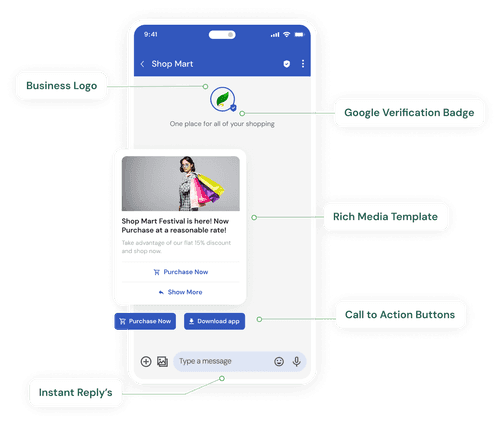
RCS (Rich Communication Services) is an open, carrier-backed messaging standard built into Google Messages on Android. It has a documented Business Messaging API that lets a verified brand send rich cards, carousels, and tappable buttons directly inside a customer's default texting app. For the Google-specific implementation of this standard, see our Google RCS Business Messaging guide. Get Click Media delivers RCS with automatic SMS fallback, so reach never drops below what plain SMS would deliver alone.
Apple's Proprietary, Device-Exclusive Messaging System
iMessage is Apple's own end-to-end-encrypted messaging protocol, built into the Messages app on iPhone, iPad, and Mac. When two Apple devices message each other, the thread shows as a blue bubble and unlocks iMessage-only features like read receipts, Memoji, and message effects. The moment either side is a non-Apple device, the thread falls back to a green bubble: historically plain SMS, and on iOS 18 and later, RCS. That happens because iMessage-to-iMessage only ever works between Apple devices. That distinction matters for business messaging specifically: iMessage itself has never offered a general API for a business to send messages programmatically the way RCS does.
RCS vs iMessage, Feature by Feature
| Feature | RCS | iMessage |
|---|---|---|
| Rich Images | ✅ | ✅ (consumer chat only, not via a business API) |
| Carousels | ✅ | ❌ |
| CTA Buttons | ✅ | ❌ (no general business API) |
| Verified Brand | ✅ (Google) | Limited (Apple Business Chat only, gated approval) |
| Read Receipts | ✅ | ✅ (consumer chat) |
| Analytics | ✅ | ❌ (no general business API) |
| API Integration | ✅ (open, documented) | ❌ (Apple Business Chat only, restricted access) |
| Customer Experience | High, cross-platform (Android + growing iOS RCS support) | High, but Apple-device-only |
| Platform reach | Android (India's dominant OS) + iOS RCS support | iOS/Apple devices only |
The pattern across nearly every row is the same: RCS features are backed by a real, documented business API. The equivalent iMessage feature either doesn't exist for businesses or is only reachable through Apple's separate, gated Business Chat program.
Why "iMessage Pricing" Isn't Really a Thing
RCS is priced per message through a documented Business Messaging API, the same way SMS or WhatsApp is. iMessage has no comparable official business-sending API or pricing structure at all. Apple Business Chat, the actual business-facing program, is a separate, more restricted offering with its own access terms set by Apple and its approved intermediary platforms, not a per-message rate card a business can simply sign up for. In practical terms, this makes pricing a meaningless axis to compare RCS against iMessage on. The real comparison is reach and access. See our RCS Pricing India page for current RCS rates.
Rich Media Businesses Can Actually Send
Both platforms support rich media inside their own consumer ecosystems. The difference is whether a business can actually send that rich media programmatically.
Rich cards, sent by a business
RCS rich cards render inline through a documented Business Messaging API. iMessage's stickers, Memoji, and message effects have no equivalent API a business can call.
Carousels & structured layouts
Swipeable product carousels are native to RCS. iMessage has no business-facing carousel format at all, since there's no general sending API to build one on top of.
CTA buttons & suggested replies
Tappable action buttons cut the steps between a message and a purchase or call. Apple Business Chat supports something similar, but only inside its own gated, invitation-based program.
Read receipts, accessible to businesses
iMessage shows read receipts inside consumer-to-consumer chats. That status isn't exposed to a general business API, because none exists. RCS read receipts are available through the same Business Messaging API a company actually integrates with.
Android vs iOS: Why Platform Availability Decides This Comparison
This is the single most important fact in the RCS vs iMessage decision: iMessage is exclusive to Apple hardware, while India's smartphone market is overwhelmingly Android. That is exactly why RCS, built into Android's default Google Messages app, matters so much for businesses reaching Indian customers.
| Aspect | iMessage | RCS |
|---|---|---|
| Device availability | iMessage-to-iMessage only ever works between Apple devices: iPhone, iPad, Mac. A text to an Android phone never becomes a true iMessage thread. | RCS is built natively into Google Messages on Android. Apple has also added RCS support inside the iOS Messages app specifically for texting Android users. |
| India's smartphone market | iMessage's reach is limited to India's iPhone-owning minority, a comparatively small slice of the country's mobile users. | Android is the overwhelming majority of smartphones in India. RCS sits inside the default Android messaging app, so it reaches the market iMessage structurally can't. |
| iPhone texting an Android contact | It drops out of iMessage entirely into a green-bubble SMS thread, or, on iOS 18 and later, a green-bubble RCS thread. Either way, it's no longer iMessage. | This is precisely the channel Apple itself now uses on iPhone to reach Android contacts. RCS was never an Android-only technology to begin with. |
Android is India's default
The vast majority of smartphones sold and used in India run Android, not iOS. A messaging strategy built around Google Messages and RCS starts with the market most Indian customers are already on.
RCS now travels across iOS too
Apple has begun rolling out RCS support inside the iOS Messages app for texting Android contacts. A well-built RCS strategy already reaches a growing share of iPhone-to-Android conversations, not just Android-to-Android ones.
iMessage-to-iMessage stays Apple-only
The blue-bubble, end-to-end-encrypted iMessage experience never leaves Apple's own device ecosystem. There's no cross-platform version of it for a business to plug into.
One channel, broader reach
Building a customer messaging program around RCS covers Android users directly. It also reaches iPhone users through carrier SMS or the newer iOS RCS path, without needing a second, separate Apple-only program.
Two Different Verification Paths
Both platforms use end-to-end encryption for their native person-to-person chat: iMessage between Apple devices, RCS through the Universal Profile carriers like Jio and Airtel support. Where they diverge is verified business sending. RCS has Google's brand verification program, a documented process with a real API path a provider can build against. Apple's equivalent runs through the separate, more gated Business Chat approval process. It typically involves an Apple-sanctioned intermediary platform rather than a direct, open path. Read more about how Google verification specifically works on our Google RCS Business Messaging page.
Reporting That Only Exists If the API Does
RCS campaigns through Get Click Media's RCS Analytics report delivery, read, and button-tap data per campaign, because the Business Messaging API those metrics come from actually exists. iMessage has no general equivalent to report on. Without a business-sending API, there's no programmatic analytics layer to build for a typical business, only whatever limited reporting Apple's own Business Chat partners may offer inside that separate program.
An Open API vs a Gated Partner Program
Business Capabilities
RCS gives any provider a documented Business Messaging API to integrate against directly. iMessage doesn't. The only way for a business to reach Apple users programmatically at all is Apple Messages for Business (Business Chat), and that program sits deliberately outside iMessage itself.
| Aspect | iMessage | RCS |
|---|---|---|
| Business sending API | No general iMessage API exists for third parties. There is no standard way for an arbitrary business to send an iMessage programmatically. | An open, documented RCS Business Messaging API that any provider, including Get Click Media, can integrate against directly. |
| How businesses reach Apple users at all | Through Apple Messages for Business (Business Chat), a separate, more restricted program. It requires Apple's own approval and is typically routed through a small number of Apple-sanctioned intermediary platforms. | Directly, through Google's Business Communications Console and a standard RCS Business Messaging integration. No intermediary gatekeeper is required. |
Enterprise Support
For an enterprise integrating messaging into its existing systems, this is where the friction gap widens most. RCS onboarding is a process Get Click Media manages directly. Apple Business Chat onboarding depends on approval from Apple and, in many cases, a third-party approved partner platform in the middle. That is a heavier lift for most businesses, and especially so outside the US.
| Aspect | iMessage | RCS |
|---|---|---|
| Approval process | Apple Business Chat approval is gated and slower, historically oriented around larger, mostly US-based brands working with approved partners. | RCS brand verification is a documented process Get Click Media manages directly as part of onboarding, with no dependency on a third-party approved intermediary. |
| Reach outside the US | Apple Business Chat's approved-partner model makes onboarding meaningfully harder for businesses based outside the US. That includes most of India. | RCS's open verification path through Google works the same way for an Indian business as anywhere else the standard is supported. |
Matching the Channel to Your Customer Base
Android-First Businesses (the Indian Norm)
If most of your customers are on Android, the default situation for the large majority of businesses operating in India, RCS is the natural fit. It reaches customers directly inside their default messaging app, with a verified sender badge, rich cards, and analytics available through a real API from day one.
iPhone-Heavy Customer Bases
For a business specifically serving an iPhone-heavy market or customer segment, exploring Apple Messages for Business (Business Chat) separately can be worth the effort. Treat it as its own program with its own approval process, not a feature of iMessage you can simply switch on. Most businesses reaching a broad Indian customer base get considerably more practical reach from an RCS-first strategy.
Where RCS Wins- and Where iMessage Still Has a Place
RCS
Open, documented Business Messaging API any provider can integrate against
Verified sender badge from Google's brand verification program
Rich cards, carousels, and CTA buttons available to businesses directly
Reaches Android- India's dominant smartphone OS- plus growing iOS RCS support
Delivery, read, and engagement analytics available through the API
Automatic SMS fallback for unsupported devices
Requires Google brand verification before sending as a verified sender
Full rich-media experience depends on the recipient's Google Messages version
iMessage
Consumer-to-consumer iMessage is fully end-to-end encrypted
Rich stickers, Memoji, and message effects inside the native Apple experience
Deep, familiar integration across iPhone, iPad, and Mac
No general business-sending API- businesses can't send iMessages programmatically
Business reach requires Apple Messages for Business (Business Chat), a separate, gated program
Approval typically routed through a small set of Apple-sanctioned intermediary platforms
No analytics or CTA buttons through a general API, because none exists
iMessage-to-iMessage never reaches Android users, by design
Higher-friction path for most businesses, especially outside the US
A Simple Decision Matrix
Choose RCS if you want...
- Direct reach into India's Android-majority smartphone market
- An open, documented Business Messaging API to integrate against
- Verified branding, rich cards, and CTA buttons out of the box
- Delivery, read, and engagement analytics per campaign
- One channel that also reaches iPhone users via SMS or iOS RCS
Consider Apple Business Chat separately if...
- Your customer base is specifically and heavily iPhone-concentrated
- You can commit to Apple's own gated approval process
- You're prepared to work through an Apple-sanctioned intermediary platform
- You understand this is a separate program from iMessage itself, not a switch you flip
For the large majority of businesses reaching a broad Indian customer base, RCS isn't just the easier integration- it's the channel that actually reaches where most of the market already is.
Built for Where Your Customers Actually Are
Trusted by 10,000+ businesses across India for messaging infrastructure built around the platform Indian customers actually carry in their pocket.
Brand verification handled for you
Google's RCS verification review is managed as part of onboarding, so your messages carry a verified identity from day one- no separate approval process to chase.
RCS-first with automatic SMS fallback
Every RCS send falls back to SMS automatically for unsupported devices, configured once at the account level, so reach never depends on a single channel.
Real analytics, not just delivery status
See read receipts, button-tap data, and campaign engagement in one dashboard- the reporting layer iMessage simply has no business API to offer.
One open API to integrate once
Integrate directly through the Get Click Media RCS API, without routing through a gated third-party approval process the way Apple Business Chat requires.
Ready to reach Android-first India?
Talk to our experts about building an RCS-first messaging program- with SMS fallback built in from day one.


Largest CPaaS partner globally
Get Click Media enables brands to move beyond iOS-only iMessage with Android-first, verified RCS messaging.

One message could
change your business.
Big or small, we power communication for all- talk to us today.
RCS vs iMessage FAQs
Not really. RCS has an open, documented Business Messaging API that a provider like Get Click Media can integrate against directly. iMessage has no equivalent general API. The actual business-facing product is Apple Messages for Business (Business Chat), a separate, more restricted program with its own gated approval process, usually routed through a small number of Apple-approved intermediary platforms.
Apple has been adding RCS support to the iOS Messages app, starting with iOS 18, specifically for texting Android users. So an iPhone can send and receive RCS messages to Android contacts. That's different from iMessage itself, which remains Apple's own proprietary, blue-bubble protocol that only works between Apple devices.
Android is the dominant smartphone operating system in India by a wide margin, and RCS is built into Google Messages, Android's default messaging app. A business built around RCS reaches the large majority of Indian mobile users directly. iMessage's native reach, by contrast, is limited to India's much smaller iPhone-owning segment.
Yes. As of iOS 18 and later, Apple's Messages app supports RCS for texts to Android contacts, alongside SMS. This doesn't change how iMessage-to-iMessage works between Apple devices, which stays proprietary and blue-bubble. But it does mean iMessage and RCS aren't purely either/or on a modern iPhone.
It's Apple's actual business-messaging product, a separate, more limited program from iMessage itself. It requires Apple's own approval and is typically implemented through a small number of Apple-sanctioned intermediary platforms rather than an open API any business can call.
Both use end-to-end encryption for native person-to-person chat within their own ecosystems. For verified business sending specifically, RCS has Google's brand verification program with a real, documented API path. Apple's business verification, by contrast, runs through the separate, more gated Business Chat approval process.
It never becomes a true iMessage conversation. Historically it dropped to plain SMS (the familiar green bubble); on iOS 18 and later, it can use RCS instead, still shown as a non-iMessage thread. Either way, iMessage-to-iMessage stays exclusive to Apple-to-Apple conversations.
Yes. An RCS-first strategy with automatic SMS fallback, the approach Get Click Media runs by default, reaches Android users directly through Google Messages. It also reaches iPhone users through SMS or the newer iOS RCS path, without needing a separate Apple Business Chat program for baseline coverage.
If your customer base skews heavily toward iPhone users, more common in some overseas markets than in India, it can be worth exploring Apple's Business Chat program on its own merits. For most Indian businesses, where Android dominates the market, building around RCS delivers far more reach for the effort.
Because iMessage has no official business-sending API or pricing model in the way RCS or WhatsApp do. Apple Business Chat is a separate, restricted program with its own access terms. So "pricing" isn't really a meaningful like-for-like axis here; the real comparison is reach and access, not cost per message.
Related resources
RCS resources
Still deciding between RCS and iMessage?
Get Click Media builds messaging programs around where your customers actually are- book a free demo and we'll map out the right approach for your business.